Navigating Freight Cost Uncertainty in 2026
The freight market worldwide in 2026 is still very unsure. Many businesses are dealing with prices that keep changing trade policies that are always evolving tensions between countries. There are conflicts that affect important shipping routes and many transportation networks do not have capacity. All these issues are making it hard to predict freight rates. They can go up or down quickly. These conditions are affecting how goods move across borders. This makes it complicated for companies that trade globally to plan their transportation. The freight market and freight rates are very unpredictable. Businesses that deal with trade have to be careful, with their transportation planning because of the freight market.
Companies that do import and export work in areas like IT, aviation, medical, and automotive sectors need to know what makes the cost of shipping go up and down. When you are exporting all around the world you are more likely to get hurt by sudden jumps in shipping costs. To keep making money and providing service businesses need to plan ahead work closely with the businesses they buy from and know what is going on with all the steps it takes to get things from one place to another. This helps companies deal with changes, in shipping costs and avoid problems that can stop them from working.
Key Factors Driving Freight Cost Uncertainty in 2026
Freight costs are still really hard to predict in 2026. This is because of all the problems with trade and the market always changing. There are a lot of issues with trade routes because of things like tensions and regional conflicts and this is making carriers take longer routes. This means it takes longer to get things from one place to another. Freight costs and port congestion are also a problem. When ports get congested it can cause a lot of delays. This can lead to a lot of other problems like not having enough equipment and having to pay extra fees. Freight costs are affected by all these things.
The economy is really uncertain now. This makes things tough. We have people wanting things prices going up and factories making different amounts of stuff. All these things together make it hard to know what freight is going to cost. So businesses need to be ready to change their plans for moving things around. They have to plan to keep their costs under control and make sure they can still get everything they need.
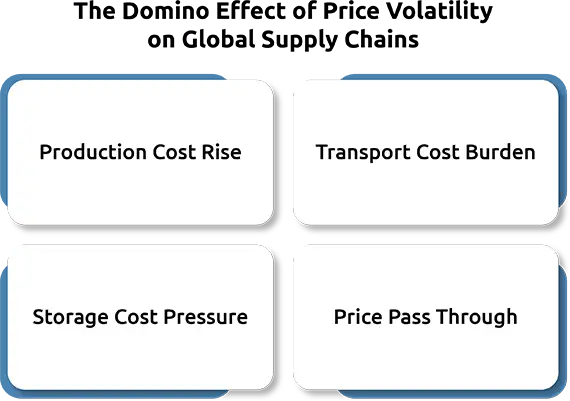
The Domino Effect of Price Volatility on Global Supply Chains
Price changes rarely affect one part of the supply chain. They create an effect that impacts every aspect of international trade. When the cost of materials like metals, semiconductors, and industrial parts goes up, manufacturers have to pay more. These rising costs are often made worse by transportation charges. This impacts manufacturers who face production expenses because of the increased cost of raw materials.
As the cost of shipping goods goes up companies might decide to keep products in stock to avoid running out if something goes wrong in the future. This means they will have to pay more to store all these products and their warehouses will get very full. The companies have to pay for all these costs so they add them to the price of the products they sell. This affects how money they make and whether or not people want to buy their products.
How Price Volatility Impacts Critical Industries
This is affecting different industries in different ways. One thing that is common for all of them is that they have to keep their supply chain going without any breaks and they have to control the costs of transportation at the same time. For the IT sector price volatility is a problem because it can make the cost of data center equipment and networking hardware go up. This is also true for semiconductor components, which’re very important for digital infrastructure projects. The aviation industry is facing problems. When it comes to aircraft parts and maintenance equipment they need to be delivered on time. If there are any problems with transportation it can cause delays. The medical sector is also having a time. Diagnostic equipment and laboratory instruments need to be delivered so that they are available on time. This is also true, for temperature- products which need special care during transportation to make sure they are not damaged.
Automotive manufacturers are still dealing with the problem of transportation costs for parts and electronic modules. They also have to manage their production in a way that things are made in time. This means they cannot afford to have any delays in shipments. The situation with trade is not clear and this is making things difficult for businesses.

Conclusion
The world of trade is dealing with a lot of uncertainty right now. Prices are going up and down businesses importing exporting are having problems between countries. Because of this it is going to be hard to know what freight costs will be, throughout 2026. Companies that import export cannot just wait and see what happens with their transportation costs. They will be successful if they make plans follow the rules get things from many different places and have transportation systems that can handle problems. Freight costs are a deal and freight cost volatility is something that companies need to think about when they are making their plans.
Companies in the IT, aviation automotive sectors need to be flexible and think about risks in the long term. This way they can handle changes in the market. Stay ahead of their competitors. The world of trade is getting harder to predict so companies need to be ready for anything.
DID YOU KNOW
“International freight costs in 2026 are defined by a ‘new normal‘ of structurally higher volatility. ”
FAQs
1. Why are 2026 freight rates so volatile?
Rates fluctuate due to early peak-season demand, sudden carrier blank sailings, and ongoing geopolitical rerouting around Africa.
2. How much does a 40ft container cost now?
If you want to know how much it costs to ship a 40ft container it is a lot. On average it costs over $3,400. If you are shipping from Shanghai to the West Coast of the United States it can cost than $4,500 for one container.
3. What is driving up airfreight prices?
Air cargo rates exceed $4.00 per kilo due to high aviation fuel costs and limited belly capacity.
4. What extra costs are making shipping bills more expensive?
Shippers often have to pay money for things like Bunker Adjustment Factors and port congestion and war risk surcharges.
5. Should I use spot rates or contract rates in 2026?
You should use both spot and contract rates. Use contract rates, for the shipments you know you will have to make all the time and use spot rates when you think you can get a deal because the market is slow.