
Introduction
Today’s developing world is a growth of artificial intelligence, A unique demand for advanced semiconductors, & high-performance computing technologies. From cloud computing & automated vehicles to smart devices & large-scale data centers, AI-powered systems mainly depend on powerful chips to process large amounts of data at high speed. Governments & technical companies are mainly investing in AI infrastructure; the international semiconductor industry is having rapid growth, managing new export opportunities for manufacturers, suppliers, logistics providers, & technology-driven economies. This developing demand is not only developing global trade patterns but also opening fresh pathways for countries & businesses looking to enhance their position in the global market.
Understanding the Connection Between AI & Semiconductors
AI & semiconductors have a deep connection, with semiconductors giving the physical infrastructure (GPUs, TPUs) needed to process huge AI workloads, while AI uses chip design, making, & performance. This collaboration uses computing power, improving efficiency in tasks like machine learning, edge computing, & automated chip manufacturing.
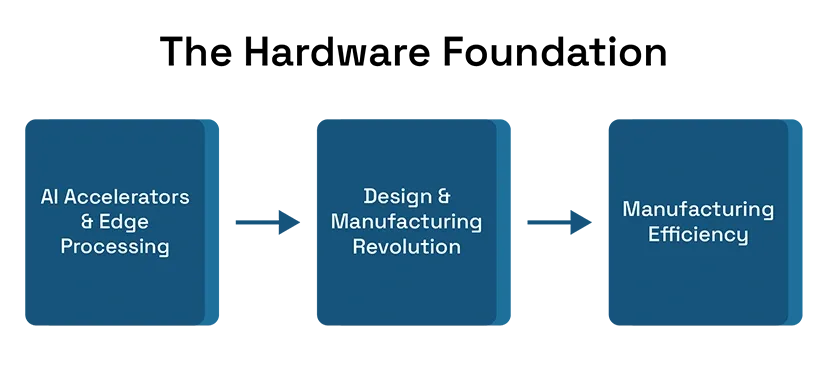
The Hardware Foundation:
Artificial Intelligence needs large computational power, making specialized semiconductors such as Graphics Processing Units (GPUs) & AI accelerators important for training & running models.
AI Accelerators & Edge Processing:
Specialized AI chips, such as Tensor Processing Units (TPUs) & Neural Processing Units (NPUs), are now mainly important for running real-time, high-speed applications on devices without cloud use.
Design & Manufacturing Revolution:
AI is used to design complex chips, minimizing design time from months to hours & improving manufacturing productivity by 4% in tool availability & up to 50% faster issue resolution.
Manufacturing Efficiency:
AI improves semiconductor production through predictive management, improving rates by detecting defects & improving robotic processes.
Symbiotic Evolution:
AI is needed to create smarter, faster chips, & those same chips are necessary to develop more advanced AI, creating a continuously reinforcing cycle of technological advancement
Rising Global Demand for AI Chips
The international AI chip market is seeing a huge surge in demand, projected to grow from approximately $121 billion in 2026 to over $1 trillion by 2035, driven by the need for high-performance computing in generative AI & data center expansion. This demand is creating a “zero-sum” competition for advanced components like high-bandwidth memory, used to address persistent shortages, mainly as AI workloads shift from model training to inference.
One of the biggest drivers behind this growth is the expansion of AI data centers & hyperscale cloud infrastructure. Major technology companies are mainly increasing investments in AI computing systems, which depend on advanced GPUs, AI use, memory chips, & networking semiconductors. Global semiconductor revenue is projected to exceed $1.3 trillion in 2026, with AI semiconductors expected to account for nearly 30% of total industry revenue.
Semiconductors for AI: Current Technology
The framework of semiconductor technology for AI is mainly developing, driven by the increasing demand for faster, more energy-efficient solutions to manage the growing difficulty of AI workloads. The two main types of chips used in AI applications are Graphics Processing Units (GPUs) & Application-Specific Integrated Circuits, each giving distinct advantages based on the application’s specific needs.
GPUs: Versatility Meets Power
Originally developed for gaming & graphics applications, GPUs have become indispensable for AI workloads due to their ability to perform numerous parallel computations. This makes them ideal for processing large datasets in applications such as image & video analysis, natural language processing, & machine learning model training. GPUs are mainly available, cost-friendly, & mainly easy to program, which has made them the best choice among researchers, developers, & startups alike.
ASICs: Customization for Efficiency
ASICs are custom-designed chips modified for specific AI tasks, prioritizing speed & energy efficiency. Instead of GPUs, which offer general-purpose parallel processing, ASICs are optimized for particular workloads, such as running deep learning inference models or powering edge AI devices. This specialization enables ASICs to achieve unmatched performance & ease for large-scale deployments.

Conclusion
The growth of Artificial Intelligence is transforming the global semiconductor industry & making powerful new export opportunities across many sectors. As demand for AI-powered technologies continues to develop, the need for advanced chips, electronics, data center networks, & supporting components is growing at an unprecedented pace. This shift is encouraging countries & businesses to develop manufacturing capabilities, invest in growth, & explore new global markets.
Did you know?
Generating new nuclear & renewable production, potentially yielding 400 gigawatts of spare capacity by 2030, which is roughly four times America’s total current nuclear energy capacity.
FAQ
1. Are export controls restricting all AI semiconductor trade?
While US export controls restrict high-end chips, the massive demand has driven gray-market activity and increased demand in intermediate markets. Many semiconductor categories (especially older-generation chips) are exempt from certain restrictions.
2. Is the AI chip demand a temporary trend?
The current surge is structural, fueled by the long-term shift toward AI-centric data centers and AI integration in consumer devices. While memory prices are cyclical, the need for advanced computing hardware is projected to continue growing beyond 2026.
3. How are AI tools changing the semiconductor industry?
AI is being used to design, test, increase productivity by 3x and accelerate time-to-market. Companies like Synopsys are utilizing AI to automate chip design, creating a competitive advantage for firms using these advanced tools.
4. What is the “super-cycle” in memory chips?
This refers to the current shortage of memory chips (specifically HBM) because manufacturers are prioritizing AI servers over standard gadgets. This has caused prices for memory chips to surge, providing a massive boost to export revenue for producers.
5. Do AI chips need semiconductors?
The term AI chip refers to an integrated circuit unit that is built out of a semiconductor and transistors. Transistors are semiconducting materials that are connected to an electronic circuit.