
Overview
In recent years, governments around the world have increase mistake on the cross-border shipments of critical care medical devices. Healthcare equipment such as ventilators, patient monitoring systems, and advanced respiratory support technologies became mainly important during global health emergencies. As nations show the problems of healthcare systems during crises, export controls grew as a policy tool to balance domestic arrangements with international support. Authorities are no longer focused only on military or dual-use technologies; lifesaving healthcare equipment is increasingly checked through a national security viewpoint. Alongside traditional trade systems such as the generalized system of preferences (GSP) and globally accepted Incoterms, exporters must now combine approval considerations directly into working planning and logistics plans.
Key Trends in Export Controls on Critical Care Devices (2024–2026)
Increased Classification of Medical Technologies
From 2024 to 2026, regulators have grown the importance of controlled medical devices. Devices that include advanced sensors or embedded software are receiving greater scrutiny. Correct categorizations through an HS code and the HTS Harmonized Tariff Schedule have become more important because authorities depend on these identifiers to know licensing and track requirements.
Greater Documentation and End-Use Verification
Authorities increasingly require detailed documentation, including proof of authorized healthcare end use. Exporters must work with approval checking before customs clearance to avoid shipment delays. This has made digital documentation and Inventory and order management systems necessary for maintaining accuracy in the supply chain.
Integration With Trade Operations
Export control compliance is no longer separate from logistics execution. Companies must confirm that International freight services providers understand regulatory problems, particularly when handling sensitive healthcare equipment shipping across multiple administrative boundaries.
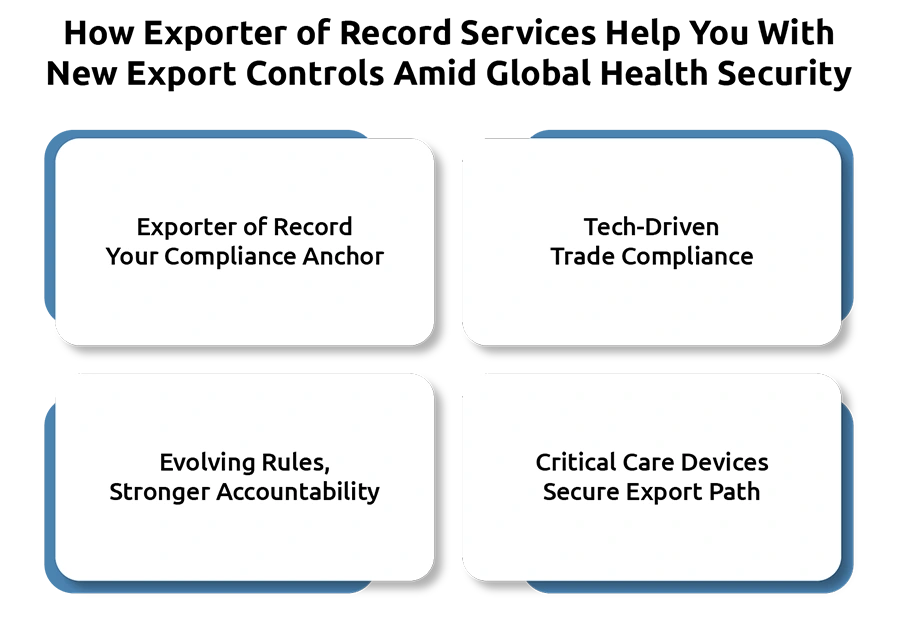
How Exporter of Record Services Help You With New Export Controls Amid Global Health Security
Managing Regulatory Accountability
As rules strengthen, the exporter of record services plays a critical role in managing export authorization responsibilities. These services help confirm accurate documentation, licensing validation, and working with developing regulatory expectations for critical care devices. In many transactions, exporters must also work with the importer of record service providers to confirm approval on both ends of the shipment.
Supporting Compliance Through Technology
Organizations increasingly depend on the best trade compliance software for import export rules to track regulatory updates, automate screening, and maintain audit trails. These tools also support supply chain optimization by combining approval checkpoints into daily operations rather than choosing them as separate processes.
Impact on Global Health Security After New Export Controls
Improving Local Preparedness
Export controls help governments maintain access to necessary healthcare equipment during emergencies. By regulating outbound shipments, countries attempt to avoid shortages that could overload healthcare systems during a sudden breakout in the storage.
Operational Challenges for Global Trade
Stricter problems can slow approvals and create operational complexity for the logistics chain. Organizations must carefully use correct documentation, regulatory approvals, and transportation planning to confirm that International freight services continue to ship without disruption.
Increased Approval Partnership
Healthcare exporters frequently ask whether a customs broker can handle both import and export documentation, showing the growing requirement for combined approval support during shipments. Partnerships among exporters, brokers, and regulatory experts help to get easy customs clearance while having a regulatory agreement.

Recommendations for Future Preparedness in New Export Controls on Critical Care Devices
Organizations should train internal teams on export controls, documentation expectations, and developing healthcare regulations. Understanding responsibilities across logistics and regulatory work reduces risk problems. Automated Inventory and order management platforms and approval tracking tools help maintain consistent documentation, improve visibility, and reduce manual errors during regulatory checks. Exporters should combine approval planning with Supply chain optimization efforts. Early work between working teams and approval specialists confirms smoother execution under stronger export controls.
Conclusion
The rise of export controls on critical care devices shows a broader change in how governments check healthcare systems as an important component of national and global security. While these regulations are for protecting local health systems, they also introduce extra work and approval requirements for exporters. Organizations that have expertise in regulations for logistics planning, technology usage, and approval management will be better prepared for future problems. By combining strong governance, correct documentation, and collaborative trade methods, exporters can continue supporting global healthcare access while navigating mainly difficult export control environments.
DID YOU KNOW?
The anesthesia and respiratory equipment market reached US$54 billion in 2024 and is projected to reach US$93.92 billion by 2033, growing at a CAGR of 6.6% during the forecast period 2025 to 2033.
FAQs:
1. Why are critical care medical devices now subject to export controls?
Governments increasingly view healthcare equipment as part of national security and emergency preparedness. Export controls help confirm local availability during global health crises while tracking sensitive technologies.
2. What medical devices are commonly affected by export regulations?
Devices such as ventilators, respiratory support systems, patient monitoring equipment, and technologies containing advanced sensors or embedded software frequently face higher regulatory scrutiny.
3. How does HTS code classification affect medical device exports?
Correct HS code categorizations determine licensing requirements, customs checks, and tracking problems. Incorrect classification can lead to shipment delays, penalties, or rejected exports.
4. What role does an Exporter of Record play in compliance?
An Exporter of Record manages export authorization, documentation accuracy, licensing validation, and regulatory responsibility to confirm shipments comply with international trade laws.
5. How can companies prepare for stricter export controls in healthcare trade?
Organizations should implement trade compliance software, documentation processes, train internal teams, and combine approval planning into logistics and supply chain operations.