Introduction
The aerospace industry works in an environment where even the smallest mistake can lead to severe safety, financial, and regulatory guidelines. From sourcing aircraft parts to final delivery, every part of aerospace logistics demands that absolute correct zero-error agreement is not just a quality standard but a basic requirement that controls manufacturing, logistics, and supply chain management. International production chain and strong aviation regulations, aerospace logistics must smoothly combine approval, security, and quick delivery while having complete tracking across global freight services.
Why is Zero-Defect Quality Assurance needed in the Aerospace Industry?
It is important in aerospace because aircraft parts directly affect tourist safety and working dependability. A single non-compliant part can ground fleets, trigger costly recalls, or result in regulatory fees. Aerospace logistics involves difficult import export documentation, customs clearance procedures, and strict confirm with Incoterms such as Delivered Duty Paid service, where accountability depends completely on the shipper. Confirming issue-free processes across logistics and warehousing, and last-mile delivery services reduces risk while having agreement with global aviation guidelines.

What Is Zero-Defect Manufacturing?
It is a regulated approach based on stopping defects rather than detecting them after production. In aircraft manufacturing, this approach extends beyond the manufacturing into logistics and supply chain optimization. Every part must be correctly categorized under the correct HS code or HTS Harmonized Tariff Schedule to avoid delays, incorrect import duties and tariffs, or agreement breach. Working with zero-defect manufacturing with logistics accuracy, aerospace organizations confirm the unwanted shipment of valuable parts across borders.
Guiding Aerospace shipping: confirming agreement, Security, and Speed
Aerospace logistics requires smooth coordination between multiple customers, such as suppliers, freight forwarders, customs officials, and IOR services providers. Security is important, as aircraft parts are sensitive and frequently related to export controls. Real-time shipment tracking plays an important role in monitoring high-value goods during international freight services, confirming visibility and risk reduction. Effective customs clearance supported by correct documentation and tariff categorization stops costly delays, while improved transportation and warehousing service confirm that parts reach manufacturing industries or maintenance without issues.
Benefits of Zero-Defect Quality Assurance in the Aerospace Sector
Adopting zero-defect quality assurance across logistics and supply chain management delivers measurable benefits to aerospace organizations. It increases regulatory agreement, reduces operational downtime, and improves cost efficiency by reducing rework and fees caused by documentation errors. Warehousing solutions for import and export goods become more dependable when inventory accuracy and traceability are maintained. Also, zero-error agreement enhances relationships with global partners by confirming a predictable delivery schedule and continuous service quality throughout the supply chain.
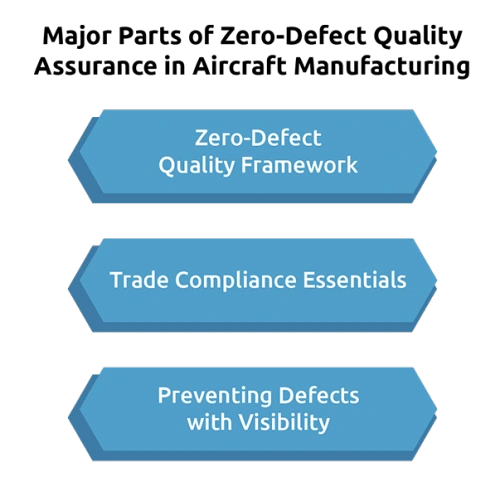
Major Parts of Zero-Defect Quality Assurance in Aircraft Manufacturing
Zero-defect quality assurance in aerospace depends on process combination, data accuracy, and responsibilities. Proper categorization under the generalized system of preferences (GSP), DAP, and DAPs trade system confirms approval with international trade agreements while optimizing cost structures. Advanced warehousing solutions support controlled storage environments and sequentially numbered inventory management. Real-time shipment tracking combined with digital documentation systems reduces human issues across logistics and import export documentation workflows. Also, well-defined supply chain optimization plans work for manufacturing schedules with transportation and customs processes, confirming unwanted production cycles.
Conclusion
In an industry where safety and approval are non-negotiable, aerospace logistics must work with zero tolerance for errors. Zero-defect quality assurance extends beyond manufacturing into every logistics function, from customs clearance and IOR services to last-mile delivery services. By combining correct documentation, real-time visibility, and compliant transportation and warehousing methods, aerospace organizations can achieve operational excellence while meeting global regulatory standards. Also, zero-error agreement is not just a competitive advantage; it is the support of a dependable and future-ready aerospace supply chain.
DID YOU KNOW?
By considering all possible combinations of supplier relationships depicted on the map using these AI tools, the company increased its visibility into its suppliers from 15,000 to 500,000 and gained a competitive advantage through improved operational efficiency and decision-making capabilities.
FAQs:
What is zero-defect quality assurance in aerospace logistics?
Zero-defect quality assurance in aerospace logistics focuses on preventing errors across transportation, customs clearance, warehousing, and documentation to ensure full regulatory compliance and safety.
Why is zero-error compliance critical in the aerospace industry?
Because even minor errors can compromise aircraft safety, cause shipment delays, lead to regulatory penalties, or result in costly recalls and grounded fleets.
How does zero-defect manufacturing support aerospace logistics?
Zero-defect manufacturing ensures that every aircraft part is accurately classified, documented, tracked, and delivered, reducing risks in international shipping and supply chain operations.
What role does customs clearance play in zero-defect aerospace logistics?
Accurate customs clearance prevents delays, incorrect duty payments, and compliance violations by ensuring correct HS codes, Incoterms, and import-export documentation.
How does real-time shipment tracking improve aerospace logistics compliance?
Real-time tracking provides full visibility of high-value aircraft parts, enhances security, reduces transit risks, and ensures on-time delivery aligned with manufacturing schedules.