
Introduction
In international trade, getting product categorization correct is not just an approval formality; it directly affects import duties and tariffs, customs clearance, and overall supply chain optimization. When shipment data is incorrect, even by a small issue, the economic impact can multiply across global freight services, import export documentation, and related processes. Businesses that understand the importance of correct product categorization to avoid costly delays, penalties, and agreement issues.
Reason for Trade Classification Mistakes and Their Cost
Trade categorization mistakes happen for many reasons, such as old information, misunderstanding product specifications, or failing to review supplier documents thoroughly. Errors can result in increased import duties and tariffs, unwanted customs checks, and unexpected working costs. In severe cases, shipments may be delayed during last-mile delivery services or blocked completely. This can affect selling timelines, agreement commitments, and profit margins, making categorization accuracy an important factor in global business.
What Your Customs Tariff Classification Affects
Your customs tariff classification impacts multiple areas of international business. It determines how much duty a shipment incurs, whether the product is eligible for preferential programs such as the generalized system of preferences (GSP), and what government regulations or documentation requirements apply. It also impacts the smooth movement of cargo, affecting logistics efficiency, shipment planning, and even real-time shipment tracking visibility. Simply put, your tariff classification controls how customs authorities view and process your goods.

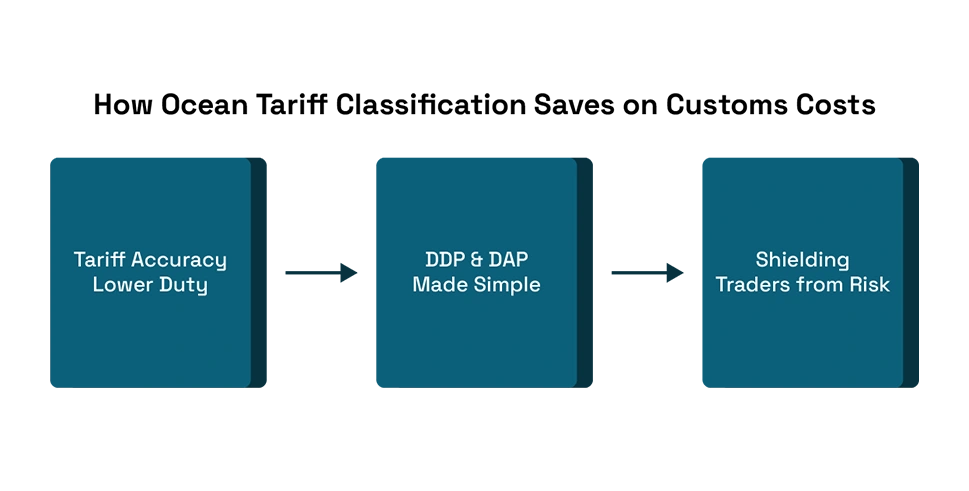
How Ocean Tariff Classification Saves on Customs Costs
Incorrect classification can lead to higher costs, but accurate ocean tariff classification can deliver real savings. Choosing the right classification can reduce payable duty, reduce administrative errors, and simplify routes for Delivered Duty Paid service or DAP shipping arrangements. This advantage means traders protect their economic risk while maintaining predictable pricing and improving supply chain optimization across shipment life cycles.
The Role of HS Codes in International Trade
Using the correct HS code or HTS Harmonized Tariff Schedule category is necessary for legally moving goods across the region. These codes categorize goods globally, helping customs officers identify descriptions, duty stages, and regulatory requirements quickly. Proper coding confirms approval, simplifying smooth border shipments, and protects businesses from unexpected costs. Even small inaccuracies in HS code usage can lead to disputes, higher customs duty valuations, or shipment holds, impacting both the importer of record responsibilities and the exporter of record definition requirements.
Neglecting to Verify Supplier-Provided Classifications
Many traders depend fully on supplier-provided classifications, but this is a risky approach. If the supplier’s information is incorrect, the receiving company is still responsible as the IOR, the Importer of Record service providers. Failing to verify good categorization can lead to misclassified goods, incorrect tariff records, and penalties that are collected over multiple shipments. Responsibility mainly depends on the importer, meaning an ignored review can interrupt customs clearance, impact delivery schedules, and damage customer trust in international markets.
Plans That Traders Use to Avoid Mistakes and Errors
Smart shippers minimize risk using a combination of best practices:
- Maintaining updated classification databases to confirm current and accurate HS code and tariff references.
- Working with professional trade advisors or IOR services for complex product categories.
- Training internal teams on classification rules, approval expectations, and import export documentation standards.
- Validating supplier inputs rather than accepting classifications at face value.
- Using audit systems and periodic reviews to confirm long-term accuracy.
- These approaches help businesses avoid categorization issues, control customs fees, and support well-managed supply chain operations.
Conclusion
The real-world cost of classification errors is far greater than simple documentation adjustments. Errors affect import duties and tariffs, delay customs clearance, and weaken global freight services. By understanding how tariff decisions impact agreements and mainly applying best methods, businesses can avoid costly mistakes, strengthen trade competitiveness, and confirm smooth global shipping outcomes.
DID YOU KNOW?
The global semiconductor industry accounts for $1.56 trillion in annual global trade, underscoring the scale of technology product movements that require accurate classification.
FAQs:
- Why is product classification important in international trade?
Product classification determines import duties, tariff rates, regulatory requirements, and how customs authorities process goods. Incorrect classification can result in penalties, delays, and higher operating costs.
- What is an HS Code?
An HS Code (Harmonized System Code) is a global standardized code used to classify goods in international trade. It defines tariff rates, customs regulations, and documentation requirements for each product category.
- What happens if a shipment is misclassified?
Misclassification can lead to increased import duties, shipment holds, additional inspections, customs fines, delayed delivery timelines, and higher logistics expenses.
- Who is responsible for correct tariff classification?
The importer of record (IOR) is ultimately responsible, even if the supplier provides the product classification. Importers must verify accuracy to ensure compliance.
- How can businesses avoid trade classification errors?
Businesses can reduce risk by maintaining updated classification databases, conducting periodic audits, verifying supplier data, training staff, and working with professional trade advisors or customs compliance experts.