
Introduction
In international trade, currency values mainly remain stable for long, and their constant movement can hugely improve the profits and financial commitments of both exporters and importers. When businesses negotiate agreements under Incoterms such as Delivered Duty Paid service (DDP) or Delivered at Place (DAP), currency changes can alter the final landed cost. As companies expand globally and depend on international freight services, live shipment tracking, last-mile delivery services, and trusted import export documentation partners, they must develop strong plans to manage exchange-rate uncertainty.
What are Currency Fluctuations?
Currency fluctuations refer to changes in the value of one currency relative to another due to market forces, trade performance, interest rates, and global economic conditions. These changes can increase the pricing of goods, logistics expenses, and landed costs under the harmonized tariff schedule systems, such as the HS code and HTS harmonized tariff Schedule classification structures. When businesses operate globally, mostly under trade programs such as the generalized system of preferences (GSP), even minor exchange-rate variations can alter how competitively goods are priced in global trades and affect contractual issues.
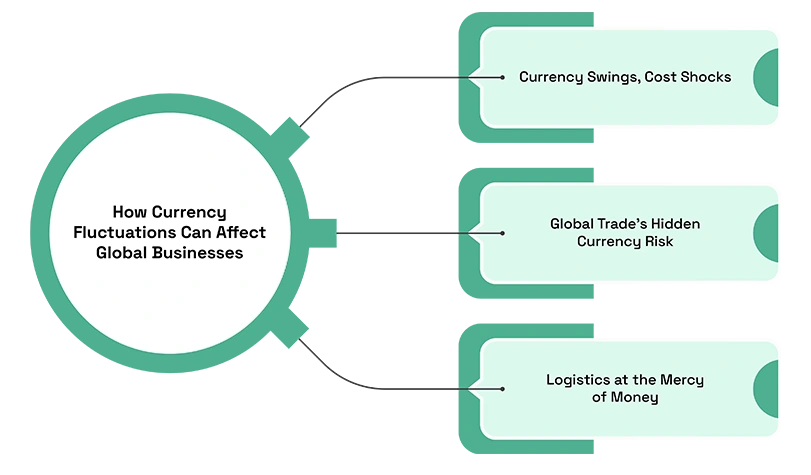
How Currency Fluctuations Can Affect Global Businesses
For companies purchasing products globally or shipping goods through DAPs and similar arrangements, exchange-rate risk can make identical shipments hugely more expensive from one month to the next. A depreciation of the buyer’s currency may increase the cost of import duties and tariffs, while an appreciation may lower final expenses. Logistics partners and freight forwarders frequently advise companies to analyze the financial impact of fluctuating values as early as the cost estimate stage. If pricing is miscalculated, organizations may face issues with extra storage expenses, unwanted tariffs, and increased shipping costs, all of which undermine the goal of supply chain improvement.

How Does Currency Volatility Affect Import-Export?
Currency fluctuations play a vital role in shipping decisions and provide an affordable advantage. When suppliers issue a cost estimate based on an agreed Incoterm, such as DAP or DDP, a change in currency value can change how much the buyer pays after customs clearance under HS code classifications. Exporters may also face risks if they quote prices in a foreign currency but receive payment months later under changing market conditions. In many cases, fees related to logistics, cargo handling, and approval with Exporter of Record definition requirements may also become more expensive.
Effective Strategies for Managing Currency Fluctuations
To reduce liability to exchange-rate volatility, companies frequently use systematic economic plans such as forward contracts and multi-currency invoicing. These measures confirm that future payments are locked in at predetermined rates, improving financial planning accuracy. Businesses are also increasingly depending on digital platforms that support live shipment tracking, electronic trade documentation, and combined freight management systems to obtain quick financial data that assists decision-making. When combined with accurate Import export documentation and systematic trade agreements, these plans help safeguard revenue and maintain competitiveness even when currency markets move sharply. Clear contract terms that define which party shoulders exchange-rate responsibility, frequently influenced by the chosen Incoterms, remain necessary for stopping disputes and cost uncertainty.
Reduce Business Currency Risks by Partnering with One Union Solutions
Working with an experienced trade management partner such as One Union Solutions provides businesses with structured tools and working support for guiding financial instability in global trade. We support organizations with Importer of Record responsibilities, Exporter of Record definition agreement, and end-to-end management of international freight services, such as customs clearance, last-mile delivery services, and live shipment tracking. Their expertise allows businesses to better predict how currency changes increase duties, storage fees, logistics expenses, and pricing based on HS code and HTS harmonized tariff Schedule classifications. By supporting accurate landed cost calculation and confirming shipments meet regulatory standards, we reduce unwanted fees and maintain consistent supply chain optimization even when currency values change.
Conclusion
Managing currency volatility in import-export contracts is necessary for maintaining predictable profit margins and avoiding cost overruns. Because international trade involves multiple variables from categorizations under the harmonized tariff schedule to delivery terms such as DAP and DDP, exchange-rate changes can hugely affect final pricing. With cost forecasting, systematic contractual agreements, and expert logistics partners like One Union Solutions, businesses can reduce uncertainty and gain stronger control over global work.
DID YOU KNOW?
So items that cost 100 pounds in the UK will cost 130 euros instead of 110, making those items less competitive in the European market.
FAQs:
What causes currency fluctuations in international trade?
Currency values change due to supply and demand, interest rates, inflation, political stability, economic data, and global market performance. These shifts directly influence the pricing of international goods and logistics.
How do currency fluctuations affect DDP and DAP shipments?
Under Incoterms like DDP or DAP, any change in exchange rate can increase or decrease the final landed cost, including duties, logistics charges, and customs clearance expenses.
How can businesses protect themselves from exchange-rate losses?
Many companies use tools such as forward contracts, hedging, multi-currency invoicing, and accurate cost forecasting to lock in predictable pricing and reduce financial uncertainty.
Why do exporters face risk when quoting prices in foreign currency?
If payment is received weeks or months later, a currency drop can convert revenue into a lower value, reducing profit margins unless the price is protected in the contract.
How does One Union Solutions help manage currency volatility?
We provide end-to-end trade management, customs compliance, landed cost forecasting, and digital freight systems that help businesses anticipate currency effects and avoid unnecessary charges.