

Demand for domestic & global air travel is developing, mainly in growing countries. This has led to more orders for new commercial aircraft. There is a greater need for updating avionics systems for safety regulations. Airlines are updating their aircraft with modern avionics to stay competitive. This growth in commercial aviation is driving the avionics market.
At the same time, new avionics technologies such as touchscreen displays, improved flight management systems, & improve connectivity are also driving growth. These upgrades make aircraft safer, easier, & better performing. As a result, both the commercial & military sectors are regularly updating their avionics systems, further supporting market growth.
Avionics Market Introduction
Avionics combines aviation & electronics. An avionics system or avionics sub-system depends on electronics. Common electronic systems in aircraft & spacecraft include engine controls, flight control systems, navigation, communications, flight recorders, lighting systems, fraud detection, electro-optic (EO/IR) systems, & weather radar.
Recent innovations in integrating software & digital code into the design of modern aircraft have driven substantial change. As a result, participants in the aviation industry have focused on improvements in flight control systems, flight deck technologies, & aircraft electrification.
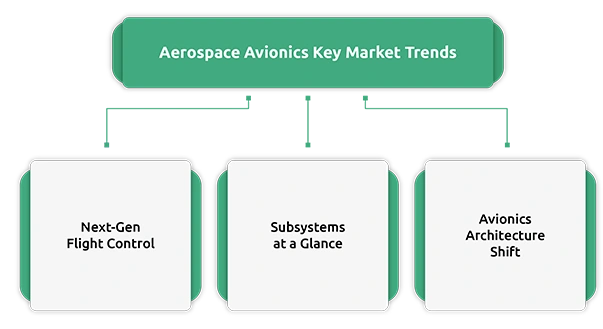
Aerospace Avionics Key Market Trends
Develop in the Integration of Modern Flight Control Systems: The integration of modern flight control systems onboard next-generation aircraft, which are expected to enter service in the coming years, is being accomplished in collaboration between aircraft OEMs & avionics manufacturers. To improve the self-sufficient operations of manned and unmanned aircraft, firms are also targeting the integration of modern technologies such as artificial intelligence (AI) & large datasets into computer systems. A further layer of cybersecurity is being enabled by multiple manufacturers developing physical unclonable function (PUF)- based nano-electromechanical switches (NEMs) that can withstand severe temperatures, microwaves, & high-dose radiation & self-destruct in the event of data breaches.
Aerospace Avionics Market Segments Analysis
Sub-System, Fit, Platform, Avionics Architecture, Performance Level, End-Use, & Region segments the Global Aerospace Avionics Market. Sub-System, the market is Split into Communication Systems, Navigation Systems, Surveillance Systems, Flight Management Systems, Flight Control Systems, Health Monitoring Systems, Electrical & Emergency Systems, Display Systems, & Avionics Integration Systems. Based on Fit, the market is segmented into Retrofit & Forward Fit. Based on Platform, the market is segmented into Commercial Aviation, Military Aviation, Special Mission Aviation, General Aviation, Business Jets, Helicopters, & Unmanned Aerial Vehicles (UAVs). Based on Avionics Architecture, the market is segmented into Centralized Avionics Systems, Distributed Avionics Systems, Integrated Modular Avionics (IMA), & Open Architecture Avionics.
Aerospace Avionics Market Regional Insights
North America accounted for the largest share of the international aerospace avionics market, at more than 30%. The region is home to aerospace manufacturers such as Boeing & Lockheed Martin, increasing demand for advanced avionics systems. The region has a large commercial aircraft fleet, & airlines are continually upgrading their jet engine systems to enhance safety. Technological innovation & research facilities in the US. are driving flight plans. Stricter security regulations & a focus on aircraft cybersecurity are encouraging investments in cutting-edge violic technology, further fueling market trends.
Focus on Efficiency & Cost
Airlines are mainly looking for ways to minimize operating costs. Advanced avionics systems help optimize flight routes & minimize delays. This not only helps airlines save money but also minimizes their environmental effect. As a result, many airlines are updating their past systems with modern avionics technology.
Technological Advancements in Avionics
Technology is developing rapidly in the aviation sector. Modern avionics systems now add digital displays, touchscreen controls, & updated flight management systems. These innovations make it easier for pilots to manage aircraft operations & improve overall performance. In addition, improved connectivity enables real-time data sharing between aircraft & ground stations, leading to faster, more informed decision-making.
Key Innovations
- Touchscreen cockpit displays
- Next-generation flight management systems
- Real-time data connectivity
- Automated monitoring and control systems

Growth in Military Aviation
The military sector is also contributing to the growth of the avionics trade. Governments worldwide are investing in advanced defense systems, with modern aircraft equipped & high-tech avionics. These systems are used for surveillance, communication, & mission control. The need for robust defense capabilities is driving demand for advanced aviation electronics.
Maintenance, Repair, and Upgrades
In addition to new aircraft purchases, maintenance & upgrades of existing fleets drive the avionics market. Many airlines choose to upgrade their current aircraft with modern systems rather than purchase new aircraft. This helps them deal with evolving regulations & improve performance without significant investment. As a result, there is a continuous demand for avionics replacement parts & upgrades.
Conclusion
The growing trade in aviation electronics & avionics systems is supported by developing air travel, safety requirements, & technological advancements. Both commercial & military sectors are investing mainly in modern avionics to enhance efficiency, safety, & performance. As the aviation industry continues to improve, the demand for advanced avionics systems continues to grow even further, making it a main area of growth in international trade.
Did you know?
The global avionics market size was valued at USD 108.2 billion in 2024 and is projected to grow from USD 117.3 billion in 2026 to USD 200.9 billion by 2034.
FAQ
1. What are avionics systems in aviation?
Avionics systems are the electronic systems used in aircraft for communication, navigation, monitoring, and control. They help pilots operate the aircraft safely and efficiently.
2. Why is the demand for avionics systems increasing?
The demand is growing due to the rise in global air travel, increasing aircraft production, and the need for advanced safety and performance technologies in modern aviation.
3. How do avionics systems improve flight safety?
Avionics systems provide real-time data, accurate navigation, and better communication with air traffic control. This reduces human error and helps pilots make safer decisions during flights.
4. What role does technology play in avionics growth?
New technologies like touchscreen displays, advanced flight management systems, and real-time connectivity improve aircraft efficiency and performance, driving the need for modern avionics systems.
5. Which sectors contribute to the growth of the avionics trade?
Both commercial aviation (airlines) and military aviation contribute to the growth. Airlines upgrade systems for efficiency and safety, while governments invest in advanced avionics for defense purposes.