Airworthiness certification is a process that ensures an aircraft part is safe to use & meets all need aviation rules. It checks whether the part has been developed, manufactured, & tested according to approved safety standards. Once certified, the component is seen as easy & can be legally installed on an aircraft.
It acts like a “safety approval” for aircraft parts. Aviation authorities review the part’s quality, performance, & documentation to make sure it will function properly without risking the aircraft or passengers. This is added with checking its manufacturing history, testing results, & traceability records.
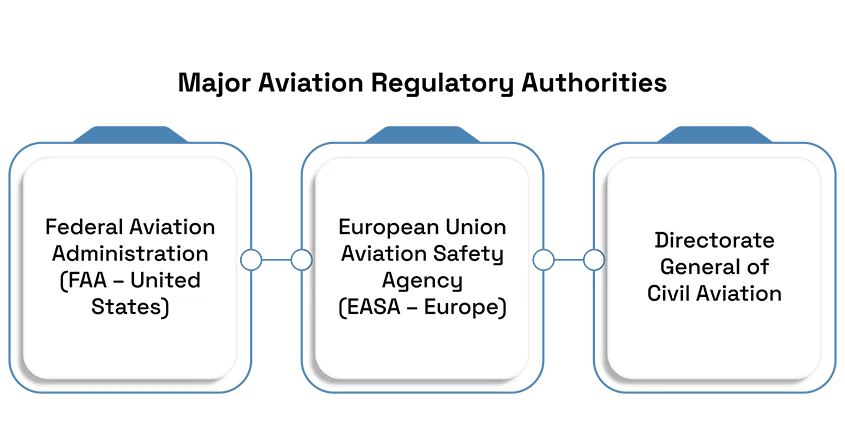
Major Aviation Regulatory Authorities
1. Federal Aviation Administration (FAA – United States)
The Federal Aviation Administration is one of the most important aviation authorities in the world. It establishes safety rules for how aircraft & their components are designed, manufactured, & manage, mainly through regulations such as 14 CFR. The FAA also issues certifications, such as FAA Form 8130-3, to confirm that aircraft components are safe & approved for use. It authorizes manufacturers, repair stations, & maintenance organizations to operate in accordance with its standards. Because many aircraft & parts used internationally are made in the United States, the FAA plays a main role in enhancing global aviation safety & regulations.
2. European Union Aviation Safety Agency (EASA – Europe)
The European Union Aviation Safety Agency (EASA) is responsible for developing aviation safety across all European Union countries. It makes sure that the same safety standards are followed throughout Europe so that aircraft & their parts are easy & safe to use. EASA issues certifications like EASA Form 1 to approve aircraft components. It also sets rules for how parts are designed, produced, & manage under regulations such as Part 21 and Part 145. EASA works with other global aviation authorities to keep global safety standards regular & arranged.
3. Directorate General of Civil Aviation
The Directorate General of Civil Aviation is India’s main aviation authority responsible for ensuring safety & regulatory compliance in the aviation sector. It manages aircraft certification, management, & airworthiness standards across the country. DGCA also makes sure that any aircraft components imported into India meet the national safety standards. At the same time, it aligns many of its rules with global aviation guidelines to manage consistency with global practices.
Bilateral Agreements & Mutual Recognition
Bilateral agreements & mutual recognition play an important role in easing global aircraft component trade. Aviation authorities often sign Bilateral Aviation Safety Agreements (BASAs), which allow countries to accept each other’s certification systems. For example, certifications issued by the Federal Aviation Administration (FAA) & the European Union Aviation Safety Agency (EASA) are often mainly recognized. This means that an aircraft part approved in the United States may not need to go through a full certification process again in Europe, helping to reduce time, minimize costs, & make global trade simpler.

Benefits of Mutual Recognition:
Bilateral agreements & mutual recognition give many important benefits to the aviation industry. They help reduce duplicate testing & verification, as components approved in one country are often accepted in another. This speeds up import & export processes, allowing aircraft parts to move more fastly across borders. It also lowers compliance costs for manufacturers & exporters by reducing the need for repeated certification procedures. At the same time, these agreements help manage consistent international safety standards, ensuring that aircraft components stay easy & safe no matter where they are used.
Why This Matters in International Trade
Because aviation is a highly regulated industry, exporters must ensure that their components meet the clear requirements of the destination country’s authority. Even with agreements in place, proper documentation & certification are still essential.
These regulatory bodies not only maintain aviation safety within their regions but also collaborate internationally to make global aircraft component exports smoother, safer, & more easy.
Conclusion
Airworthiness certification is a main part of global aircraft component exports. Make sure that each part has strict safety, quality, & regulatory standards before it is used in aviation operations. With authorities like the Federal Aviation Administration, European Union Aviation Safety Agency, & Directorate General of Civil Aviation overseeing compliance, businesses must carefully follow global & local requirements.
Did you know?
The MRO industry forms one of the most critical pillars of the aviation value chain. As aircraft fleets expand and technology becomes increasingly sophisticated, the role of maintenance has become central to ensuring operational safety, reliability, and economic efficiency.
FAQ
1. What is airworthiness certification in aircraft component exports?
Airworthiness certification is a process that ensures aircraft parts meet the required safety and quality standards set by aviation authorities. It confirms that the component is safe to use and legally approved for installation and international trade.
2. Which authorities issue airworthiness certifications?
Major aviation authorities include the Federal Aviation Administration (FAA), European Union Aviation Safety Agency (EASA), and the Directorate General of Civil Aviation (DGCA). Each authority sets its own certification standards, but many follow similar global guidelines.
3. What documents are required for exporting aircraft components?
Common documents include airworthiness approval tags (like FAA Form 8130-3 or EASA Form 1), certificate of conformity, maintenance records, and traceability documents. Proper documentation is essential to avoid delays or rejection during export.
4. Do aircraft parts need re-certification in every country?
Not always. Due to bilateral agreements between authorities like the FAA and EASA, certifications are often mutually recognized. This reduces the need for full re-certification and makes global trade faster and more efficient.
5. Why is airworthiness certification important in global trade?
It ensures safety, regulatory compliance, and smooth cross-border movement of aircraft components. Without proper certification, parts cannot be legally exported or used in aircraft operations.