Introduction
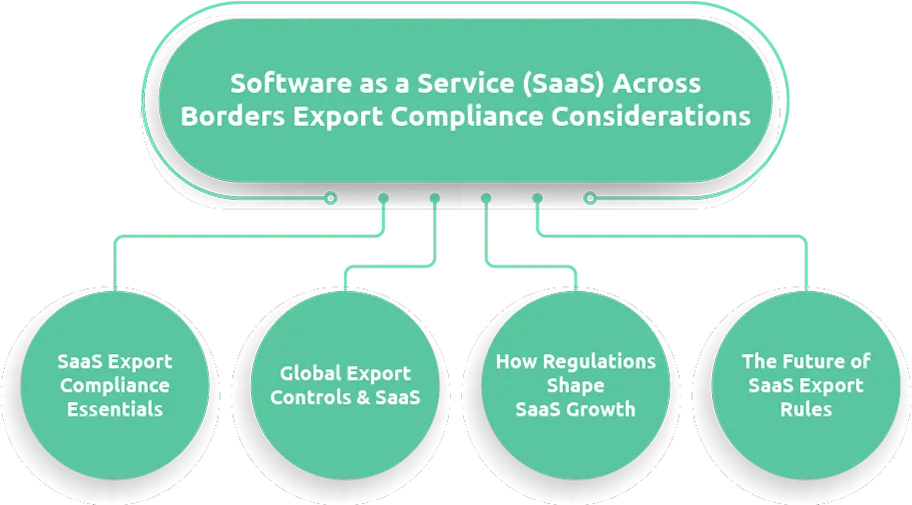
The rapid market growth of Software as a Service (SaaS) allows businesses to use flexible solutions that cross borders successfully. The international expansion of SaaS providers requires them to handle numerous complex legal frameworks that become specifically challenging in export compliance matters. The success and legal validity of cross-border SaaS distribution depends on proper understanding and full compliance with export regulations, which include data privacy laws and software licensing.
The following blog delves into the principal export compliance aspects that SaaS providers should consider as they venture into international marketplaces. Knowledge of legal regulations enables SaaS providers to reduce security dangers while they execute their business growth plans.
The Basics of Export Compliance for SaaS Providers
Export compliance describes the framework of law enforcement used for software and technological distribution across international borders. The exportation process involves stipulations regarding who can acquire particular technology, its authorized transfer methods, and every piece of documentation that must be produced for legal exportation.
All SaaS companies must begin their compliance efforts by studying the export control laws in the nation where their headquarters exist. Control guidelines from organizations determine the procedures for international software distribution. SaaS companies must continuously monitor the export laws that determine their software product availability for nations subject to trade embargoes. Failing to follow these regulations will lead to severe penalties, legal consequences, and export privileges.
It remains essential for SaaS providers to monitor evolving compliance requirements that determine export control classifications of their software, since this classification depends on both functional capabilities and encryption methods implemented in their product.
Navigating International Data Privacy Laws and Their Impact on SaaS Exports
The primary issue facing SaaS companies that target worldwide expansion involves compliance with various international data privacy regulations. Data privacy becomes essential for export compliance due to the different country regulations.
For SaaS companies expanding globally, one of the biggest challenges is complying with different data privacy laws in each country. Regulations vary widely, making it essential for companies to understand how user data is collected, stored, and transferred across borders. Failing to follow these rules can lead to legal penalties, service restrictions, and loss of customer trust. As a result, strong data protection policies and compliance frameworks are critical for successful international SaaS operations.
The SaaS industry faces strict GDPR under EU law since it protects personal data from EU
Companies must receive explicit user authorization that enables data processing operations and movement procedures. SaaS providers must establish data security measures that safeguard all the information between locations because different privacy regulations come into play as the data leaves EU territory.
Internet-based service providers conducting business worldwide must meet the United States & India’s data protection requirements. SaaS providers must follow these principles to avoid data breaches & heavy fines during cross-border data transfers, which occur when hosting data in one jurisdiction and providing services from another.
SaaS Licensing and Intellectual Property Considerations in a Global Context
Software as a service export compliance needs businesses to safeguard their intellectual property rights. Software allocation worldwide requires complete intellectual property protection because countries enforce different IP regulations. A SaaS company needs a complete understanding of the border licensing agreements that dictate how their software gets utilized worldwide.
When offering SaaS solutions in multiple countries, companies must carefully review and draft licensing agreements that outline the rights and restrictions for international customers. These agreements should address factors like usage limits, access controls, and intellectual property ownership to prevent unauthorized use of the software.
SaaS providers should also consider the specific intellectual property protection laws of each country where they operate. For instance, countries with robust IP protections may offer stronger safeguards for proprietary technology, while others may present challenges in enforcing rights.
The Role of Encryption Technology in SaaS Export Compliance
SaaS tech relies heavily on encryption to secure information transfers between service providers and their users. Implementing export controls against encryption software produces obstacles that affect SaaS providers who want to operate across international borders.
The United States and other nations maintain strict encryption export controls that dictate both the sales targets and recipient list of encryption technology. To operate globally, SaaS companies with encryption features need proper export licenses to distribute their encryption technology to specific destinations.
Different encryption systems should be chosen based on the distinctive characteristics of the provided service. Certain nations have stronger limitations for SaaS solution usage within the healthcare and defence sectors. Business entities need to know encryption regulations because this knowledge prevents monetary damages and legal penalties.
Understanding SaaS Export Rules Worldwide
When a business offers SaaS services to users in different countries, it may have to follow local rules and regulations. These rules can apply to data privacy, software security, and user data. Different countries have different rules, therefore companies should be understand the rules before delivering their services globally. Following these regulations helps businesses to avoid issues, secure client data, and grow smoothly in global markets.
Conclusion
Expanding SaaS businesses into international markets creates growth potential while presenting multiple complex rules for compliance. The success of SaaS providers in international operations depends on their continuous compliance with local data privacy rules, IP protections, export control rules, and encryption requirements.
One Union Solutions provides experienced guidance to SaaS companies that need support for export compliance in their scaling processes. We will help you achieve successful market expansion across global territories while meeting all required legal & regulatory standards.
Did You Know,
The global Software as a Service (SaaS) market size was valued at USD 315.68 billion in 2025. The market is projected to grow from USD 375.57 billion in 2026 to USD 1,482.44 billion by 2034
FAQ
Is SaaS considered an export?
Yes. Even though SaaS is delivered digitally, providing software access or cloud services to users in another country is treated as an export under many export control laws.
Which export regulations apply to cross-border SaaS?
SaaS exports may fall under regulations such as the U.S. Export Administration Regulations (EAR), especially if the software includes encryption or advanced technologies.
Do SaaS providers need export licenses?
In some cases, yes. If the software is classified as controlled technology or is accessed by users in restricted countries, an export license may be required.
How do user location and end-use affect SaaS compliance?
Export rules depend on where the user is located and how the software will be used. Access by sanctioned countries, restricted users, or military end-use can trigger compliance requirements.
How can companies stay compliant when offering SaaS globally?
Companies should classify their software correctly, screen users and countries, maintain proper records, and work with export compliance experts to avoid legal risks.