Introduction
Rules regulating aviation equipment exports have been created as a multifaceted regulatory scheme to prevent unauthorized individuals from acquiring these technologically advanced products. Export compliance in aviation aims to succeed by implementing end-user and end-use restrictions. National authorities establish these limitations through government policies to govern sales of military equipment and dual-use and sensitive technologies. Investing in end-user and end-use restriction knowledge allows exporters to follow international trade regulations while managing market complexities.
What Are End-User and End-Use Restrictions?
Restrictions regarding end-users define the specific recipients who can obtain exported merchandise. Such regulatory measures limit the products sent to authorized recipients whose selection depends on political factors, security concerns, and economic qualifications. The target audience for exported goods is qualified through end-user restrictions, distinct from end-use limits, which dictate usage plans in the destination markets. The joint limitations of end-user and end-use controls prevent the unauthorized supply or military exploitation of sensitive aviation equipment.

Why Are End-User and End-Use Checks Important in Aviation Exports?
End-user and end-use checks are critical in aviation exports because they ensure that sensitive equipment does not fall into the wrong hands or get used for unauthorized purposes. Aviation components—especially avionics, navigation systems, and dual-use technologies—can have both civilian and military applications, making strict oversight essential.
These checks help prevent aviation equipment from being used in illegal activities, unauthorized military programs, or by sanctioned and restricted entities. By verifying who the buyer is and how the product will be used, exporters can avoid the risk of diversion, where goods are redirected to unintended users or purposes after shipment.
Exporter of Record and Compliance
Exporters need a complete understanding of international legislation since they should uphold end-user and end-use limitations. A widespread export regulation known as the Generalized System of Preferences (GSP) permits certain nations to import products through tariff-free channels. Modalities of GSP require multiple checks to confirm compliance regarding the ultimate user and intended use of exported products.
Export Registers are monitoring tools to track and keep records of all exported products. The Export Register enables exporters to maintain compliance through export tracking and end-user documentation that facilitates official audits if such inquiries occur.
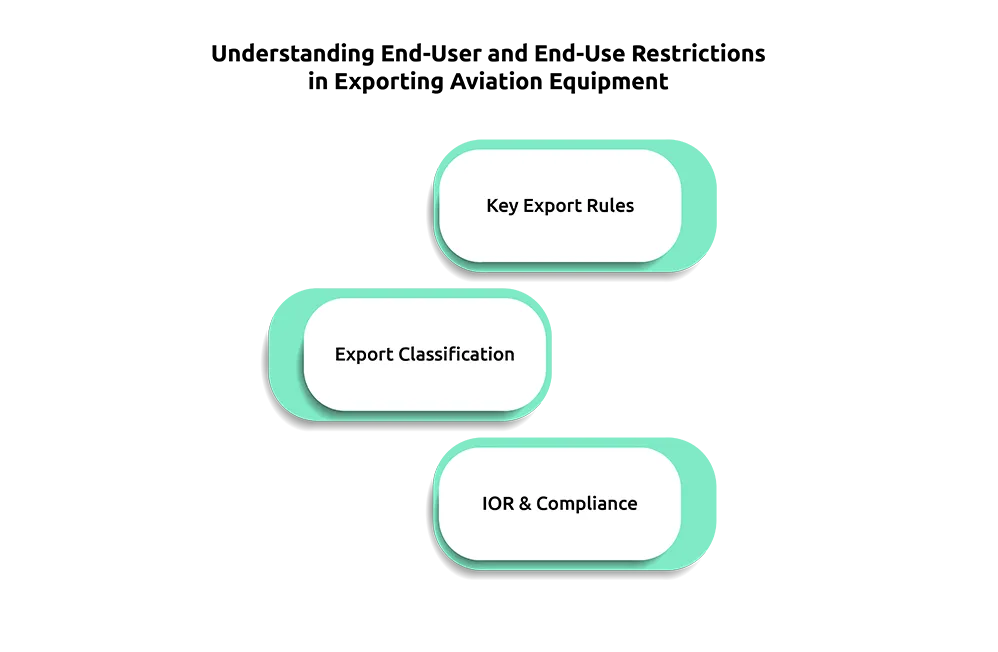
Export Process and Documentation
The procedures for exporting goods require multiple specific steps to satisfy legal requirements. The export process requires an HS Code to classify goods for trade purposes. The proper application of the HS code enables companies to pay the right duties and keep track of their products during international border transit.
The export process includes shipping methods and delivery terms, which are essential components. Under DAP Delivered At Place, the seller transfers goods to the specified place, and the buyer must handle all import taxes and duties.
The air freight calculator system enables exporters to find cost-efficient ways to ship delicate products, and the air freight cost calculator reveals all shipping expenses involved in air transport.
Ensuring Compliance in Aviation Equipment Exports
Compliance means following all the rules when sending aviation equipment to another country. Businesses need to check who is receiving the equipment and make sure it will be used for the correct purpose. They must also prepare the required documents and follow customs rules. Following rules helps avoid delays, fines, and other issues. It also makes sure the equipment reaches the correct customer safely and legally.
Warehousing and In-Transit Management
Efficient warehousing services and stringent in-transit management play a critical role in the secure movement of aviation equipment. Modern warehouse solutions designed for high-value and sensitive components support robust surveillance, controlled access, and proper documentation—ensuring compliance with global trade compliance rules, end-user restrictions, and HS code classification requirements.By integrating freight forwarding services, customs clearance support, and secure storage under international Incoterms® 2020, exporters reduce risks of diversion, protect MRO-critical parts, and maintain full traceability across the aviation supply chain.
The tracking system monitors a shipment through all supply chain stations to monitor product movement completely. International exports of sensitive equipment require specific attention because the diversion and misuse risks are elevated.
Conclusion
Companies must handle international export laws cautiously when moving aviation equipment through end-user and end-use restriction protocols. Businesses that partner with Exporter of Record services and use air freight calculators and white glove delivery as tools will achieve secure and compliant exports. Through its leadership position, One Union Solutions delivers complete services ranging from supply chain management to warehousing that help businesses operate within compliance parameters while enhancing their export operations.
Did You Know?
The world’s major economies appear poised to continue their heavy reliance on trade controls—though the mix of tools and targets could radically shift.
FAQs
Why are end-user checks important in aviation exports?
End-user checks help make sure aviation equipment is sent only to approved customers and not to restricted or unauthorized parties.
How does One Union Solutions support aviation equipment exports?
One Union Solutions helps businesses manage export compliance, documentation, logistics, and supply chain operations for smooth international shipments.
What information is needed before exporting aviation equipment?
Businesses usually need product details, customer information, shipping documents, and compliance records.
Can One Union Solutions help with end-user and end-use verification?
Yes. One Union Solutions helps businesses verify customers and meet export compliance requirements before shipping aviation equipment internationally.
Why is warehousing important for aviation equipment exports?
Ans: Warehousing ensures that high-value aviation equipment is stored securely before shipping. It also helps maintain compliance with regulations, ensuring the equipment doesn’t fall into unauthorized hands.