A Resurgence of Trade Tensions
International trade exists in a new period characterized by unpredictable market conditions. The growing hostility between America and China throughout 2025 has created new uncertainties for importers who operate in the IT hardware industry. International import procedures face fundamental changes due to rising requirements for trade tariff enforcement alongside regulatory checks and new compliance rules. Due to recent changes in foreign trade policies, international supply chain leaders must now reconsider their strategies for sourcing logistics and documentation processes. Importers are required to adapt to these changes since survival becomes their only option.
The 2018–2020 Trade War: A Recap
The United States began a round of escalating tariffs on Chinese goods, leading Beijing to introduce new trade limits in 2018. The U.S.-China trade dispute was a prototype of global trade disputes that established trade investment barriers, delayed tariffs, and potent volatile shipping rate increases for foreign trade.
The International Trade Commission documented that import tariffs for IT goods increased by 20% throughout this timeframe. The changes in Chinese import prices affected expansion margins and the calculation of costs and shipping durations for international importers worldwide. Supply chains faced actual and repeated interruptions that broke their hypothetical nature.

The 2025 Trade Escalation
Fast forward to today, and we’re witnessing a renewed trade escalation. This time, however, the approach is more strategic and deeply tied to long-term economic and national security goals. The current phase of tension focuses on advanced technologies, including IT hardware critical to U.S. infrastructure. The result? Increased scrutiny by U.S. customs management, tougher negotiations, and additional compliance requirements. International trade business protocols now require importers to adopt new customs tariff code classifications, protecting them against penalties and delays.
Comparing Trade War Then and Now
Unlike the short-term tit-for-tat measures of the past, the 2025 phase is marked by long-term policy recalibrations. U.S. regulators are pushing for diversification of imports away from China. This reshapes foreign trade exchange flows and places a renewed emphasis on traceability, transparency, and documentation accuracy. While some importers have relocated manufacturing to neighboring countries, many are still entangled in legacy supply chain contracts. These must now be renegotiated, restructured, or even abandoned to comply with the evolving international trade environment.
Impact of Supply Chain Disruptions on IT Hardware Imports
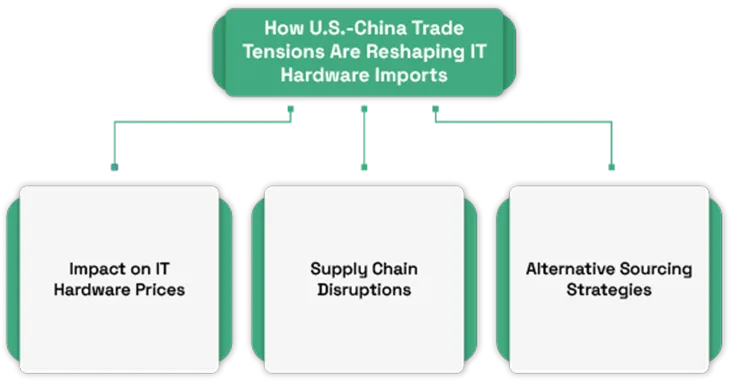
In 2025, supply chain disruptions are no longer short-term challenges but structural barriers affecting the movement of IT hardware across global borders. Rising freight charges, congestion at major ports, and enhanced customs inspections have increased shipment delays for importers. To stay competitive, businesses now adopt AI-powered demand forecasting tools, streamlined documentation workflows, and freight forwarding services that support real-time tracking and accurate customs clearance. Importers are increasingly relying on DDP shipping and in-transit warehousing services to reduce risk exposure and maintain delivery consistency. These strategies not only enhance supply chain visibility but also help companies navigate tightening trade rules with greater efficiency.
Overview of the Stock Market During 2018–2020
During the previous wave of trade conflict, the U.S. technology index showed a sharp 14% decline in mid-2019. The ripple effects of these tensions on stock performance revealed just how interconnected hardware imports, market sentiment, and trade tariffs have become. Investors grew cautious, and global trade slowed down. Lessons from this period are now shaping risk-mitigation strategies in 2025.
Performance Comparison with Other Emerging Markets
As U.S. and China trade relations falter, countries such as Vietnam, Malaysia, and Poland are seeing a rise in foreign trade investment. These emerging economies are now considered stable alternatives for hardware manufacturing, offering simplified customs clearance procedures and favorable trade tariff policies. Global firms are diversifying imports, shifting focus toward countries with bilateral trade agreements and fewer regulatory frictions.
Macroeconomic Effects of the Trade War
GDP Impact: Government data indicates that the 2025 escalation will cause a decrease between 0.3% and 0.5% in GDP consumption, while U.S. growth showed a mild reduction during prior trade conflicts.
Trade Balance: The slight reduction in the U.S.-China trade deficit alongside unchanged export performance emerged in 2024 because of overall global market instability.
Currency Volatility: Trade currency exchange volatility has intensified because the yuan-to-dollar rate decreased, so export costs have become unpredictable for import businesses.
Strengthening Global Trade Compliance for IT Hardware Importers
As U.S.–China tensions reshape global logistics, IT hardware importers must improve their approach to global trade compliance for IT hardware to avoid penalties and customs-related bottlenecks. This includes accurate HS code classification, updated documentation aligned with Incoterms 2025, and strict adherence to sourcing guidelines enforced by customs authorities. Many companies now partner with Importer of Record (IOR) specialists who handle tariff calculations, technical documentation, and customs clearance meaning in complex jurisdictions. With rising compliance risks impacting telecom and data-center shipments, businesses are shifting toward multimodal transport and freight forwarding services that offer better route optimization and stable delivery timelines. This compliance-first approach has become essential for companies operating in high-risk sectors like IT, telecom, and the automotive hardware supply chain.
China’s Response
In response to the trade escalation, China has ramped up bilateral cooperation with non-U.S. markets and simplified its own export protocols. The CCPIT has intensified outreach programs to attract new partners and protect its manufacturing base. Exporters are also leveraging flexible trade corridors via Southeast Asia to circumvent U.S. restrictions.
U.S. Supply Chain Adjustments
The U.S. government is responding with infrastructure and policy investments aimed at reshaping its supply chain resilience. New incentive agendas are being presented to encourage domestic manufacturing and reduce reliance on high-risk import origins. These efforts are slowly creating a more diverse but complex import landscape.
Conclusion
Trade dynamics between the U.S. and China continue to shift, adding new layers of complexity for hardware importers worldwide. From managing compliance under tighter customs scrutiny to adjusting global supply chains for long-term viability, businesses must evolve fast. At One Union Solutions, we help importers stay compliant, minimize costs, and simplify their international trade operations in an increasingly unpredictable world.
With expertise in Importer of Record (IOR), Exporter of Record (EOR), customs compliance, and global logistics, One Union Solutions helps businesses navigate changing trade regulations with confidence. Our tailored solutions reduce operational risks and ensure the smooth movement of IT hardware across international markets.
Did You Know,
In 2024, U.S. The International Trade Commission projects $12.5 billion in added costs to importers due to new 2025 tariffs.
FAQs
1. How have import tariffs changed in 2025 for IT hardware?
Ans: Tariffs have increased by an average of 10–15%, specifically targeting key components like semiconductors and circuit boards.
2. What role does compliance play under new trade rules?
Ans: Compliance is critical. Importers must align with new customs codes, documentation standards, and updated incoterms to avoid shipment holds or penalties.
3. How can importers track packages under heightened customs checks?
Ans: US customs package tracking systems are now integrated with AI, offering real-time visibility into shipment status and risk alerts.
4. Are trade incentives available for shifting away from Chinese suppliers?
Ans: Yes, the U.S. has introduced multiple incentive programs for companies relocating supply chains to allied or domestic partners.
5. Can simplifying international trade help reduce costs amid tariffs?
Ans: Absolutely. Streamlining documentation, leveraging alternative routes, and working with experienced trade consultants can significantly reduce risk and expense.