Introduction
As businesses expand their digital operations globally, the global cloud system has become important for improving performance, scalability, & business continuity. However, deploying an IT infrastructure across multiple countries involves complex logistics, customs compliance, & country-specific import requirements.
One Union Solutions simplifies global deployments through IOR services, helping businesses import servers, networking equipment, storage systems, and other IT hardware into over 190+ countries while reducing customs delays & compliance risks.
Why Logistics Planning Is Critical for Multi-Region Cloud Infrastructure
Deploying a cloud network across multiple countries includes more than shipping IT equipment. Businesses must coordinate servers, networking hardware, & storage systems while meeting each country’s customs rules, documentation requirements, & import compliance.
Effective logistics planning helps reduce customs delays, improve shipment visibility, control shipment costs, & make sure equipment reaches deployment sites on time. Proper preparation keeps global cloud system projects on schedule & reduced working risks.
How One Union Solutions Supports Global Cloud Infrastructure Projects
One Union Solutions simplifies global cloud network deployment through complete Importer of Record services & global logistics support. We manage customs documentation, compliance requirements, HS code verification, & customs clearance to help businesses import IT networks smoothly across multiple countries.
With operations in over 190+ countries, we manage the secure movement of servers, networking equipment, storage systems, & telecom hardware. Our expertise helps reduce customs delays, reduce compliance risks, & keep global cloud network projects on schedule.
Country Compliance & Global Import Regulations
Importing cloud system & networking equipment requires compliance with each country’s customs rules, import documentation, & approvals requirements. Depending on the destination, businesses may also need telecom permits, import licenses, or local representation.
Proper planning of documents, correct HS code classification, & compliance with applicable duties & taxes help prevent customs delays. Working with an experienced Importer of Record make sure smooth customs clearance & compliance with country-specific import rules.
Industries That Depend on Multi-Region Cloud Infrastructure
Cloud network deployment supports a wide range of industries that require secure, scalable, and high-performance digital environments. The technology sector depends on a global cloud system to deliver software platforms, AI applications, cybersecurity services, & businesses solutions across global markets.
Healthcare device organizations rely on cloud systems to manage electronic medical equipment records, patient data, & billing systems, & patient data while meeting strict security & compliance standards. Financial organization use cloud environments to support digital banking, payment processing, fraud detection, & regulatory reporting across multiple regions.
Telecom providers continuously grow their cloud networks to deliver faster networks, support 5G systems, & improve customer experiences. Production companies increasingly adopt cloud technologies to enable industrial automation, predictive maintenance, supply chain visibility, & smart factory operations across global facilities.
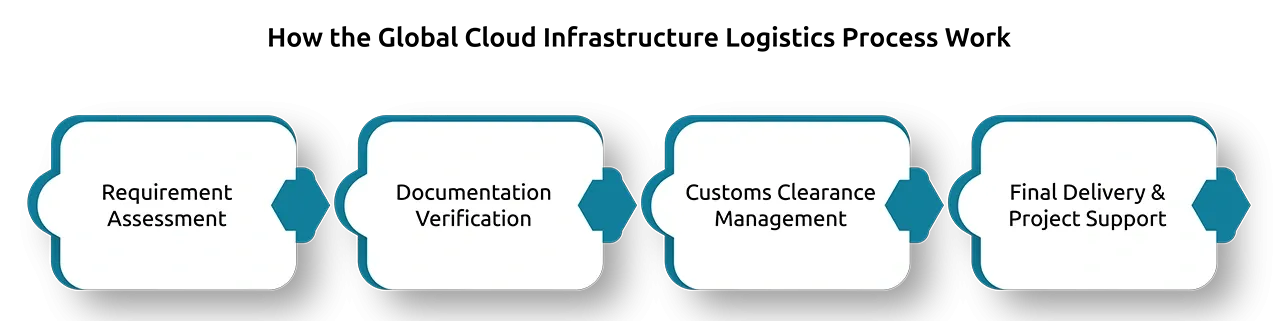
How the Global Cloud Infrastructure Logistics Process Works
Successful cloud system deployment requires a structured logistics process that reduces delays & make sure compliance at every stage. One Union Solutions follows an efficient approach that helps organizations move complex IT equipment across borders efficiently while maintaining complete regulatory compliance.
Step 1: Requirement Assessment
The process begins with understanding the project scope, destination countries, product requirements, & deployment schedule. This allows our team to identify country-specific import requirements & develop an efficient logistics plan before shipment begins.
Step 2: Documentation Verification
Our specialists carefully review commercial invoices, packing lists, HS classifications, certificates of origin, technical product details, & other required documents. Accurate documentation reduces customs risks & helps prevent unnecessary shipment delays.
Step 3: Compliance and Import Authorization
Each shipment is checked against local import rules, telecom requirements, & product certification standards. Where necessary, we coordinate import authorizations & make sure all compliance requirements are fulfilled before the equipment reaches customs.
Step 4: Customs Clearance Management
Our Importer of Record team manages customs formalities, duty payments, regulatory documentation, & communication with customs authorities. This proactive approach helps accelerate customs clearance while reducing inspection-related delays.
Step 5: International Logistics Coordination
Once customs requirements are completed, we coordinate shipping through trusted global logistics partners. Every shipment is monitored across transportation to maintain visibility & make sure equipment arrives according to project timelines.
Step 6: Final Delivery & Project Support
After customs clearance, equipment is delivered safely to the deployment site with continued shipment tracking & logistics support. This makes sure organizations can begin installation & deployment without unnecessary delay.
Benefits of Effective Logistics Planning
Strategic logistics planning helps businesses improve shipment visibility, reduce shipping risks, & make sure timely delivery of cloud system equipment. It also supports better customs compliance, lower working costs, & a more effective supply chain.
Working with an experienced Importer of Record provider simplifies global imports by removing the need for a local entity, reducing operational challenges, & helping businesses deploy cloud system faster & more effectively.
Challenges and Solutions in Global Cloud Infrastructure Deployment
Global cloud network projects often face customs delays, changing import rules, documentation errors, & country-specific compliance requirements. These challenges can increase costs & delay deployment schedules.
One Union Solutions simplifies the process through expert logistics planning & Importer of Record services. We verify documentation, manage customs compliance, coordinate global shipments, & provide end-to-end tracking to help businesses reduce delays, reduce risks, & keep projects on schedule.

Why Choose One Union Solutions?
One Union Solutions provides end-to-end logistics & IOR services for global cloud system projects. We help businesses import servers, networking equipment, storage systems, & telecom hardware into over 190+ countries without requiring a local entity.
Our expertise in customs compliance, documentation, & global logistics helps reduce delays, minimize risks, & make sure smooth cross-border deployments, keeping your cloud system projects on schedule.
Conclusion
Successful multi-region cloud system deployment depends on effective logistics planning, accurate documentation, & customs compliance. Without proper management, businesses may face shipment delays, higher costs, & project delays.
One Union Solutions simplifies the complete process through IOR services, global logistics expertise, and end-to-end compliance support. We help businesses deploy cloud networks effectively while making sure smooth, timely, & compliant global shipments
Did You Know?
The UK Government recommends a multi-region cloud approach to improve resilience, capacity, and access to innovation. It also states that organizations can use cloud regions outside the UK when appropriate legal, data protection, and security measures are in place.
Frequently Asked Questions
What is logistics planning for multi-region cloud systems deployment?
Logistics planning, including coordinating the global transportation, customs compliance, documentation, & delivery of cloud network equipment across multiple countries to make sure successful project implementation.
Why is an Importer of Record important for cloud infrastructure projects?
An Importer of Record assumes legal responsibility for importing equipment, managing customs documentation, regulatory compliance, & duty payments, allowing businesses to deploy the system without creating a local legal entity.
What equipment is commonly imported for cloud infrastructure deployment?
Cloud system projects typically require servers, storage systems, networking switches, routers, firewalls, telecom equipment, cables, power distribution units, & other supporting IT hardware.
What factors can delay international cloud infrastructure deployments?
Common causes include incomplete documentation, incorrect HS classifications, changing import regulations, customs inspections, missing certifications, & the lack of a qualified local Importer of Record.
How does One Union Solutions support global cloud infrastructure logistics?
One Union Solutions provides end-to-end Importer of Record services, customs compliance management, documentation verification, global logistics coordination, & global shipment support to make sure smooth & compliant cloud system deployments across more than 190+ countries.