Overview
Supply chains in 2026 are evolving at a pace that few industries have experienced before. Global disruptions over the past few years have forced businesses to rethink traditional models and adopt more resilient, flexible, and technology-driven approaches. For companies operating in import-export businesses—especially those connected to IT, aviation, medical, and automotive sectors—this transformation is not optional but essential for survival and growth.
Today’s supply chains are no longer just about moving goods from one point to another. They have become complex ecosystems that require strategic planning, real-time visibility, and strong compliance frameworks. Businesses are increasingly focusing on building systems that can quickly adapt to changing market demands and regulatory environments.
Supply Chains
Modern supply chains are becoming more interconnected and data-driven. Companies are integrating digital tools to gain better visibility into their operations, enabling faster decision-making and improved efficiency. The importance of supply chain optimization is growing as businesses aim to reduce delays, control costs, and maintain consistent service levels.
In the import-export landscape, international freight services play a critical role in ensuring the smooth movement of goods across borders. With increasing regulatory complexities, businesses are relying more on structured compliance processes, including importer of record service and exporter of record services, to manage documentation and legal responsibilities.
Another key element is customs clearance, which remains a crucial step in global trade. Efficient handling of documentation and adherence to regulations can significantly impact delivery timelines. This is why many companies are investing in the best trade compliance software for import export rules to minimize errors and improve accuracy.
Inventory and order management has also become a central focus. Businesses are moving toward real-time tracking systems that provide better control over stock levels and order fulfillment. This is particularly important for industries like medical equipment and aviation, where delays can have serious consequences.
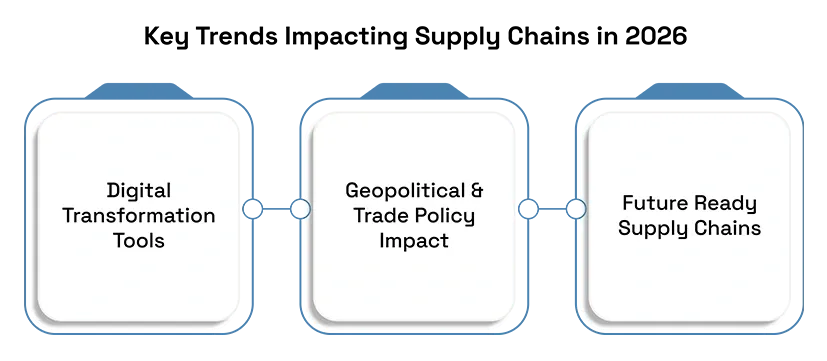
Key Trends Impacting Supply Chains in 2026
One of the most significant trends in 2026 is the shift toward regionalization and nearshoring. Companies are reducing their dependence on distant suppliers and moving production closer to key markets. This approach helps in minimizing risks, reducing transit times, and improving overall efficiency.
Sustainability is another major trend shaping supply chains. Businesses are under increasing pressure to reduce their environmental impact, leading to the adoption of greener transportation methods and energy-efficient processes. This is especially relevant in the automotive and aviation sectors, where regulatory requirements are becoming stricter.
Digital transformation continues to be a driving force. Technologies such as artificial intelligence, blockchain, and advanced analytics are being integrated into supply chain operations. These tools enhance transparency, improve forecasting, and enable better risk management.
Geopolitical factors and changing trade policies are also influencing supply chains. Businesses must stay updated with evolving regulations and adapt their strategies accordingly. This includes understanding the implications of tariffs, trade agreements, and compliance requirements across different regions.
Another emerging trend is the increasing demand for agility and flexibility. Companies are focusing on building supply chains that can quickly respond to disruptions, whether caused by economic shifts, natural disasters, or political changes. This involves diversifying supplier networks and investing in robust contingency planning.
The Rise of Intelligent and Resilient Supply Networks
From a strategic perspective, one of the most impactful developments in 2026 is the emergence of intelligent and resilient supply networks. These networks leverage advanced technologies and data analytics to create a more responsive and adaptive supply chain ecosystem.
Businesses are moving away from linear supply chain models and adopting network-based approaches that allow for better collaboration among stakeholders. This includes suppliers, manufacturers, distributors, and service providers working together in a more integrated manner.
The use of predictive analytics enables companies to anticipate potential disruptions and take proactive measures. For example, in the IT sector, companies can forecast demand for hardware components and adjust their sourcing strategies accordingly. Similarly, in the medical field, real-time data can help ensure the availability of critical equipment.
Automation is also playing a key role in enhancing efficiency. From warehouse operations to transportation management, automated systems are reducing manual errors and improving overall productivity. This is particularly beneficial for industries that require high precision and reliability, such as aviation and automotive.

Conclusion
Supply chains in 2026 are defined by resilience, innovation, and adaptability. As businesses continue to navigate an increasingly complex global environment, the ability to respond quickly to changes will be a key differentiator.
For import-export companies working across IT, aviation, medical, and automotive industries, embracing these trends is essential. By leveraging international freight services, strengthening compliance processes, and focusing on supply chain optimization, businesses can build robust and future-ready operations.
The road ahead may be challenging, but it also presents significant opportunities for those willing to adapt and innovate.
DID YOU KNOW
“For supply chain leaders, 2026 is unlikely to offer respite from the continual challenges of recent years. We expect six trends to have the potential to dominate their experience, with some reshaping overarching strategies, others enhancing the use of technology and data, and a few addressing the relentless external pressures that impact all supply chains.”
FAQs
1. What are the key supply chain trends in 2026?
Major trends include nearshoring, digital transformation, sustainability, and increased focus on agility and resilience.
2. Why is supply chain optimization important in 2026?
It helps businesses reduce costs, improve efficiency, and respond quickly to disruptions in global trade.
3. How is technology transforming supply chains?
Technologies like AI, blockchain, and analytics improve visibility, forecasting, and overall decision-making.
4. What challenges do import-export businesses face today?
They deal with regulatory complexities, changing trade policies, and the need for faster and more reliable delivery systems.
5. How can businesses build resilient supply chains?
By diversifying suppliers, adopting digital tools, and improving inventory and order management systems.