Introduction
In international trade, few concepts are more crucial than understanding Incoterms. These globally recognized commercial rules define the responsibilities of buyers and sellers regarding shipping costs, risks, delivery location, and managing requirements. While the global trade is developing rapidly, mainly with modern technology, changing supply chains, and new agreement terms remain at the core of import-export work: FOB and CIF.
Businesses working in valuable, urgent shipments of IT, aviation, medical, and automotive industries continue to depend massively on FOB and CIF. Knowing how these terms work and how they are used in 2026 and beyond is important for reducing risk, managing costs, and confirming easy global shipments.
Definition of FOB
It stands for Free on Board. Under this term, the seller is responsible for clearing goods for export and delivering them to the ship at the related port of shipment. Once the goods are loaded into the ship, charge of the shipment goes to the buyer even though the importer may not yet have physical care of the goods.
Explanation
- Creating the goods, export clearance, shipping to the delivery port, and loading them onto the ship.
- Paying for the sea shipping, insurance, unloading fees, import documentation, inland logistics, and managing risks after the goods are on board.
FOB is mainly used for ocean and inland sea shipments, mostly where buyers want control over the main logistics. For industries such as automotive manufacturing or aviation parts supply, where routing, freight rates, and carriers are mainly selected, FOB provides flexibility and negotiation control.
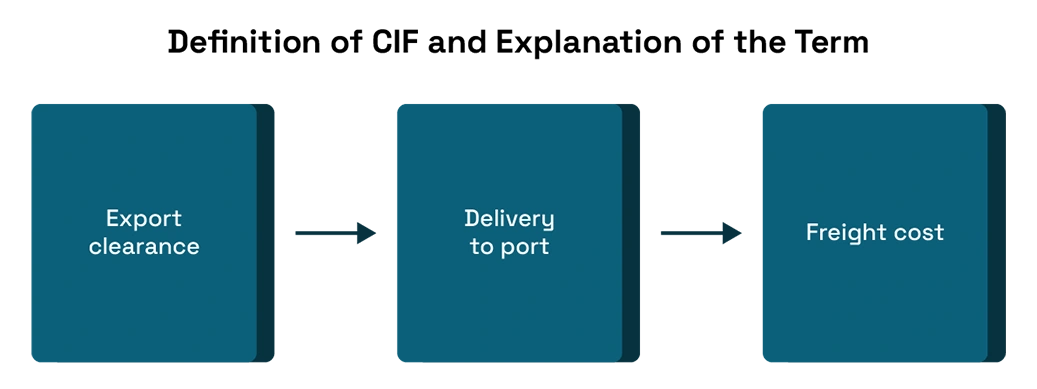
Definition of CIF and Explanation of the Term
It stands for Cost, Insurance, and Freight. Under this Incoterm, the seller is responsible not only for shipping the goods to the port of departure but also for paying for sea freight and cargo insurance up to the given port. Also, the seller pays these charges, and the risk goes to the buyer as soon as the goods are loaded on the ship at the origin port.
This structure means the seller handles:
- Export clearance
- Delivery to port
- Loading
- Freight cost
- Minimum insurance for marine transit
Meanwhile, the buyer handles destination port charges, import clearance fees, and further transportation after the goods arrive.
CIF is frequently preferred by small or growing businesses that want simplicity and predictability. In sectors such as medical equipment or IT hardware, where buyers may not have deep freight procurement capacity, CIF works as a dependable and straightforward arrangement.
How to Use FOB and CIF Incoterms in 2026
By 2026, international trade will be changed by technology integration, live tracking, an advanced approval system, and greater clarity in the supply chain. Under this term, selecting between FOB and CIF requires considering cost visibility, delivery control, trade risks, and technological systems integration.
For FOB in 2026:
- Buyers can secure better freight rates through tech-driven marketplace comparisons.
- Digital shipment visibility allows importers in IT, aviation, and medical supply chains to monitor progress from departure port to final delivery.
- Companies gain stronger cost transparency, data-based carrier selection, and fewer surprises in freight and handling charges.
For CIF in 2026:
- Sellers can partner with international freight service providers to provide predictable logistics packages.
- Buyers benefit from reduced administrative load, mainly organizations without in-house shipping teams.
- CIF still demands vigilance, as insurance may be limited to minimum coverage, requiring buyers to arrange extra protection if handling valuable automotive or aviation parts.
Both terms continue to be effective, but businesses must use them with awareness of modern digital systems, document requirements, regulatory updates, and risk controls.
Benefits of the FOB and CIF
Advantages
- Greater control for buyers: Choice of carriers, shipping routes, and cost deduction.
- Improved cost efficiency: Buyers can manage freight spend with clarity.
- Stronger logistics coordination: perfect for industries where timing and precision are important for the terms.
Disadvantages
- More responsibility on the buyer: Managing freight, customs, and insurance requires handling goods.
- Higher risk exposure: If buyers have minimal experience, missed details can lead to higher costs or shipment delays.
Conclusion
FOB and CIF remain two of the most commonly used Incoterms in global trade. As industries in IT, medical technology, automotive manufacturing, and aviation grow increasingly global and the urgency of goods, selecting the right term can hugely affect cost control, risk management, and working efficiency. In 2026 and beyond, businesses must assess their supply chain capabilities, technology tools, and internal expertise before deciding which Incoterm best supports their major trade.
DID YOU KNOW?
New York City orders 1000 units of electronic components from ABC Company in Shanghai, China. The contract specifies FOB origin for the shipment.
FAQs:
- What is the main difference between FOB and CIF?
FOB shifts shipping risk to the buyer once goods are loaded on the vessel, while CIF keeps responsibility with the seller until freight and insurance are arranged to the destination port.
- Which industries commonly use FOB and CIF?
Industries such as IT hardware, aviation components, automotive manufacturing, and medical equipment frequently use FOB and CIF due to the value and urgency of their shipments.
- Is CIF better for new or small importers?
Yes. CIF offers simplicity since the seller handles freight and insurance, making it ideal for companies without extensive logistics expertise.
- Why is FOB preferred by experienced buyers?
FOB gives buyers more control over freight rates, carrier selection, routing decisions, and cost transparency, often leading to reduced logistics expenses.
- How will FOB and CIF change by 2026?
By 2026, digital tracking, automated documentation, and smarter logistics systems will make both terms more transparent, allowing businesses to make data-driven shipping decisions.