Insight
Import licensing is a crucial component in international trade in automotive safety equipment, which is vital for the safety of vehicles and occupants. Depending on crash sensors or defensive barriers, etc., the regulatory environment of automotive safety equipment importation differs greatly across countries. Contributing to the fact that vehicle safety standards keep changing is the fact that requirements for import licensing are also changing. These regulations are necessary for manufacturers and Original Equipment Manufacturers (OEMs) that would like to export their products internationally. Within this paper, we shall offer a nation-by-nation analysis of auto safety equipment import licensing and how the same complicates matters for manufacturers unable to navigate the existing requirements.
Proper planning and understanding of each country’s import licensing rules help manufacturers avoid delays, fines, and shipment rejections. Working closely with testing agencies and compliance experts ensures all safety standards are met. Accurate documentation and certification streamline customs clearance and speed up market entry. By staying informed and proactive, OEMs can successfully navigate complex regulations and expand their global reach.
Why Automotive Safety Equipment Licensing Matters
The official permission granted by a government on the importation of goods into a country is known as the Import Licensing. In the case of automotive safety gear, the licensing procedure is the most critical part to ensure that the product meets national security requirements of high quality and safety for the environment. The various testing and certification processes that these products are made to pass before they are permitted to find their way into the market are required by regulatory authorities in various countries. The aim is to guarantee that everything is safe to the extent that consumers will be secure and the industry remains pure.
The rules involved in import licensing between two countries may differ extensively, and failure to comply may delay shipment, rejection, or payment of fines. With the automotive sector growing to be progressively internationalized, the companies that are involved and deal in automotive industry, including OEMs and suppliers, have to know the conditions of import to every country that they prefer to export to, to ensure that the trading process will be running smoothly, and the possibility of ending up in an expensive delay will be cut to a minimum.
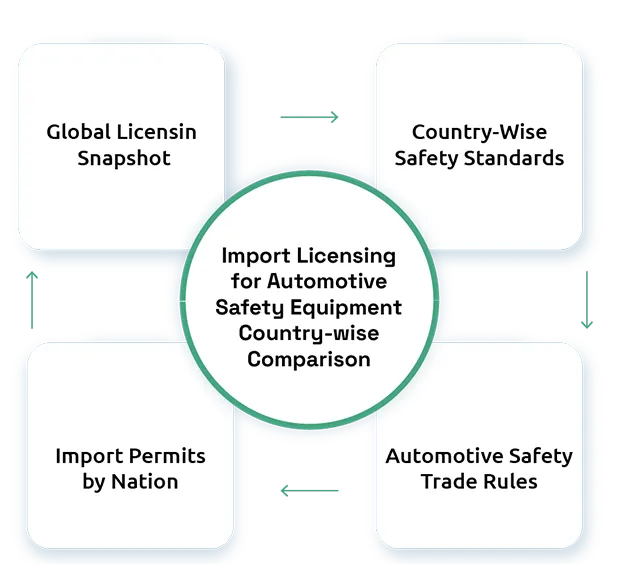
Country-Wise Comparison of import licensing for Automotive Safety Equipment
United States
As per the National Highway Traffic Safety Administration, regulations for automobile safety equipment fall under the U.S. Federal Motor Vehicle Safety Standards. When manufacturers import such safety parts, they must appear before the NHTSA. Here they should indicate that they adhere to the FMVSS and have a safety certification. Penalties could be accrued, and delays could also be due to non-compliance. Environmental requirements should also be met using safety devices such as the Clean Air Act.
European Union
The EU applies a strict regulatory regime of automotive safety implemented via the Whole Vehicle Type Approval (WVTA) framework. The importers must type-approve their safety equipment by undergoing crash tests and emission evaluation. It requires that products be labeled with a CE mark, thus indicating conformity to the EU. Any non-conformance with these requirements might lead to market ban or delays.
China
In China, the General Administration of Quality Supervision, Inspection, & Quarantine controls the importation of safety equipment, which must have the China Compulsory Certification (CCC) mark. It involves factory visits, testing of the products, and documentation by visiting authorities, such as safety reports. Failure is punishable in terms of delays and extra expenses.
India
In India, automotive safety equipment must be based on standards recognized by the Bureau of Indian Standards (BIS) & the Automotive Research Association of India (ARAI). Manufacturers must apply to the Directorate General of Foreign Trade to obtain an import license, accompanied by evidence of adherence by the manufacturer to the safety requirements. Other environmental requirements in India include emission and fuel efficiency requirements.
Japan
The Japan Ministry of Land, Infrastructure, Transport & Tourism regulates the importation of safety equipment, where one has to follow the Japanese Automotive Standards. Safety products should be inspected and checked in terms of quality. Similar to enforcing environmental laws in Japan, it covers emissions and energy efficiency in automotive parts.
Market Research Insights
It is projected that global demand for automotive safety equipment may rise rapidly because of the growing need for automobiles to be secured and enhanced legislative pressures in most countries. Based on a recent report, the automotive safety market sector is projected to grow to a mark of 60 billion by the year 2027 with a compound growth rate (CAGR) of 7.1%. The Asia-Pacific market, especially China and India, should be the fastest-growing market due to increasing vehicle manufacturing and increased demand for safety.
The hassle of the import licensing process, particularly the regulations concerning such areas as environment and safety, will, however, become an issue for manufacturers’ entry into such markets. To cope with the competition, companies must keep up-to-date with the most recent changes in rules and invest in the required certification procedures.
Conclusion
Automotive safety equipment licensing is very important in the process of products fitting in the fields of safety, quality, and environmental issues within the different markets worldwide. The regulatory framework varies among countries; hence, manufacturers should know compliance frameworks in large countries, e.g., the United States, the EU, China, India, & Japan. OEMs can simplify the import process & avoid costly delays.
It guarantees the ability to import their safety parts successfully by knowing these regulations and using the appropriate testing and certification alliances. At One Union Solutions, we assist in the complexities of global trade to make global trade a suitable and healthy business by offering bespoke solutions to ensure your company is compliant, allowing easy entry to an international market.
Did You Know,
In the European Union, the Whole Vehicle Type Approval system controls more than 90% of vehicles and vehicle parts sold there. The effective regulatory framework enables automotive products to reach the market through high standards of safety and eco-friendliness.
FAQs
1. What is the China Compulsory Certification (CCC)?
The CCC is required to sell automotive safety products in China. It ensures that vehicles and parts meet Chinese safety and environmental standards.
2. How can automakers stay compliant with import regulations?
OEMs should stay updated on local rules, work with testing agencies, and ensure all necessary certifications are in place before exporting.
3. What is the EU Whole Vehicle Type Approval (WVTA)?
The WVTA ensures that all vehicles and parts sold in the EU meet safety, environmental, and performance standards.
4. How do environmental standards affect automotive safety equipment imports?
Imported safety equipment must comply with strict global rules on emissions, energy efficiency, and sustainability.
5. How long does it take to get import licenses for automotive safety equipment?
Approval times vary by country, usually taking several weeks to months, depending on testing and certification requirements.