The Growing Debate in Medical Equipment Trade
The global demand for advanced healthcare infrastructure is rising rapidly, driven by population growth, aging demographics, and the need for better diagnostic and treatment capabilities. This surge has intensified the debate between import dependency and domestic manufacturing in the medical equipment trade. Many countries, including India, continue to rely heavily on imports for high-end medical devices due to technological complexity and established global supply networks. At the same time, there is a strong push toward strengthening local manufacturing to reduce dependency, improve accessibility, and enhance economic resilience. This dual dynamic reflects a broader global trend where nations are balancing the benefits of international sourcing with the need to build self-reliant healthcare ecosystems.
In India people are talking a lot about this now because the healthcare sector is getting bigger and the government is trying to help local companies make things. When it comes to complicated medical devices like machines that take pictures of the inside of our bodies and equipment that helps keep very sick people alive India still has to rely on other countries for these things.
Globally we see patterns. Developed markets rely on cross-border trade, for specialized medical innovations. The medical equipment trade is changing into a system. In this system import dependency and domestic manufacturing must work together. This is to ensure a supply of medical equipment, technological progress and long-term sustainability of medical equipment.
Understanding Import Dependency in Medical Equipment
Import dependency remains a defining feature of the global medical equipment trade, particularly for countries where advanced manufacturing capabilities are still developing. Many healthcare systems rely on global sourcing to access high-end technologies such as diagnostic imaging equipment, precision surgical instruments, and life-saving devices that require sophisticated engineering and continuous innovation. This reliance is largely driven by the technology gap, as producing complex medical equipment demands significant investment in research, skilled expertise, and regulatory compliance.
Cost is also very important because it is usually cheaper to buy things from places that are already making them. This is why a lot of countries get their equipment from other countries that are good at making them. Some countries are really good at making equipment and they control a lot of the production and distribution. So countries have to rely on imports which affects how they make healthcare available and affordable. Medical equipment is a part of this and countries have to think about how to get the best medical equipment.
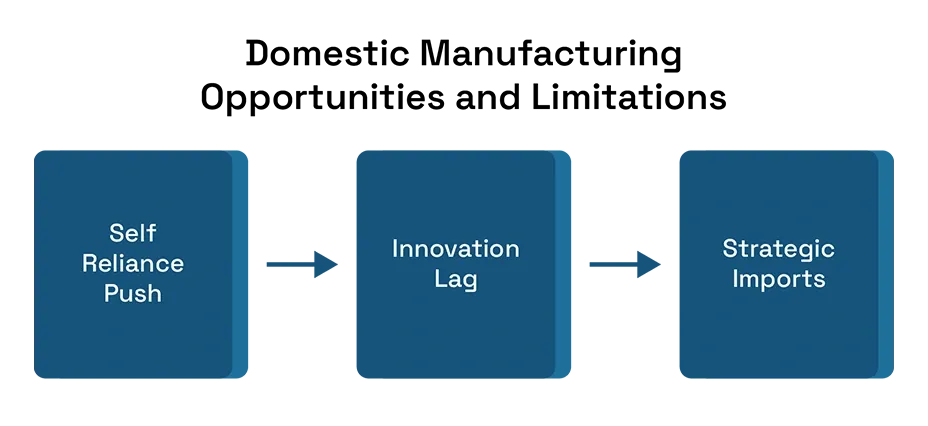
Domestic Manufacturing: Opportunities and Limitations
The growth of domestic manufacturing in the medical equipment sector reflects a strong push toward self-reliance and long-term sustainability. Governments and industry stakeholders are actively supporting local production through incentives, policy reforms, and infrastructure development, encouraging companies to invest in building manufacturing capabilities within the country.
Domestic manufacturing is not doing well as it could be. There are still some problems that get in the way. One of these problems is that people are not putting money into domestic manufacturing research and development. This means that domestic manufacturing is not coming up with ideas like it should be. Another problem is that it costs a lot of money to start a domestic manufacturing business. This makes it hard for new companies to start making things in manufacturing. Domestic manufacturing needs people to invest in research and development so that domestic manufacturing can come up with ideas and grow.
Additionally, keeping quality standards that are accepted worldwide is very important. This is especially true, for equipment that needs to be very precise and has technology. As a result, even though we are making medical equipment at home, we still need to import some. The medical equipment trade needs this strategic approach.
Role of Global Trade and Supply Chain Dynamics
Global trade is really important for the medical equipment sector. This is because things like wars and pandemics can affect how we get equipment from one place to another. When there are problems like this it can take a time to get the things we need and it can cost a lot more money. This is especially true when we only get equipment from a few places. So now companies are trying to get equipment from more places and they are trying to find ways to make sure they can still get what they need even if there are problems.
The medical trade is getting really complicated because of rules and regulations. We need to keep records and follow the rules that are always changing in different countries. When we import and export equipment we need to have good systems in place and be able to track everything in real time.

Conclusion
The future of medical equipment trade is about finding the right balance between relying on imports and making medical equipment. We still need to import because they’re very advanced and precise. If we make more medical equipment in our own country we will be safer and not have to worry so much about things going wrong from outside. Medical equipment trade is connected around the world. This way medical equipment is always available in our healthcare systems.
The healthcare industry will be strong for a time if it does things this way. If companies use people from around the world and work with people in their own country they can make supply chains that are strong and ready for what people will need from healthcare in the future. The healthcare industry will have supply chains that work well and can handle what is coming.
DID YOU KNOW
“India is currently 70–80% dependent on imported medical devices, particularly for high-end technology, despite being a top-20 global market.”
FAQS
1. What are the 4 categories of medical devices?
Medical devices are classified into four risk groups, according to the classification rules: I, IIa, IIb, and III (depending on the risk during use).
2. What is the import duty for medical devices?
In India, import duty on medical equipment generally includes a Basic Customs Duty (BCD) of 7.5% to 10%, a 5% Health Cess, and a 12% Integrated Goods and Services Tax (IGST).
3. How to import a medical device?
Application for an import permit must be submitted through the online permit system. Applications may be submitted to the Authority at least 7 days prior to shipment of medical devices. The import permit will be processed within 3 working days upon confirmation of payment.
4. Which license is required for import in India?
The primary license required for importing goods into India is the Importer-Exporter Code (IEC), a mandatory 10-digit code issued by the Directorate General of Foreign Trade (DGFT).
5. How can businesses reduce risks associated with import dependency in medical equipment trade?
Businesses can reduce risks by adopting a diversified sourcing strategy and avoiding reliance on a single country or supplier. Building strong relationships with multiple global manufacturers, maintaining safety stock for critical components, and improving demand forecasting can help ensure continuity.