Introduction
Small & medium-sized enterprises (SMEs) are going through huge pressure in 2026 as new trade rules change the global business environment. Developing tariffs, stricter import-export laws, sanctions, & converting compliance requirements are making global trade more costly & difficult for smaller businesses. Unlike many large corporations, SMEs often lack the financial strength, legal resources, & supply chain flexibility needed to quickly adapt to some policy changes. Many are experiencing delayed shipments, high costs, limited access to foreign markets, & issues in sourcing raw materials. As governments mainly adopt trade restriction measures to secure domestic industries & respond to geopolitical tensions, SMEs are dealing with managing productivity while balancing profitability & regulatory compliance in an irregular global market.
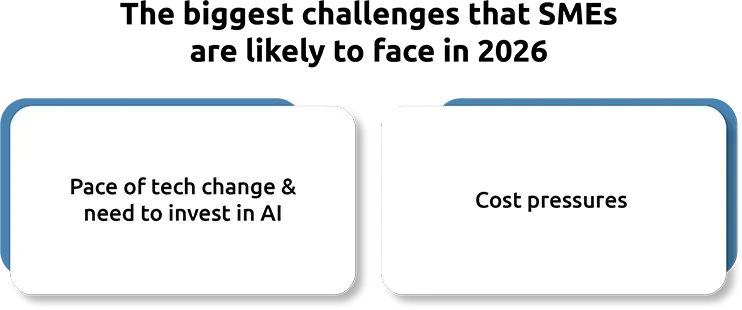
The biggest challenges that SMEs are likely to face in 2026.
1. Pace of tech change & need to invest in AI
The new world of Gen AI poses both fraud & opportunities for SMEs. For those who can adapt and adopt, there is a genuine opportunity to outperform Enterprise-scale competitors. Not only that, but AI allows an SME to scale efficiently without incurring high costs for their business.
That makes it sound easy. Foundation models are still evolving rapidly; it is difficult to know which tech will be outsourced vs owned by major technology providers, AI regulation is still uncertain, AI skills are in tight demand, and barriers are cultural as well as structural for all businesses. Many lean SMEs simply do not have the time or the budget to spend on working out the art of the possible.
SMES must find trusted partners in the AI space, consultants & tools that can facilitate the processes & agents required. It is important to remember that SMEs don’t need to deliver all AI
solutions themselves, but they should increase expectations on their third-party providers. PSA tools are adopting AI in their processes, so SMEs can benefit from the AI revolution without needing to build the automations themselves.
2. Cost pressures
Developing employment costs will still be the dominant challenge for SMEs in 2026. The Autumn budget created pressure with the National Living Wage rising again in April 2026 & younger worker rates climbing even faster, while Employer National Insurance thresholds stay frozen. The Employment Allowance uplift will help the smallest end of SMEs, but most will still feel the squeeze. The focus on updating tech to automate tasks rather than hiring additional heads will be the main focus, as well as outsourcing. It’s also important to maximise the productivity of your people, which allows businesses to automate everything from routine HR tasks to delivering targeted training programmes, helping businesses free up time, improve engagement, and create a more productive workforce.
3. Cyber security and data governance
As businesses accelerate digital adoption & AI opens the ‘surface area’ for cyber-attacks, risks for SMEs will continue to increase in 2026. Fraud actors are sophisticated and are targeting smaller firms as they know many lack dedicated security teams. The challenge is balancing resilience with cost, but security must go beyond endpoint protection or employee training to deliver active management.

4. Go-to-market in an AI world
Buyers continue to expect hyper-personalised experiences, instant responses & seamless digital journeys. AI-driven search is changing how people discover all businesses, and it is often unhelpful for SMEs who are seeing a reduction in performance from organic or paid marketing. However, while those that are reliant on ppc to drive leads may find challenges ahead in 2026, more generally, the search landscape has broadened, which may create opportunities for businesses who adapt quickly to tactics such as GEO, LLM optimisation, & increased use of social search across the customer journey. The important thing is not to just watch your organic traffic falling, but to understand how to adapt to the new world of search.
5. Global macro uncertainty
It may feel like we’ve been predicting global macro mainly for a few years now, but, unfortunately, we haven’t yet been wrong. While 2026 should be more measured in terms of price growth & economic shocks, the world still feels very uncertain when it comes to shifting alliances, the what-next on tariffs & supply chain impacts caused by geopolitical instability & climate shocks.
Conclusion
New trade restrictions in 2026 are creating a major challenging environment for small & medium-sized enterprises across global markets. From increasing tariffs & strict compliance needs to supply chain issues, cyber risks, & increasing operational costs, SMEs are being forced to adapt faster than ever before. Unlike large corporations with stronger financial reserves & global networks, smaller businesses often struggle with limited resources, restricted access to grants, & fastly changing regulatory conditions. The growth of artificial intelligence, digital transformation, & developing customer expectations is adding further pressure on SMEs to develop their operations while managing costs.
Did you know?
CAGR forecasts for Asian trade finance range from 18.6% for SSCF by 2033 to 9.8% for overall SCF by that date, according to consultancy Global Growth Insights.
FAQs
1. Why are SMEs more affected by trade restrictions than large companies?
SMEs are more vulnerable because they often have limited financial resources, smaller supply chain networks, and fewer compliance specialists. This makes it more difficult for them to adapt quickly to changing tariffs, regulations, and global trade policies.
2. How do new trade restrictions impact SME profitability?
New trade restrictions increase operational expenses through higher tariffs, shipping costs, compliance requirements, and supply chain disruptions. These rising costs can reduce profit margins and weaken business growth.
3. What are the biggest challenges SMEs face in 2026?
Some of the biggest challenges include increasing employment costs, cybersecurity risks, supply chain instability, AI adoption pressures, changing customer expectations, and global economic uncertainty.
4. How can SMEs reduce the impact of trade disruptions?
SMEs can reduce risks by diversifying suppliers, adopting digital technologies, investing in AI-powered tools, improving cybersecurity measures, and building stronger financial reserves to handle market volatility.
5. What role does technology play in helping SMEs manage trade challenges?
Technology helps SMEs automate operations, improve compliance management, strengthen cybersecurity, optimize supply chains, and enhance customer engagement through AI-driven tools and cloud-based platforms.