Non-tariff measures are becoming one of the main problems in global trade as governments produce stricter regulations, compliance requirements, & product standards across global markets. Unlike traditional tariffs, NTMs added with licensing procedures, technical standards, customs regulations, sanitary measures, environmental policies, & import restrictions that can mainly complicate cross-border trade operations. While these measures are often developed to protect customer safety, national security, & domestic industries, they are also increasing operational costs, delaying shipments, & creating compliance issues for businesses worldwide. As global supply chains become more updated & trade regulations continue to develop, companies are facing growing pressure to adapt quickly to difficult & mainly changing global trade requirements.
What are non-tariff measures?
Non-tariff measures are policy measures that can mainly affect traded goods by changing their quantities, prices, or both. The purposes of non-tariff measures include the security of public health or the environment, & may suggest information, compliance, & procedural costs. These measures can apply to both imports & exports and are divided into categories. The United Nations Conference on Trade and Development provides a full list of non-tariff measures & their definitions.
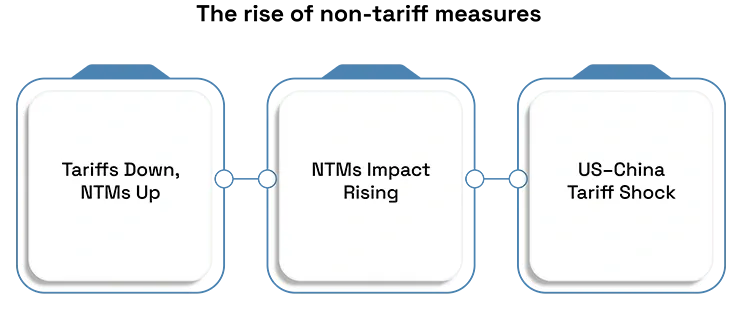
The rise of non-tariff measures
During the past two decades, applied tariffs in the Asia-Pacific region have been limited. The number of non-tariff measures & technical trade barriers has risen significantly. Both in relative and absolute terms, the impact of NTMs tariffs as an impediment to trade has increased. While the higher tariffs imposed by the United States & China during the past two years have made headline news, the rising importance of NTMs as barriers to trade at the regional & global levels is expected to continue. A key concern is that trade tensions evolve from existing relatively transparent tariff wars to discriminatory implementation of NTMs, the impact of which is much more difficult to assess and predict.
Non-tariff measures versus non-tariff barriers
Non-tariff barriers are the policies that induce an adverse impact on trade due to the specific discriminatory & protectionist intent. Unlike for NTMs, there is no widely accepted definition of NTBs. Whether an NTM is an NTB largely depends on the intent of the regulation. NTMs are mainly put in place to serve public interest, Classifying an NTM as an NTB is a rather contentious issue since trade partners are likely to disagree on whether a particular NTM is discriminatory or has a protectionist intent. Technical NTMs are, de facto, not NTBs unless they have been successfully challenged through the WTO dispute settlement process, which is lengthy & expensive. It is generally seen that some technical NTMs are indeed discriminatory/more trade restrictive than necessary & sometimes used by governments as a trade policy. Non-technical NTMs are mostly NTBs. Governments can be creative and use virtually any NTM category as an NTB. NTBs could be targeted for removal, whereas other NTMs, subject to regulatory review, could either continue to exist or be replaced by more effective & efficient policy measures.
How Non-Tariff Measures Are Affecting Global Supply Chains
Non-tariff measures are increasingly disrupting global supply chains by creating delays, increasing documentation requirements, & complicating cross-border logistics. Businesses now face stricter customs inspections, certification procedures, product testing requirements, & country-specific compliance standards that slow the movement of goods across global markets. These challenges are forcing companies to diversify suppliers, shift toward regional sourcing strategies, & invest in more usable supply chain operations. For industries that depend mainly on just-in-time manufacturing & global supplier networks, developing NTMs is increasing operational uncertainty & mainly developing trade costs.

Conclusion
Non-tariff measures are becoming one of the most important challenges in global trade as governments mainly depend on regulations, technical standards, & compliance requirements instead of past tariffs. These measures are mainly introduced to protect public health, environmental sustainability, & national security; they also create major operational & financial risks for businesses engaged in global trade. Developing documentation requirements, customs verification, certification procedures, & country-specific regulations are slowing supply chains, increasing trade costs, & creating uncertainty across global markets.
Did you know?
Global tariffs on exports increased sharply in 2025 by 10 per cent for developed countries, 16 per cent for developing countries, and 18 per cent for least developed countries (LDCs).
FAQ
1. What are non-tariff measures in global trade?
Non-tariff measures are regulations & policies other than tariffs that affect international trade. These include licensing requirements, product standards, customs procedures, and environmental regulations.
2. How are non-tariff measures different from tariffs?
Tariffs are direct taxes imposed on imported or exported goods, while non-tariff measures involve regulatory requirements and restrictions that influence trade without directly imposing taxes.
3. Why are non-tariff measures increasing globally?
Non-tariff measures are increasing due to rising concerns related to consumer safety, environmental protection, national security, product quality standards, and geopolitical tensions between countries.
4. How do non-tariff measures affect global supply chains?
NTMs can delay shipments, increase documentation and compliance costs, complicate customs procedures, and create sourcing challenges for businesses operating across multiple countries.
5. Which industries are most affected by non-tariff measures?
Industries such as automotive, electronics, and manufacturing are among the most affected because they rely heavily on international trade and regulatory approvals.