Developing tariff issues mainly change global management by enhancing raw material costs, problematic supply chains, & managing geographic relocation. While designed to secure domestic industries, these growing duties compress profit margins, force operational transformation, & drive a structural transition toward regionalized or localized production hubs.
Understanding Tariff Barriers
Tariff issues are taxes or duties charged by a government on imported or exported goods. They are mainly used as an industry protection measure to enhance the cost of foreign products, making domestic alternatives more competitive, or to generate revenue for the state.
What Are Tariffs?
Tariffs are a type of trade barrier that makes imported products more costly than domestic products. Tariffs typically come in the form of taxes or duties applied to importers, & they’re mainly passed on to customers. They’re mainly used in international trade as a protectionist measure. President Trump developed a 35% tariff on imports from Canada as part of his sweeping tariff reforms, in addition to a 10% tariff on energy resources.
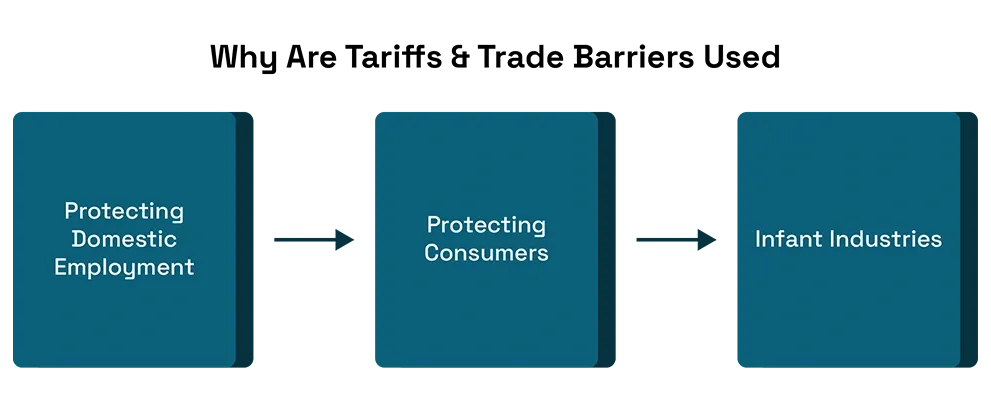
Why Are Tariffs & Trade Barriers Used?
Tariffs are often created to protect infant industries and developing economies, but are also used by more advanced economies with developed industries. Here are the top reasons tariffs are used.
Protecting Domestic Employment
The levying of tariffs is often highly politicized. The possibility of increased competition from imported goods can threaten domestic industries. These domestic companies may fire workers or shift production abroad to cut costs, which means higher unemployment and a less happy electorate. The unemployment argument often shifts to domestic industries complaining about cheap foreign labor, and how poor working conditions and lack of regulation allow foreign companies to produce goods more cheaply. In economics, however, countries will continue to produce goods until they no longer have a comparative advantage (not to be confused with an absolute advantage).
Protecting Consumers
A government may levy a tariff on products that it feels could endanger its population. For example, a country may place a tariff on imported beef if it thinks that the goods could be tainted with a disease.
Infant Industries
The use of tariffs to protect infant industries can be seen in the Import Substitution Industrialization (ISI) strategy employed by many developing nations. A developing economy’s government will levy tariffs on imported goods in industries in which it wants to foster growth.
This increases the prices of imported goods and creates a domestic market for domestically produced goods while protecting those industries from being forced out by competitive pricing. It decreases unemployment and allows developing countries to shift from products to finished goods. Criticisms of this sort of protectionist strategy revolve around the cost of subsidizing the development of infant industries. If an industry develops without competition, it could wind up producing lower-quality goods, and the subsidies required to keep the state-backed industry afloat could sap economic growth.
National Security
Barriers are also employed by developed countries to protect certain industries that are deemed strategically important, such as those supporting national security. Defense industries are often viewed as vital to state interests and often enjoy significant levels of protection. For example, while both Western Europe and the United States are industrialized, both are very protective of defense-oriented companies.
Who Benefits From Tariffs?
The benefits of tariffs are uneven. Because a tariff is a tax, the government will see increased revenue as imports enter the domestic market. Domestic industries also benefit from a reduction in competition, since import prices are artificially inflated. Unfortunately for consumers, both individual consumers and businesses, higher import prices mean higher prices for goods. If the price of goods is inflated due to tariffs, individual consumers pay more for products, & businesses pay more for goods that they use to make goods.
The effect of tariffs and trade barriers on businesses, consumers, and the government shifts over time. In the short run, higher prices for goods can reduce consumption by individual consumers and by businesses. During this period, some businesses will profit, and the government will see an increase in revenue from duties. In the long term, these businesses may see a decline in efficiency due to a lack of competition and may also see a reduction in profits due to the emergence of substitutes for their products. For the government, the long-term effect of subsidies is an increase in the demand for public services, due to increased prices.

Conclusion
Increasing tariff issues are mainly changing the framework of global manufacturing by increasing production costs, issues in international supply chains, & accelerating the shift toward regionalized management ecosystems. Although tariffs are often developed to secure domestic industries, update national security, & minimizes dependence on foreign suppliers, they also create significant operational & financial challenges for management operating in heavily connected global markets.
Did you know?
Global economic growth is projected to remain subdued at 2.6% in 2026, with developing economies excluding China slowing to 4.2%.
FAQs
1. What are tariff barriers in global trade?
Tariff barriers are taxes or duties imposed by governments on imported or exported goods. They are used to protect domestic industries, regulate trade, generate government revenue, or address national security concerns.
2. How do rising tariffs affect global manufacturing?
Rising tariffs increase the cost of raw materials, components, and imported goods, which raises production expenses for manufacturers. They can also disrupt supply chains, reduce profit margins, and force companies to relocate manufacturing operations.
3. Why are countries increasing tariff barriers in 2026?
Countries are increasing tariff barriers due to geopolitical tensions, economic protectionism, supply chain security concerns, and efforts to strengthen domestic manufacturing industries and reduce dependence on foreign suppliers.
4. Which industries are most affected by tariff barriers?
Industries heavily dependent on global supply chains are most affected, including automotive, electronics, semiconductors, renewable energy, consumer goods, and industrial manufacturing sectors.
5. How do tariffs impact consumers?
Tariffs often lead to higher prices for imported products and goods that rely on imported materials. Businesses may pass these additional costs on to consumers, contributing to inflation and reduced purchasing power.