

Overview
Global trade has become increasingly interconnected, but with that growth comes greater regulatory pressure. Export compliance is no longer limited to exporters; it now requires multiple brokers, such as freight forwarders, customs brokers, and third-party intermediaries in the supply chain. While these allow faster international freight services and easy customs clearance, they also introduce stages of responsibility during shipments. Exporters frequently assume that automating processes results in automatic approval, but this can create problems. Regulatory authorities still hold the main exporter responsible for following export control rules, accurate categorization, and documentation. The involvement of intermediaries can create gaps in communication, inconsistent data management, and misunderstandings about who owns approval decisions. As organizations expand globally and rely on these services, enforcing export compliance becomes more challenging in global trade.
Compliance Risks for Global Logistics Intermediaries
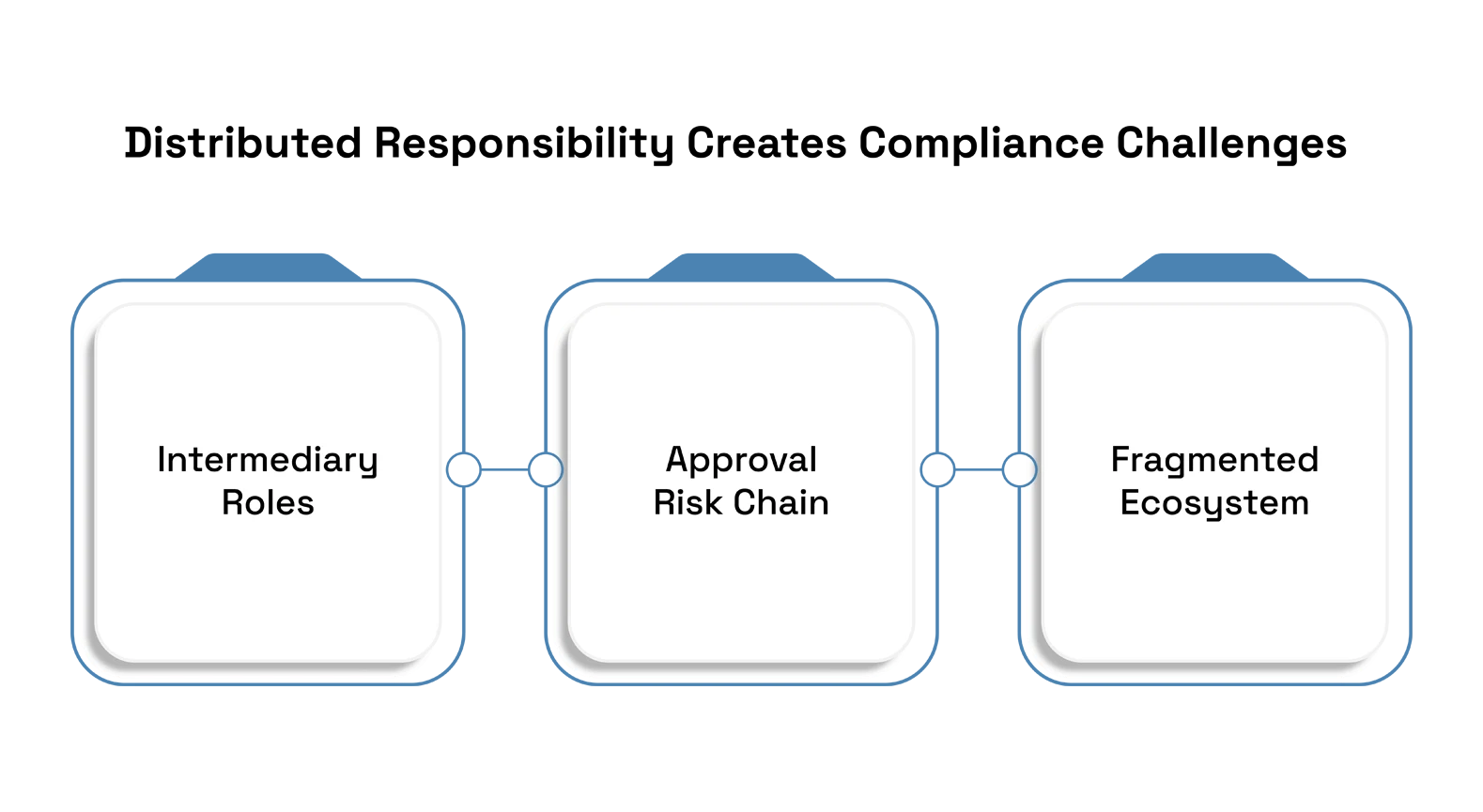
Distributed Responsibility Creates Compliance Challenges
Intermediaries play an important role in logistics work, documentation preparation, and shipment execution. Also, when multiple brokers manage shipment data, approval risks increase. Freight forwarders may depend on information provided by exporters, while support intermediaries check regulatory details. This dependency frequently leads to incomplete checks. Incorrect product categorizations under an HS code or HTS harmonized tariff schedule can pass unnoticed if each party supports that the other has checked the information. Similarly, shipment terms defined under Incoterms, such as DAP or DAPs, may change working responsibility but do not remove legal export problems from the exporter of record services.
Technological decentralization and Data barriers
Many organizations depend on separate inventory and order management systems, broker portals, and documentation tools. Without integration, data inconsistencies grow. Even organizations investing in the best trade compliance software for import export rules may struggle when intermediaries work outside the same digital ecosystem.
Export Compliance Problems Cannot Be Assigned to Freight Forwarders
Operational Support vs. Legal Accountability
A common misconception is that freight forwarders can assume full compliance responsibility. Businesses frequently ask questions like “Can a freight forwarder be an exporter of record?” The answer depends on the administration, but in most cases, regulators still expect exporters to maintain control. Freight forwarders simplify transportation planning, documentation submission, and coordination of international freight services. However, they typically work based on instructions provided by the exporter. If licensing information, valuation data, or restricted party screening results are incorrect, dependability frequently returns to the exporting company.
Misunderstanding Exporter and Importer Roles
Confusion also arises between the exporter of record services and the importer of record service arrangements. While intermediaries may provide administrative support, organizations must clearly define who holds regulatory responsibility. Giving tasks without governance systems can result in seizure, shipment holds, or penalties. Export compliance execution becomes challenging when documentation is prepared by one party, reviewed by another, and submitted by a third organization.
Customs Brokerages Complicate Export Compliance Enforcement
Documentation Control Challenges
Customs brokers are necessary for customs clearance and regulatory compliance, yet their requirement introduces another layer of interpretation. Businesses frequently wonder whether a customs broker can handle both import and export documentation. While brokers may support both processes, their authority is mainly limited to filing information provided by clients. If exporters provide incomplete or outdated data, brokers may unknowingly submit an inaccurate statement. Regulators, however, still investigate the originating company rather than the intermediary of shipments.
Regulatory Interpretation Differences
Different brokers may interpret trade rules differently, mainly when working with preferential programs or changing tariff systems. Misapplication of programs like the Generalized System of Preferences (GSP) or misunderstanding shipment terms can create approval issues. Also, brokers frequently focus on transaction efficiency rather than long-term trade strategy. Their priority is clearing shipments quickly, whereas exporters must confirm regulatory consistency across all shipments.
Conclusion
Brokers and intermediaries are required for modern global trade, but their participation makes export compliance enforcement difficult by supplying working control across multiple suppliers. Freight forwarders, customs brokers, and third-party service providers improve efficiency, yet they also introduce communication gaps, data systems, and unclear responsibility. Even when using exporter of record services, importer of record service arrangements, or advanced logistics partners, organizations must have internal problems, standardized processes, and combined approval processes.
DID YOU KNOW?
Fines are significantly increased for regulatory violations, where the fine will increase from 70% to 250% of the value of the goods.
FAQs:
1. Can a freight forwarder be an exporter of record globally?
In most cases, freight forwarders provide working support but do not give full legal responsibility. Regulatory authorities typically hold the original exporter responsible for export compliance, licensing, and documentation accuracy.
2. Who is responsible for export compliance when intermediaries are required?
The exporter of record remains mainly responsible, even when customs brokers or logistics partners prepare or submit documentation on their behalf.
3. Do customs brokers handle both import and export compliance?
Customs brokers can assist with documentation and filings, but they usually depend on information provided by exporters. They do not replace the exporter’s legal compliance obligations.
4. Why do intermediaries create export compliance risks?
Multiple parties handling shipment data can lead to communication gaps, inconsistent product classification, and unclear ownership of agreement decisions.
5. How can companies reduce export compliance issues with brokers?
Organizations should implement standardized processes, data systems, internal compliance oversight, and clear responsibility definitions across all logistics partners.


