Introduction
Infrastructure for liquid cooling is becoming more and more important as AI, high-speed computing, and current data centers use more effective CPUs that produces more heat. For high-density servers, liquid cooling systems can remove heat more efficiently and handle larger processing loads than typical air cooling. In 2026, improved data center cooling will become an important part of new infrastructure planning due to the sudden growth of AI data centers, specifically in markets like India. Importing cooling equipment, however, involves more than just shipping goods between countries. Before shipping, businesses must check import documents, environmental rules, safety rules, product standards, HS code classification, and customs rules. It is also possible for requirements to change between countries. Companies may avoid customs delays, unexpected costs, and issues during clearance by following to global trade compliance.
Understanding Liquid Cooling Infrastructure for Data Centers
Liquid is used in data center liquid cooling for removing heat from CPUs, GPUs, servers, and other high-performance devices. Because AI and high-density computing systems produce a lot of heat, it is growing more important. Immersion cooling use particular liquid to cool server parts directly, and direct-to-chip cooling uses cooling plates placed on CPUs to remove heat. Coolant flow, temperature, & pressure are all handled by a coolant distribution unit (CDU). Heat exchangers remove heat from the system while pumps move the liquid. Coolant is shipped and delivered to different servers and racks using manifolds and pipes. The connection between the liquid cooling system and IT equipment is supported by cooling racks. To help identify issues fast, control and monitoring systems keep track on temperature, pressure, liquid flow, and equipment efficiency. When combined, these factors improve heat handling and allow current data centers to safely and efficiently handle powerful computing equipment.
Why Liquid Cooling Is Growing in Global Data Centers
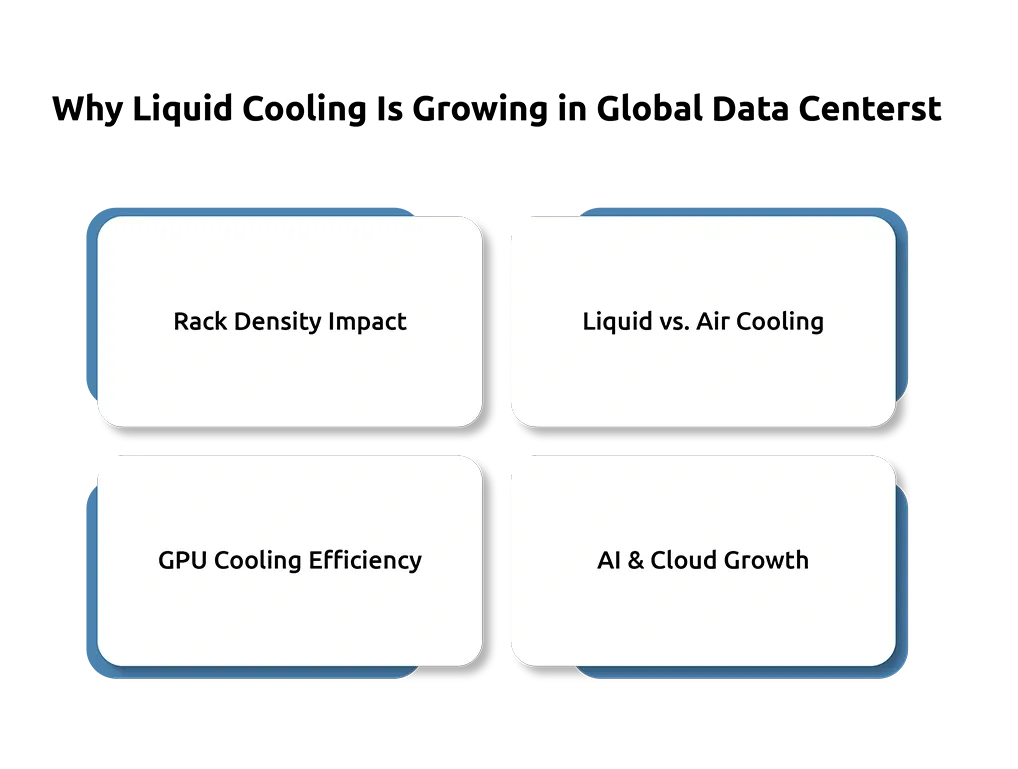
Modern data centers are handling more difficult task load than in the past, which pushes up demand for liquid cooling. Strong CPUs and GPUs, which produce a lot of heat, are required for high-performance computing, cloud services, & AI applications. As a result, AI data center cooling is becoming an important part of data center structure. Additionally, the need for improved cooling is increased by high-density computing. Higher rack power results in each rack producing more heat, and more computers and GPUs are being packed into smaller spaces. GPU cooling using liquid systems can help keep equipment temperatures fixed and remove heat directly. This can help data centers work more effectively and support improved heat management.
Another cause for the change is the use of energy. When properly developed, liquid cooling may increase cooling efficiency and remove the need for some traditional air-cooling equipment. Additionally, the growth of edge data centers pushes up the need for small, efficient cooling systems that allow computing for near customers. Liquid cooling is becoming an important option for modern data center infrastructure as AI, cloud computing, and other high-end applications continue to grow.
Key Components Imported for Liquid Cooling Systems
Different kinds of cooling equipment may be required by companies importing liquid cooling parts for data centers. Heat pumps that transfer heat away from the equipment, cooling plates that remove heat from CPUs and GPUs, and cooling pumps that transport liquid across the system are examples of common products. Additionally, they might import pipes and fittings, sensors, control units, rack cooling systems, CDUs (Coolant Distribution Units), and coolant systems. These hardware parts for data center cooling work together to control heat and maintain constant equipment performance. Every product may have different technical details and conform to different regulatory requirements and customs classifications. Therefore, before delivering cooling pumps, cooling plates, heated exchangers, & other equipment across borders, companies should verify the correct HS code, product standards, documents, and import rules.
Global Customs Compliance for Liquid Cooling Equipment Imports
Businesses must follow to the destination country’s customs compliance rules when importing liquid cooling equipment. Choosing a proper HS code for cooling equipment is the first step because it helps customs officials in identifying the product and carrying out the proper import taxes and charges. It should be made clear in the product details what the equipment is and how it is used. Additionally, since the country of origin and customs value might have an affect on import rules and duty calculations, businesses should supply correct data. For a successful customs clearance process, complete customs documents is also important. A bill of lading or airway bill, packing list, commercial invoice, and customs declaration are types of common documents. Import permits or other approval may also be required for some goods or countries. Importers must make sure that every detail is the same across all documents & check the relevant import rules before delivery. Customs delays, extra expenses, shipment holds, or penalties may result from incorrect HS classification, incorrect product data, undervalue, & missing documents. Businesses can import liquid cooling systems across borders with fewer compliance issues when they are properly prepared.

Conclusion
The requirement for efficient liquid cooling systems and reliable data center liquid cooling is growing due to the growing use of AI and high-density computing. However, complete international compliance is needed when importing data center cooling equipment between countries. Companies must check product documents, check HS codes, supply correct documents, check environmental rules,, and follow to import rules in every country. Companies can avoid customs delays, extra costs, and other issues by making sure of proper import compliance before exporting. Liquid cooling infrastructure imports become more reliable and smooth with a well-planned strategy.
Did you know
The global liquid cooling systems market size was valued at USD 13.4 billion in 2025 and is projected to grow from USD 14.4 billion in 2026 to USD 28.8 billion by 2033, at a CAGR of 10.4% from 2026 to 2033.
FAQ
Why is liquid cooling important for data centers?
It helps manage the high heat produced by AI servers, GPUs, and high-density computing systems.
How can businesses simplify liquid cooling equipment imports?
Businesses can check import rules early, use the correct HS codes, prepare complete documents, & work with experienced customs or IOR service providers.
What documents are needed to import liquid cooling systems?
Common documents include a commercial invoice, packing list, bill of lading or airway bill, & customs declaration. Some countries may require additional documents.
Are liquid cooling components classified under the same HS code?
Not always. Different parts may have different HS codes based on their type, function, and specifications.
How can companies reduce import compliance risks?
They can verify HS codes, check country-specific rules, prepare accurate documents, & review product certifications before shipping.