
Introduction
The European Union and the United States have gained a new trade agreement that launches a 15% tariff on European exports to America. This development has mixed discussions across global markets, changing the dynamics of international export regulations and the global supply chain services sector. The new system aims to balance trade relations, protect local industries, and create a fair environment for both sides, but it also introduces new challenges for exporters and logistics providers working between the two major economies.
How Businesses Are Affected After the EU and the US Agree on a Trade Deal, After the US Imposed a 15% Tax on European Exports
Businesses involved in trade between Europe and the United States are now adjusting to the new reality of higher tariffs. The 15% tax affects industries ranging from automotive and aviation to medical devices and IT equipment. For organizations depending on DDP shipping and IOR services, agreement and cost control have become top priorities. Exporters are increasingly relying on Comprehensive import-export support and Customs clearance support to navigate the changing landscape. The trade deal has also highlighted the importance of understanding Incoterms and the HTS Harmonized Tariff Schedule classifications to confirm accurate valuation and tariff calculation on goods. While the tariff may add short-term costs, it also encourages businesses to strengthen their import export registration and documentation accuracy to maintain smooth operations in the developing market.
How Businesses Are Shifting Supply Chains Beyond Europe?
Because of the 15% tariff, companies are reducing their dependence on Europe for export to the US. They are changing where they produce and assemble goods to manage rising costs. Many businesses are moving operations to countries like Mexico, Vietnam, and other Asian regions. This approach, known as “nearshoring,” helps them trade with countries that have better relations with the US. It allows companies to avoid high tariffs and stay competitive in pricing. Businesses are also finding new suppliers instead of relying on one region. Asian countries are becoming key hubs due to lower costs and easier trade. Overall, companies are now using different locations for their supply chains to reduce problems and stay flexible.

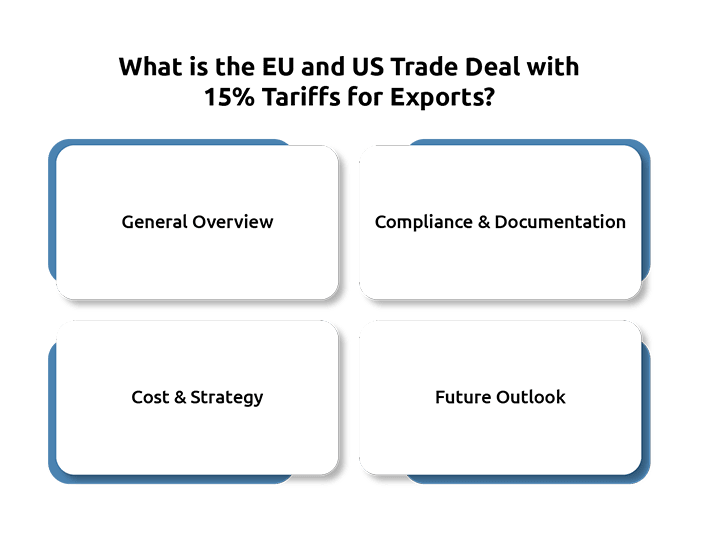
What is the EU and US Trade Deal with 15% Tariffs for Exports?
The new EU–US trade deal begins with structured rules to address long-standing disputes and promote mutual transparency in trade methods. Under this agreement, the US will apply a 15% tariff on specific categories of European exports, including automobiles, machinery, and certain medical goods. The deal aims to coordinate trade policies, promote innovation, and increase cooperation on technology exports. For organizations engaged in the import and export business, this agreement shows the requirement for detailed documentation, adherence to the HS code and HTS Harmonized Tariff Schedule, and strategic use of Importer of Record services to confirm regulatory approval. Many exporters are now reevaluation their cost systems and logistics plans to minimize the impact of tariffs on profitability.
Key Terms of the Agreement with the EU and the US with 15% Tariffs for European Exports to America
The trade agreement’s key terms include:
- A 15% tariff on select European exports entering the US market.
- Increased collaboration on International export regulations and trade monitoring.
- Provisions for transparency in export customs brokerage and value declaration.
- The establishment of a review mechanism for dispute resolution.
- Encouragement for businesses to adopt standardized Incoterms and accurate HS code classification to confirm agreement.
This agreement not only redefines tariff systems but also strengthens accountability among importer and exporter businesses. For organizations operating within both trades, understanding these terms is necessary to improve global supply chain services and maintain competitiveness in cross-border trade.
The Imposition of a 15% Tax on European Exports Will Affect Exporters of the EU
The 15% tax will have a significant impact on European exporters, particularly in high-value sectors such as automotive, medical devices, and advanced electronics. Exporters may face increased costs, longer clearance times, and the requirement for special IOR services and Export customs brokerage to guide the updated rules. Organizations that integrate Comprehensive import-export support and Customs clearance support into their operations can reduce these challenges more effectively. Also, businesses with strong import export registration and a clear understanding of International export regulations will be better equipped to adjust pricing strategies, manage approval risks, and maintain trade access despite higher tariffs.
Conclusion
The recent EU–US trade deal marks a huge change in cross-border trade. While the 15% tariffs may initially strain exporters, they also present an opportunity for businesses to modernize their import and export business models, strengthen agreements, and increase efficiency through better logistics and global supply chain services. By using solutions such as Importer of Record services, DDP shipping, and expert export customs brokerage, organizations can adapt to developing trade systems and maintain a competitive edge in one of the world’s most crucial trade corridors.
DID YOU KNOW?
Under the deal, the US imposed a 15% tax on European exports, particularly automobiles, while exempting aircraft and raw materials. In return, the EU agreed to increase imports of AI chips and pledged to invest $600 billion in the US.
FAQs:
What is the new EU–US trade deal about?
The new EU–US trade deal introduces a 15% tariff on selected European exports to the United States, including automobiles, machinery, and medical equipment. It aims to balance trade relations, promote transparency, and strengthen cooperation in global supply chain management.
Which industries are most affected by the 15% tariff on European exports?
Industries such as automotive, aviation, medical devices, and IT equipment are most impacted. Exporters in these sectors face higher costs, stricter documentation requirements, and longer customs clearance times.
How can businesses reduce the impact of the 15% tariff?
Businesses can minimize tariff impacts by using Importer of Record (IOR) and DDP (Delivered Duty Paid) services, optimizing HS code classifications, and ensuring compliance with Incoterms and international trade documentation.
What are the key terms of the EU–US trade agreement?
The deal includes a 15% tariff on select goods, increased trade monitoring, transparency in customs declarations, a dispute resolution system, and encouragement for standardized Incoterms and HS code use.
How does the 15% tariff affect global supply chain services?
The tariff introduces new challenges for logistics providers, increasing the demand for customs brokerage, import-export support, and strategic supply chain planning to ensure smooth cross-border trade operations.