Insight
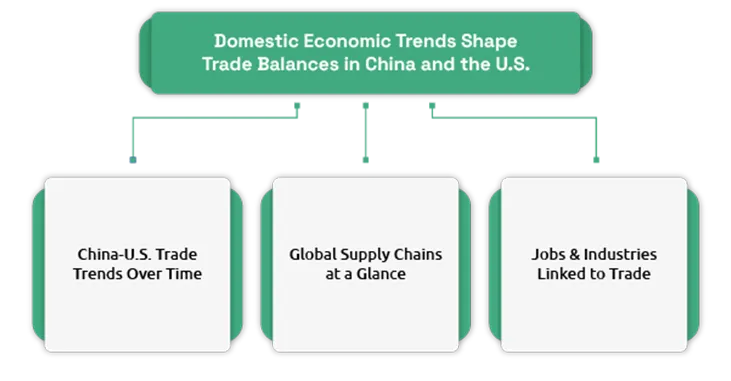
In the current globalized world, international policies only partly affect trade balances in countries like China and the USA, as their state are strongly dependent on domestic economic tendencies. Both states are global market leaders; their economies greatly influence industries such as aviation, medical equipment, IT/ data centers, and automobile equipment. The role of domestic processes, including economic growth, industrial production, and domestic consumption, in determining the trade balances is thus critical to understanding the overall dynamics of international trade.
The interaction between China & the U.S. has long been marked by the fact that both countries are the largest producers and consumers in the entire world. The trade balances in both countries are determined by the demand for imported products and services according to the trends in their economies. For example, the ability to produce and develop infrastructure, including low-level technologies in these states, varies, which impacts the levels of imports and exports, especially in such high-value segments as medical equipment, IT/data center devices, aircraft parts, and automobile production.

Domestic Economic Trends and Their Impact on Trade Balances
An economy’s internal balance is decisive in a country’s trade. When there is a robust domestic economy, the production output is high. There is the development of technology in a particular country, and there will be less of a need for imports since the local industries will be capable of fulfilling the domestic demand. On the other hand, the weak performance of the domestic economies can result in more imports to cover the gap in production capacities.
The U.S. economy at a domestic level, automation in the manufacture of automobiles, and an expansion in the number of data centers have changed the demand for foreign-made equipment. As the industries grow and develop, there is a tendency in the U.S. to switch to net-exporter countries, mainly in sectors such as IT and aviation equipment. Nevertheless, producing high-tech equipment and parts requires some dependence on certain imports, and companies like China have lower production prices.
The U.S.-China Trade Relationship: Impact on Sectors
In many cases, China and the U.S. trade has been a political and economic debate in the U.S., especially in the medical equipment, IT/data center, and aviation industries. The U.S. is a major importer and exporter of these sectors, and among the trading partners of the U.S. is China. Having checked the balance in these major industries, some domestic factors are involved. In the same light, the U.S. medical equipment market depends on medical equipment components mostly imported into the country from China, producing some of the more affordable and high-volume medical equipment used in medical practice. Nevertheless, another large part of the U.S. exports are high-quality medical devices and diagnostic equipment, which remain in demand worldwide as healthcare standards are improving in various developing nations.
Share of Exports and Imports to Domestic GDP
The level of export and import components of the GDP is another important aspect of measuring how internal economic dynamics influence trade balances. In the case of China and the U.S., the export-import situation plays an important role in the health of the entire economy, particularly industries such as IT, medical devices, and the auto industry.
The attempt by the government of China to transition to an independent economy, more appropriately in industries such as aviation and medical equipment, has created a free export-import balance in China, which has created an imbalance in the imports and exports of the country. Even though China still needs to import advanced technologies and items used in the IT industry, it can now supply itself with medical equipment and automobile parts.
Conclusion
In today’s interconnected trade environment, understanding how local economic trends affect global trade balances is necessary for organizations. Import duties and tariffs continue to shape how nations such as China and the U.S. manage their flow of goods across borders. As industries grow, specifically in IT, medical, aviation, and automotive sectors, effective supply chain management, warehousing, and dependable warehousing and distribution services become important to maintaining trade and reducing costs. Businesses that align their logistics plans with these economic variables gain a competitive edge in global trade.
Monitoring economic shifts helps businesses anticipate changes in demand, tariffs, and trade policies. Strong logistics planning reduces disruptions caused by regulatory or market fluctuations. Efficient warehousing and distribution improve inventory control and delivery speed. Together, these strategies support stable operations and long-term global trade success.
Did You Know,
According to a 2023 report by the World Bank, the trade in IT and medical equipment between the U.S. and China accounts for over $200 billion annually, with China being a key supplier of components for U.S. data centers and medical machinery.
FAQs
What are the impacts of domestic economic patterns on trade balances?
Domestic economic trends such as production capacity, technological growth, and consumer demand influence how much a country imports and exports, directly affecting its trade balance.
Which U.S. sectors are most affected by trade balances with China?
The IT, medical equipment, and aviation sectors are among the most affected. These industries import many components from China while exporting high-value products globally.
Why is China reducing its dependence on imports?
China is reducing import dependence by increasing domestic production, especially in industries like aviation, IT, and medical equipment, as part of government-led industrial growth plans.
What impact do tariffs have on trade balances?
Tariffs increase the cost of imported goods, which can reduce demand for foreign products and encourage the use of domestically produced alternatives, affecting the trade balance.
Does technology play a role in shaping trade balances?
Yes. Technological advancements improve production efficiency, reduce reliance on imports, and strengthen a country’s export competitiveness.