Introduction
The air cargo industry is undergoing a significant technological transformation in the way shipments are documented and tracked. Manual paperwork, which has long been an issue in logistics, is now upgraded by automation systems that increase efficiency, reduce issues, and improve approval. With the growing complexity of import export documentation, knowing Incoterms, Delivered Duty Paid service requirements, and Importer of Record responsibilities, businesses are increasingly changing to AI and Robotic Process Automation to simplify air cargo work.
The Role of AI in Air Cargo Documentation
Artificial Intelligence is changing air cargo documentation by allowing automated data extraction, AI verification, and predictive analytics. AI-powered systems can read and clarify cargo manifests, customs declarations, and HS code categorization with impressive accuracy. These technologies help businesses adhere to difficult regulations, including the Generalized System of Preferences, harmonized tariff schedules code, and import duties and tariffs, while also confirming that logistics work remains effective.
What is a Cargo Manifest?
It is a complete document for all goods shipped on a specific aircraft, detailing their origin, destination, and description. It is working as an important source for customs officials, carriers, and logistics providers, confirming agreement with local and international trade regulations. Accurate cargo manifests are necessary for correctly applying Incoterms, determining DAP or DDP service issues, and calculating applicable import duties and tariffs, which can directly affect an importer’s or exporter’s responsibilities.

Challenges with Cargo Manifest Data Extraction
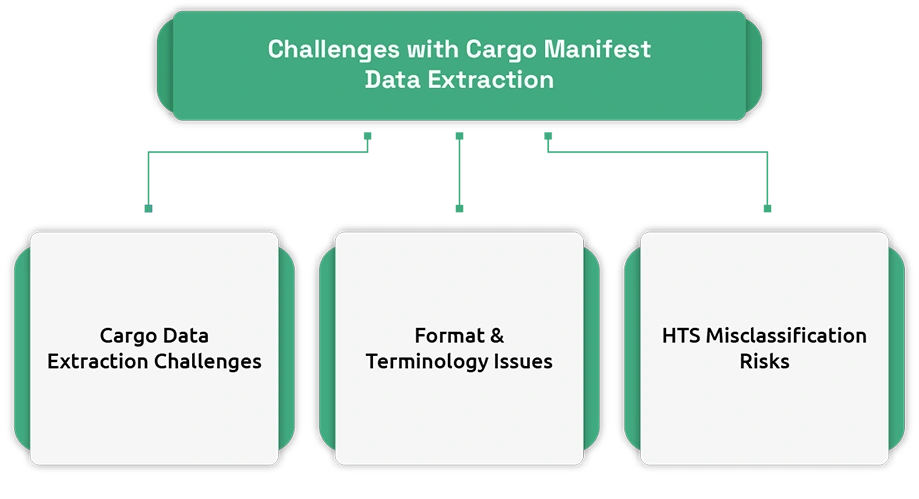
Extracting data from cargo manifests and related customs declarations is frequently a long and unreliable process. Variations in formats and inconsistent terminologies can lead to variations that interrupt international freight services. Manual processes struggle to manage the growth and difficulties of modern logistics, leading to delays in last-mile delivery services and possible approval issues. Also, miscategorizations of goods under the HTS harmonized tariff schedule or incorrect application of Incoterms can charges and delays at customs, affecting overall supply chain improvement.
How to Choose a Dependable Tool for Cargo Manifest Data Extraction
Selecting the correct digital approach for cargo manifest data extraction requires accuracy, scalability, and combination capabilities of the tool. Dependable systems use AI to interpret varied data formats and RPA to automate repetitive tasks such as data entry and customs declaration preparation. Businesses should look for tools that support real-time shipment tracking, manage DAP and Delivered Duty Paid service scenarios, and follow importer of record responsibilities and exporter of record definitions. Combination with existing logistics platforms confirms smooth workflows and increases overall efficiency in international freight services.
How AI and RPA are Automating Air Cargo Manifest and Customs Declarations
AI and RPA work together to automate air cargo manifest and customs declaration processes end-to-end. Artificial Intelligence algorithms analyze and categorize shipment data, HS codes, calculate applicable import duties and tariffs, and detect possible agreement risks. RPA bots manage continuous tasks such as loading forms, submitting declarations to customs officials, and updating shipment tracking systems. This automation reduces workload, speeds up documentation processing, and increases accuracy in logistics work.
One Union Solutions Leading Smart Air Cargo with Digital Paperwork
One Union Solutions has grown as a leader in changing air cargo logistics with its smart digital paperwork solutions. By combining AI and RPA technologies, the platform allows automated cargo manifest creation, customs declaration preparation, and live shipment tracking. Their system addresses difficulties such as DAP and DDP service agreements, Importer of Record responsibilities, and the combination with international freight services.
Conclusion
The integration of AI and RPA in air cargo documentation is no longer a futuristic concept; it is a practical necessity for modern logistics. By automating cargo manifest processing and customs declarations, businesses can improve accuracy, confirm approval with HTS harmonized tariff schedules and Incoterms, and increase supply chain optimization. Solutions like those provided by One Union Solutions provide the tools necessary to simplify operations, handle difficult international freight services, and meet the growing demand for effective last-mile delivery services.
DID YOU KNOW?
One provider reduced 15 minutes of manual work to just 21 seconds, replaced 302 full-time positions with 200 automations, and saved over $6 million annually. Another provider optimized pre-pickup communications, reducing margin decay by nearly 30% an annual savings of $648,000.
FAQs:
- What is the role of AI in air cargo documentation?
AI automates data extraction, validates information, classifies HS codes, and identifies compliance risks. It reduces manual errors and increases processing speed for cargo manifests and customs declarations.
- Why is cargo manifest data extraction challenging?
Cargo manifests come in multiple formats and often contain inconsistent terminology. Manual extraction is slow and error-prone, leading to delays, misclassification, and customs approval issues.
- How does RPA help in automating customs declarations?
RPA bots handle repetitive tasks such as filling forms, uploading data, and submitting declarations to customs systems. This ensures faster processing and reduces human workload.
- What features should a reliable cargo manifest extraction tool have?
It should offer high accuracy, AI-based data reading, RPA automation for repetitive tasks, integration with logistics systems, real-time tracking, and compliance with Incoterms and HTS rules.
- How is One Union Solutions improving digital paperwork?
One Union Solutions uses AI and RPA to automate cargo manifest creation, customs documentation, and shipment tracking while ensuring compliance with DDP/DAP requirements and importer-of-record obligations.