Latin America is becoming an important location for data centers, cloud infrastructure, telecommunications, enterprise technology, & IT hardware. Companies are increasingly shipping servers, GPUs, networking equipment, storage systems, telecom hardware, & other technology products across the country.
Importing IT equipment into Latin American countries is not as simple as shipping the hardware to its final location. Each country has its own customs procedures, tax needs, importer rules, product certifications, & documentation requirements.
This is where an Importer of Record can help. An IOR takes responsibility for ensuring that imported equipment meets local customs & regulatory needs while providing a compliant import route for businesses that may not have a local legal entity.
Why IT Equipment Imports Can Be Challenging in Latin America
IT equipment can added more than customs clearance. Depending on the product & destination, importers may need to address tariff classification, customs valuation, import duties, VAT or other taxes, telecom approvals, electrical certifications, environmental requirements, & local documentation. Servers may need accurate HS classification, while wireless networking equipment can trigger additional telecommunications requirements. Equipment containing batteries or radio-frequency components may also need additional review. A mistake in classification, documentation, or valuation can result in customs delays, additional costs, inspections, or shipment holds.
An IOR helps coordinate these requirements before the shipment reaches the border.
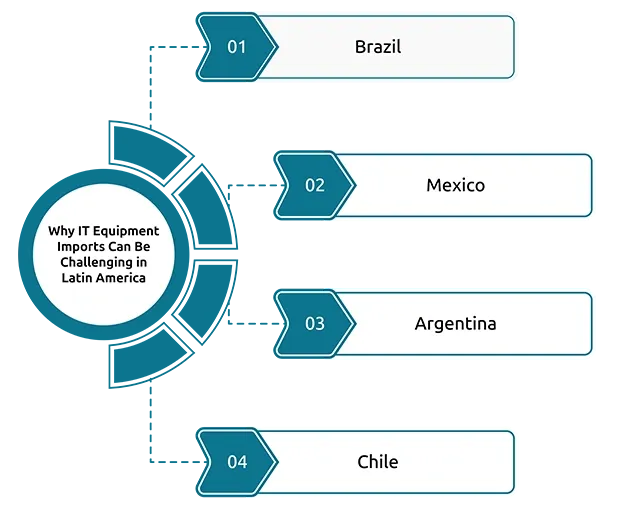
Brazil
Brazil has one of the largest technology markets in Latin America, but importing commercial IT equipment can added with significant customs & tax complexity.
Importers need to consider product classification, customs valuation, applicable import taxes, & local regulatory needs. Technology products may also need attention to requirements when they contain telecommunications or radio-frequency functionality.
An IOR can act as the responsible local importing party, handle customs documentation, & coordinate applicable approvals before equipment arrives.
Mexico
Mexico is an important technology & manufacturing hub, making it an important location for servers, networking equipment, data center network, & telecommunications hardware.
Imports need proper customs classification, documentation, valuation, & tax management. Some telecommunications & wireless products can also need compliance with Mexican technical or telecommunications regulations.
For companies without an established Mexican importing structure, an IOR can provide a compliant route for bringing IT equipment into the country.
Argentina
Argentina has specific customs & import-control needs that businesses should evaluate before shipping technology equipment.
IT hardware imports can involve customs classification, duties, taxes, documentation, & product-specific needs. Import planning is mainly important when equipment is being deployed for data centers, enterprise networks, or telecommunications projects.
An IOR can help develop the correct import structure & coordinate customs & regulatory documentation.
Chile
Chile is mainly used as a regional technology & data center market. Businesses importing IT equipment should ensure that commercial invoices, packing lists, HS classifications, customs values, & tax information are correct.
Wireless & telecommunications equipment may also need regulatory consideration depending on the product.
An IOR can help businesses handle the local import process without requiring them to establish their own importing entity.
Colombia
Colombia has growing demand for cloud computing, data centers, telecommunications, & enterprise IT network.
Importers need to prepare correct customs paperwork & determine the applicable duties & taxes based on the equipment and its classification. Certain products may also be subject to technical or regulatory needs.
Using an IOR can simplify the process by providing a local party responsible for import compliance & customs coordination.
Peru
Peru is another developing market for technology network. Businesses importing servers, networking devices, storage systems, & other IT equipment should review customs classification, valuation, duties, taxes, & any product-specific need before shipment.
An IOR can help coordinate documentation & customs clearance while minimizing the risk of shipment delays caused by incomplete import preparation.
Costa Rica & Other Latin American Markets
Costa Rica has attracted data center, technology, & multinational business activity. Similar to other markets in the region, importers must evaluate customs procedures, taxes, documentation, & product-specific laws.
Other Latin American locations, added with Panama, Ecuador, Uruguay, Paraguay, Bolivia, & Central American markets, also have their own customs & regulatory frameworks. There is no single IOR process that applies across the whole region.
This makes country-specific import planning essential.

What an IOR Handles for IT Equipment
A trustworthy IOR service can help manage some stages of the import process. This can include determining the appropriate importer structure, reviewing HS classification, preparing customs documentation, coordinating duties & taxes, supporting product compliance, & working with customs brokers & logistics providers.
For technology shipments, the IOR should also review whether the equipment contains wireless functionality, batteries, telecom components, encryption capabilities, or other features that could trigger additional regulatory needs.
The objective is not simply to clear the shipment. It is to create a compliant import process from origin to final delivery.
Why Businesses Use IOR Services in Latin America
Developing a local entity in every Latin American market can be costly & time-consuming. Yet businesses may still need to develop technology quickly for data centers, offices, telecom networks, cloud network, or customer projects.
An IOR provides an similar by giving companies access to a local compliant import structure without need them to establish their own legal entity in every destination.
Before shipping, businesses should confirm who will act as the importer, how the equipment will be classified, what duties & taxes apply, whether local certifications are need, & which documents customs will need.
Conclusion
Latin America provides important opportunities for IT network development, but each market has its own customs, tax, & regulatory need. Brazil, Mexico, Argentina, Chile, Colombia, Peru, Costa Rica, & other country markets should therefore be assessed individually rather than treated as one unified import market.
With the correct Importer of Record service, companies can simplify cross-border IT equipment deployments, minimize compliance risks, & develop a more predictable path from global shipment to final delivery.
Did you know?
The Inter-American Development Bank (IDB) estimates that Latin America’s data center market could nearly double from around $5 billion in 2023 to almost $10 billion by 2029, with Brazil, Mexico, and Chile leading regional growth.
FAQ
1. What is an Importer of Record for IT equipment?
An Importer of Record (IOR) is the party responsible for ensuring that imported IT equipment complies with the destination country’s customs, tax, and regulatory requirements. An IOR can also manage import documentation, duties, taxes, and customs clearance.
2. Why is an IOR important for importing IT equipment into Latin America?
Each Latin American country has different customs procedures, tax rules, product regulations, and importer requirements. An IOR helps businesses navigate these country-specific requirements and import IT equipment without necessarily establishing a local legal entity.
3. Which IT equipment can an IOR help import?
An IOR can support the import of various technology products, including servers, GPUs, storage systems, switches, routers, networking equipment, telecom hardware, data center equipment, and other enterprise IT infrastructure, subject to local regulations.
4. Does every Latin American country have the same IOR requirements?
No. Import requirements differ between countries. Brazil, Mexico, Argentina, Chile, Colombia, Peru, Costa Rica, and other markets have their own customs procedures, tax structures, documentation requirements, and product-specific regulations. Businesses should therefore review the requirements for each destination before shipping.
5. Can an IOR import IT equipment without a local company?
In many cases, an IOR can provide a compliant importing structure for businesses that do not have their own legal entity in the destination country. However, the exact requirements depend on the country, product, and applicable regulations.