Introduction
Latin America is an important market for companies deploying IT hardware, including servers, networking devices and telecom equipment. Importing IT equipment in Latin America can be more difficult than using a single standard process because the country has different customs systems, tax laws, and import regulations. Following changes in international trade regulations, Latin American and Caribbean exports did well in 2026, according to current trade data, which also shows strong activity across the region. For companies without a local legal entity, an Importer of Record (IOR) can provide a way to manage imports without creating a company in every market. IOR services in Latin America can help with customs documentation, duties and taxes, product classification and customs clearance in Latin America. The exact requirements still depend on the country, product and customs classification.
When businesses need to import hardware into Latin American markets including Mexico, Brazil, Colombia, Chile, Peru, Argentina, Costa Rica, and Panama, this is most important. Before the equipment is shipped out, the importer, documents, and compliance processes should be checked because requirements may differ from country to country.
Why IT Equipment Imports Can Be Complex in Latin America
Importing IT equipment in Latin America can be difficult because each country has its own customs and import rules. Companies may need different documents, permits, product approvals and tax information depending on the country and equipment. For import hardware in Latin America, accurate HS code classification and product details are important. Errors can cause customs delays, extra costs or shipment holds.
Requirements can also differ for servers, networking and telecom equipment. Companies without a local entity may need an IOR Latin America partner to act as the legal importer and support customs clearance in Latin America. This makes IOR services in Latin America useful for companies that want to deploy IT equipment across multiple LATAM markets without creating a local company in each country.
What an IOR Does in a LATAM Deployment
An Importer of Record (IOR) is in charge of bringing IT equipment into a country in Latin America. The IOR can help with customs clearance in Latin America, verify required permits or approvals, provide import documents, check the HS code, and work with customs brokers. It can also handle applicable duties and taxes and help resolve customs issues if they arise. This makes IOR services in Latin America useful for companies that want to import IT equipment in Latin America without having their own local legal entity. The exact responsibilities can vary by country, product and import rules.
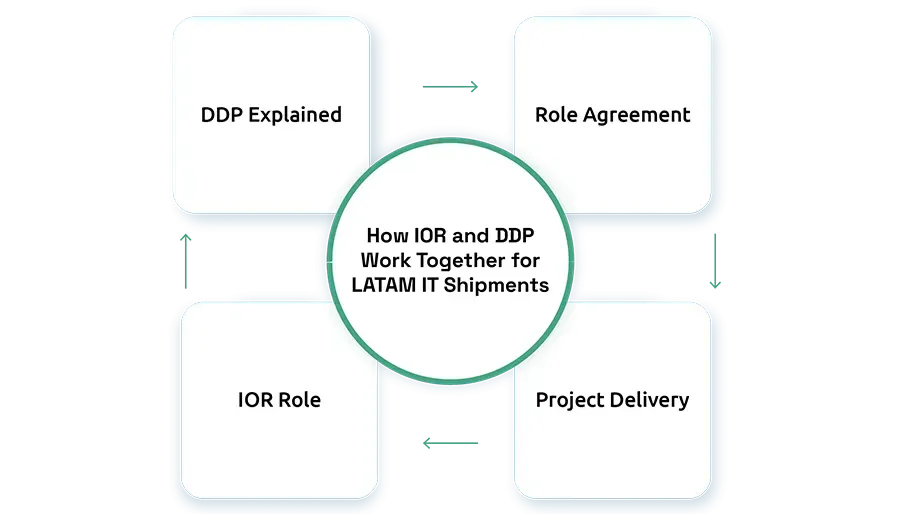
How IOR and DDP Work Together for LATAM IT Shipments
DDP (Delivered Duty Paid) is applied to the sellers duty of managing import clearance, tariffs, and related taxes in place of delivering the products to the scheduled location. However, the seller must be able to legally manage import formalities in the destination country. An IOR Latin America provider can support this model when the seller does not have a suitable local entity. The IOR can act as the importer, work with the customs broker, provide the required import information and support the clearance of IT equipment. This can make DDP delivery in Latin America easier for companies shipping servers, networking or other IT hardware to customers or project sites.
The roles should be clearly agreed before shipping. DDP defines who pays for and manages delivery and import costs, while the IOR provides the local importer role where permitted. Country rules can differ, and some markets may not allow a foreign seller or a particular IOR structure to handle import clearance.
How to Select an IOR Provider
Choose an IOR Latin America provider that has local knowledge and can legally act as the importer in your target country. It should understand IT equipment, HS code classification, customs documents, duties, taxes and required approvals. For companies that import IT equipment in Latin America, it is also important to check country coverage, customs support and clear pricing. The provider should explain who handles each step and what happens if customs raises an issue. One Union Solutions offers IOR services Latin America for IT and telecom equipment, including documentation, compliance checks, HS classification and customs clearance Latin America.
Conclusion – Simplifying IT Equipment Imports in Latin America
Importing IT equipment across Latin America can be complex because customs and product requirements differ by country. An Importer of Record (IOR) can be used by companies without a local company to handle the import process and help with customs clearance. A reliable IOR can help reduce delays, manage documents and keep the shipment aligned with local rules. One Union Solutions helps companies manage IT and telecom equipment imports across LATAM without setting up a local entity in every country.

Did You Know
Latin American and Caribbean economies is also seen expanding moderately, with growth estimated at around 1.1% in 2026 versus 1.5% in 2025.
FAQ
Can a company import IT equipment into Latin America without having a local entity?
Yes, in some countries an IOR can act as the legal importer. However, the exact rules depend on the country, product and importer requirements.
Can an IOR import servers and networking equipment in Latin America?
Yes, an IOR may handle these imports, but some equipment can require additional product approvals or registrations depending on the destination country.
Can an IOR handle customs clearance for IT equipment?
Yes. An IOR can coordinate the import process and work with a local customs broker where required. The exact responsibilities depend on the country and import arrangement.
What happens if IT equipment is shipped before checking local requirements?
The shipment may face delays, additional costs, requests for documents or customs holds. Checking classification and regulatory requirements before shipping can reduce these risks.
Can an IOR manage several shipments for one LATAM project?
Yes. An IOR can support multiple shipments, but each shipment still needs correct documents, classification and compliance checks for its destination.