Introduction
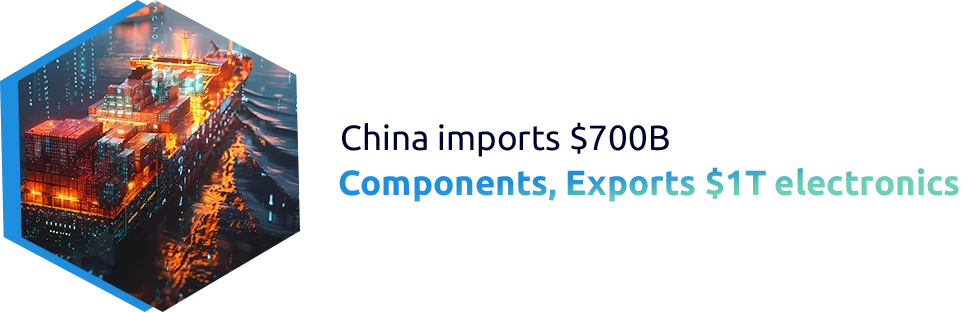
China’s electronics manufacturing industry has changed into the world’s most powerful production ecosystem, importing nearly $700 billion worth of components and changing them into more than $1 trillion in finished electronics for global trade. This huge scale is supported by a highly optimized supply chain, complete Import export documentation systems, and major dependence on systems such as the Generalized System of Preferences (GSP) in partner regions that allow duty benefits for select goods. As global brands depend on China for precision components, printed circuit boards, semiconductors, sensors, and displays, the role of HS code and the HTS Harmonized Tariff Schedule becomes increasingly important for exporters and importers, guiding customs, Import duties and tariffs, and approval rules.
China’s Electronics Trade, Global Supply Chains, and the Role of Incoterms
China both imports and exports components, but much of its export strength comes from assembling imported combined circuits, microchips, and advanced processors sourced from South Korea, Taiwan, Japan, and the United States. These components are used in smartphones, EV systems, industrial robots, and consumer electronics before being exported globally. As these goods move across borders, Incoterms such as DAP, DDP, and DAPs define the responsibilities of buyers and sellers, specifically when determining who manages logistics, IOR services during customs clearance. Many companies depend on Delivered Duty Paid service for benefit, while others prefer flexible International freight services that give them more control. Each shipment must be classified accurately under the correct HS code, which not only supports approval but also avoids penalties, cargo delays, or miscalculations in Import duties and tariffs.
Which countries supply electronic components to China?
Major suppliers include countries like South Korea, Japan, Taiwan, and the United States, which are known for advanced semiconductor and technology production.
These countries provide high-value components such as microchips, memory chips, display panels, and precision electronic parts that are essential for manufacturing smartphones, laptops, and other consumer electronics. Taiwan and South Korea are especially strong in semiconductor manufacturing, while Japan is known for high-quality electronic materials and components. The United States supplies advanced chip technology and design expertise.
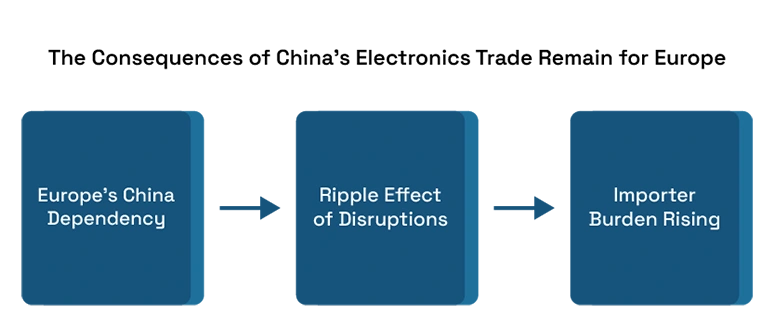
The Consequences of China’s Electronics Trade Remain for Europe
Europe depends a lot on China for electronics, and this has long-term effects on its ability to be independent and flexible in its supply chains. Many European companies rely on electronics that are assembled in China, which makes them more vulnerable to problems like shipping delays, trade restrictions, or political tensions.
If there are any disruptions in China’s supply chain, it will directly affect Europe. Shipments may get delayed, real-time tracking becomes difficult, last-mile deliveries slow down, and overall costs increase. Because of this strong connection, Europe needs to rethink its strategy—while still working with China for important electronic components that it cannot yet produce in large quantities.
Important Considerations for Electronic Exports
Organizations exporting electronics from China must prioritize accuracy in HS code categorization to avoid approval issues that could cause customs holds or penalties. Correct categorizations under the HTS Harmonized Tariff Schedule confirm clarity in import duties and tariffs and reduce differences in global trade documentation. Exporters must also know Incoterms clearly because terms such as DAP and DDP determine who pays for logistics, customs fees, insurance, and last-mile shipment. Logistics partners must have dependable live shipment tracking systems to meet global expectations for visibility and efficiency. Also, exporters require strong Supply chain optimization plans that combine obtaining, packaging, IOR services, and the Exporter of Record definition to have smooth cross-border work.
China’s Component Imports and Electronics Export Strategy
One Union Solutions simplifies the complete trade cycle through smooth logistics planning, accurate HS code classification, and comprehensive IOR services customized for electronics shipments. Their expertise in managing Importer of Record responsibilities helps businesses overcome approval challenges, mainly when dealing with advanced components and regulations across multiple countries. They confirm that Import export documentation is completed correctly, support the Exporter of Record definition for outbound shipments, and provide Real-time shipment tracking and last-mile delivery services to reduce uncertainty. With deep experience in International freight services and Delivered Duty Paid service, we help organizations achieve effective Supply chain optimization, minimizing delays and reducing Import duties and tariffs through compliant processes.
Conclusion
China’s ability to import massive volumes of electronic components and re-export high-value finished goods has reshaped global manufacturing dynamics. For businesses engaged in this ecosystem, understanding HS code classification, Incoterms, Import duties and tariffs, logistics planning, and IOR services is vital to maintaining smooth operations. With reliable partners such as One Union Solutions, organizations can guide difficult regulations, simplify Supply chain optimization, and confidently work in the fast-evolving electronics trade in China.
DID YOU KNOW?
India’s electronics exports grew by 19%, with a significant increase of $2.4 billion in smartphone shipments.
FAQs:
-
Why does China import so many electronics components?
China imports advanced microchips, processors, sensors, and semiconductor parts from countries like South Korea, Taiwan, Japan, and the U.S. These are then assembled into high-value electronics for global export.
-
Which electronics components are most commonly imported into China?
The most important components include integrated circuits, semiconductors, PCBs, displays, lithium batteries, sensors, and precision modules used in smartphones, EVs, robotics, and consumer electronics.
-
How do HS codes impact electronics imports and exports?
HS codes determine customs classification, import duties, tariffs, and compliance requirements. Incorrect HS code use can result in fines, delays, or shipment rejections.
-
What challenges does Europe face due to China’s dominance in electronics manufacturing?
Europe depends heavily on China for assembled electronics, creating risks involving supply chain disruptions, geopolitical issues, increased import regulations, and delays in customs clearance.
-
How does an Importer of Record (IOR) help in electronics shipments?
An IOR manages compliance, customs clearance, approvals, and import documentation, ensuring shipments meet local regulations and preventing delays or penalties.