Introduction
In 2025, global tech companies are operating in an environment characterized by high-value hardware, stringent customs regulations, and growing pressure to reduce costs. From servers and networking gear to GPUs and data center components, IT equipment often crosses borders before being deployed. To manage these difficulties effectively, many organizations are changing to bonded warehousing as a major solution. Duty-free storage options allow organizations to delay taxes, simplify customs clearance, and improve inventory flexibility while maintaining agreement with developing trade rules.
How Bonded Warehousing Supports Data Center Deployment Projects
Bonded warehousing plays an essential role in large-scale data center & IT network projects where equipment arrives before final installation. Companies can store servers, networking hardware, and computing components securely until deployment schedules are confirmed. This approach helps reduce unnecessary customs costs, improves project planning, & allows faster equipment availability across different regions. By integrating secure storage with stock visibility, bonded warehouses help technology companies manage complex infrastructure rollouts more efficiently.
Key Reasons Tech Firms Use Bonded Warehousing
Tech organizations depend on bonded warehousing benefits to balance speed, agreement, and financial efficiency. One of the main uses is the ability to store imported IT equipment without immediately paying customs duties or taxes. This is mainly valuable when equipment is imported in bulk but deployed in stages.
Bonded warehouse also supports supply chain optimization by allowing organizations to respond quickly to regional demand without re-importing goods. For organizations managing sensitive electronics, bonded warehouses provide controlled temperature that reduces risks of damage, safety, or regulatory delays. These benefits make bonded storage an important part of new freight logistics management.

What Is Called a Bonded Warehouse, and How Does It Work for IT Equipment?
Understanding Customs Bonded Storage
A bonded warehouse is a government-authorized facility where imported goods can be stored under customs supervision. IT equipment store in customs bonded storage remains duty-free until it is either cleared for local use or re-exported. This system is perfect for a tech organization that manages global storage or works in multiple markets from a single hub.
How IT Equipment Is Handled
For IT hardware, bonded warehouses follow strong management and documentation guidelines. Equipment is logged, secured, and tracked while remaining under customs control. Companies frequently use Importer of Record Service providers to confirm regulatory agreement during storage and release for IT devices. This setup allows businesses to align inventory movement with the project schedule, avoiding unnecessary duty payments on inactive stock.
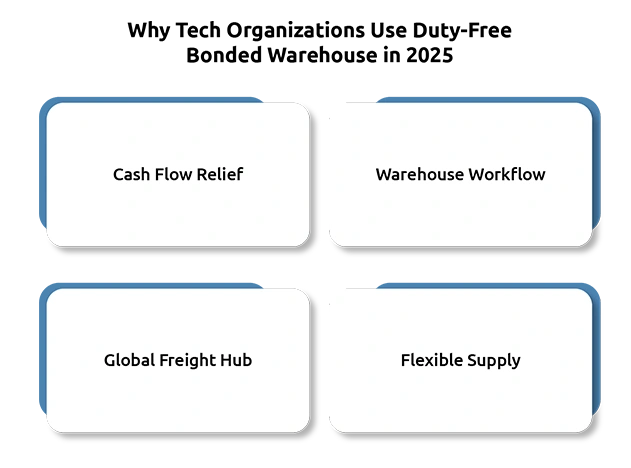
Why Tech Organizations Use Duty-Free Bonded Warehouse in 2025
In 2025, growing part costs and unwanted demand stages have made cash flow management a priority for tech organizations. Duty-free warehouse storage helps organizations delay large immediate payments, release capital for R&D and infrastructure expansion.
Also, many organizations depend on international freight services to move equipment between regions. Bonded warehouses work as a combined hub, allowing limited shipments and flexible supply. This approach reduces lead times and supports flexible work without interrupt agreement requirements. As trade guidelines continue to grow, bonded warehousing provides a constant, flexible approach for cross-border IT equipment shipment.
How Long Can an IT device Be Stored in a Duty-Free Bonded Warehouse?
Storage Duration and Flexibility
The permitted storage period for IT equipment in a bonded warehouse varies by country but typically ranges from one to many years. During this time, goods remain exempt from duties and taxes as long as they are not released into the local market.
Strategic Use for Tech Firms
This extended storage window is specifically useful for organizations managing long-term projects or staged deployments. Hardware can be stored until it is needed, re-exported, or transferred for final clearance. By working on storage duration with deployment plans, organizations can improve supply chain management and warehouse efficiency while maintaining regulatory guidelines.
Conclusion
Bonded warehousing has become a strategic necessity for tech organizations handling high-value IT equipment in 2025. By providing duty delay, regulatory agreement, and operational flexibility, bonded warehouses support smarter inventory decisions and stronger global supply chains. As technology deployments grow more difficult and capital-heavy, using bonded warehousing is no longer just a cost-saving measure; it is a competitive advantage. For organizations looking for dependability and efficiency in global trade, bonded storage remains a necessary tool in modern IT equipment management.
DID YOU KNOW?
In 2025, India’s Central Warehousing Corporation (CWC) operated 18 Customs Bonded Warehouses along with multiple logistics facilities to support secure storage and international trade operations. These bonded facilities help businesses manage imported goods under customs supervision while improving supply chain flexibility.
FAQs:
What is a bonded warehouse for IT equipment?
A bonded warehouse is a customs-authorized facility where imported IT equipment can be stored without paying duties or taxes until the goods are released or re-exported.
Why do tech companies prefer bonded warehousing in 2025?
Tech firms use bonded warehousing to delay customs duties, improve cash flow, manage staged deployments, and maintain compliance with evolving trade regulations.
How long can IT equipment be stored in a bonded warehouse?
Storage duration depends on country-specific customs laws but usually ranges from one year to several years while remaining duty-free.
Is bonded warehousing suitable for high-value electronics like GPUs and servers?
Yes, bonded warehouses offer secure handling, climate-controlled storage, and customs supervision, making them ideal for sensitive and high-value IT hardware.
Can IT equipment be re-exported directly from a bonded warehouse?
Yes, goods stored in a bonded warehouse can be re-exported without paying local customs duties, helping companies manage global distribution efficiently.