Introduction
As businesses grow around the world, the demand for data centers increases quickly. Companies are increasing their IT infrastructure to deal with cloud computing, artificial intelligence, & digital services. This development requires the shipment of more data center equipment, such as servers, storage systems, & networking equipment, to different countries. However, importing data center equipment from multiple countries may be difficult. Every country has its own customs processes, import charges, & documentation requirements. Missing documents or having to follow local compliance rules can result in customs delays, extra costs, & project difficulties. Businesses can make the data center equipment import process smoother & more efficient by following to the proper best practices. Proper planning, correct documents, & strong customs compliance all help reduce delays, avoid unexpected extra charges, & make sure that IT equipment reaches on time.
Why Multi-Country Data Center Equipment Imports Are More Complex
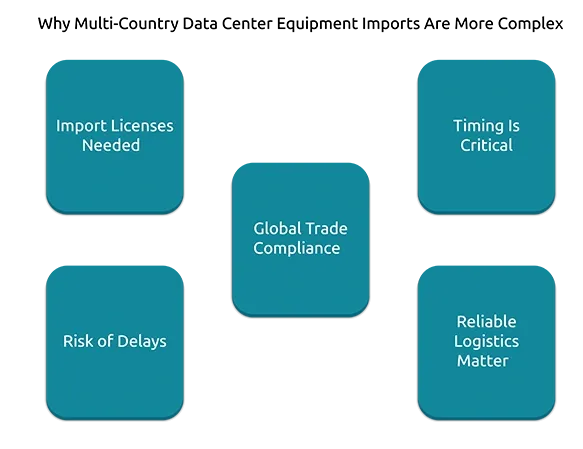
Importing data center equipment into multiple countries is not as simple as shipping a shipment from one location to another. Every country has its own set of customs regulations, import laws, & approval processes. As a result, before moving IT equipment to a different country, businesses must first understand its regulations. This reduces delays & keeps the import process running smoothly. Import licenses are also required in some countries for specific servers, networking equipment, & telecom goods. Many countries also have their own certification processes in place to make sure that imported products follow local safety & technical standards. Shipments may be delayed or stopped at customs if the required approvals are not approved. Timing is important for businesses handling global data center deployment projects. Equipment must usually reach on time in multiple countries so that installation may start without delay. Businesses may make international IT equipment shipping & cross-border hardware imports easier, faster, & cost-effective by following local laws, using reliable data center logistics, & following to global trade compliance.
Why Importer of Record (IOR) Services Matter for Global Data Center Projects
An Importer of Record (IOR) is a entity & partner that takes legal responsibility for importing goods into a country. IOR services are useful when a business wants to complete an IT equipment import but does not have a local legal entity or is unfamiliar with local import rules. Using a global IOR helps businesses follow legal requirements, submit the correct import documents, & reduce the risk of customs delays. An IOR also works with customs officials &, when needed, a customs broker to help shipments ship smoothly. This helps companies to receive their data center equipment faster & keep global deployment projects on time.
Common Challenges When Importing Data Center Equipment Across Multiple Countries
Importing data center equipment into different countries can be challenging because every country has different import regulations & customs rules. Missing customs documentation, incorrect shipping documentation, & required product certifications can delay the customs clearance process. Businesses may also face different duties and taxes, & some countries require a local importer to bring in IT equipment. Following import compliance requirements helps avoid delays, extra costs, & shipping problems.
Types of Data Center Equipment That Need Careful Import Planning
Many types of data center hardware need careful planning before they are imported into another country. This includes servers, storage systems, networking equipment such as switches & routers, firewalls, racks, UPS systems, cooling equipment, PDUs, fiber optic equipment, & telecom hardware. These products are important parts of an IT infrastructure and may have different customs rules, certification requirements, & import documents. Proper server import planning and following local regulations help businesses avoid delays & ensure their equipment reaches its destination safely and on time.
Best Practices for Multi-Country Data Center Equipment Imports
Plan Imports Early
Good import planning helps businesses avoid delays & unexpected costs. Before shipping data center equipment, check delivery schedules, required documents, & local rules for each country. Early planning makes international shipping easier & keeps projects on time.
Understand Local Regulations and Use Importer of Record (IOR) Services
Every country has different customs & import requirements. Understanding these rules helps businesses maintain customs compliance & trade compliance. If a company does not have a local legal entity, importer of record services can help complete the import process legally & smoothly.
Prepare Correct Documents & HS Codes
Correct invoices, packing lists, product details, & HS codes are important for faster customs clearance. Correct documents reduce mistakes, avoid shipment delays, & help equipment ship across borders without unnecessary problems.
Work with Reliable Logistics Partners
Experienced global logistics providers can handle shipments, monitor shipments, & solve shipping issues quickly. They also help businesses with smooth IT asset deployment by making sure equipment reaches the right location safely & on time.
Conclusion
Importing data center equipment into multiple countries takes careful planning & a clear understanding of local import rules. Since every country has different customs & compliance requirements, preparing the right documents & working with experienced logistics experts can help avoid delays & extra costs. One Union Solutions provides reliable Importer of Record (IOR) services, customs support, & global logistics solutions to make IT equipment imports simple & hassle-free. With the right support, businesses can deploy their data center infrastructure smoothly and complete global projects on time.
Did you know
The total data center market generated $416.09 billion in revenue in 2024 and is forecast to climb past $620 billion by 2029, according to Statista Market Insights.
FAQ
Why is import planning important for data center equipment?
Good planning helps avoid customs delays, reduces extra costs, & makes sure equipment arrives on time.
What are customs duties in data center equipment imports?
Customs duties are taxes that countries charge when IT equipment is brought from another country.
How does One Union Solutions support global data center projects?
One Union Solutions helps with Importer of Record services, customs clearance, documents, & smooth delivery of IT hardware globally.
Why is coordination important in multi-country imports?
Coordination helps handles multiple shipments at the same time & avoids problems or delays.
What is the main goal of data center equipment imports?
The main goal is to safely move IT equipment like servers & networking tools from one country to another for setup & use.