Insight
Cloud providers operate a large-scale global system that depends on smooth hardware deployment across multiple countries. This includes the movement of servers, storage systems, networking devices, & data center equipment through complex global logistics network.
Each deployment must follow strict customs rules, documentation requirements, & supply chain management to make sure smooth & smooth cloud operations worldwide.
What Are Global Hardware Deployments in Cloud Computing?
Cloud providers manage global hardware deployments by coordinating global logistics, handling customs compliance, managing import documentation, & making sure timely delivery of IT equipment to data centers worldwide. This process involves structured supply chain planning, regulatory approvals, & support with local partners to make sure smooth installation & operation of the cloud system across different countries.
Benefits of Global Hardware Deployment
Global hardware deployment allows cloud providers to grow systems rapidly across regions, making sure better service availability & reduced response time for users worldwide. It helps improve scalability by supporting data centers to grow based on demand. It also makes sure cost improvement through effective logistics planning & bulk hardware movement. Proper deployment processes reduce downtime & improve system reliability. Additionally, it improves global connectivity by positioning systems closer to end users, which improves application performance & data processing speed.
How Do Cloud Providers Manage Global Supply Chains?
Global Supply Chain Strategies for Cloud Providers: Handling global hardware deployments requires more than shipping & customs compliance. Cloud providers use advanced supply chain planning to make sure hardware is available where & when it is needed. This involves demand planning, regional warehousing, stock planning, & supplier management to reduce lead times & avoid delays. By maintaining reliable supply chains, cloud providers can respond quickly to growing system demands while making sure continuous service availability across global data centers.
Industry Applications
Cloud hardware deployment is important for multiple industries that depend on digital systems. In the IT & cloud computing sector, it supports hosting platforms, applications, & enterprise systems. In telecom, it enables network expansion, including 5G system & communication systems. Business & SaaS companies rely on global deployments to make sure smooth software delivery & backend performance. AI & data center operations depend heavily on high-performance computing hardware such as GPUs & storage clusters deployed across multiple regions. Financial institutions also rely on secure & scalable cloud systems to manage transactions, data security, & real-time operations.
What Are the Country Compliance Requirements for Global Hardware Deployment?
Global hardware deployment requires strict compliance with each country’s import regulations and customs laws. Cloud providers must ensure proper documentation, including invoices, packing lists, and correct HS code classification for all equipment. Many countries also require specific certifications, safety approvals, and tax compliance before allowing IT hardware imports. In addition, data center equipment must follow local regulatory frameworks related to technology imports, taxation, and infrastructure setup. Countries such as the United States, India, Germany, Singapore, and the United Arab Emirates have strict compliance systems that must be followed for seamless hardware movement and installation.
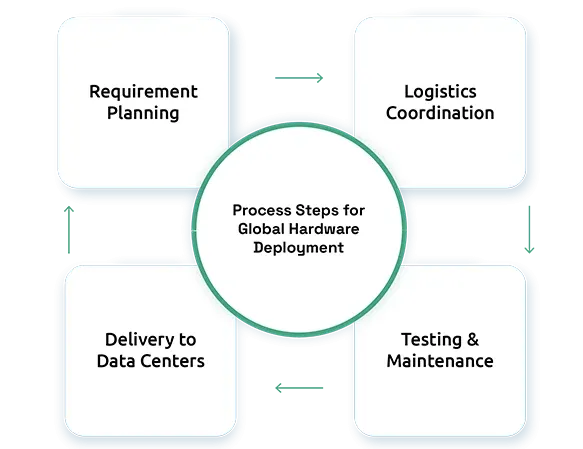
Process Steps for Global Hardware Deployment
Step 1: Requirement Planning
The process starts with identifying system needs based on business demand, expansion goals, & data center capacity requirements.
Step 2: Procurement
Hardware is sourced & purchased from approved vendors & production based on technical specifications & deployment needs.
Step 3: Logistics Coordination
Once ready, shipments are planned and coordinated for safe transportation through air, sea, or land routes, depending on destination and urgency.
Step 4: Customs Clearance
All required documentation, compliance checks, & HS code classifications are completed to make sure smooth customs approval in each country.
Step 5: Delivery to Data Centers
After clearance, hardware is delivered securely to data center facilities for installation & setup.
Step 6: Installation & Configuration
Equipment is set up, configured, & connected into existing systems to make sure proper system performance.
Step 7: Testing & Maintenance
Systems are tested for performance, followed by continuous tracking & maintenance to make sure effectiveness & reliability.
Why Efficient Hardware Deployment Matters for Cloud Infrastructure
Efficient hardware deployment is important for making sure an advanced cloud system. Delays in hardware delivery or installation can affect data center growth, application availability, & customer experience. A well-planned deployment process helps cloud providers maintain uptime, support business growth, & scale systems faster while make sure working efficiency across multiple regions.
Common Challenges in Global Hardware Deployment
Global hardware deployment faces several challenges, including complex customs rules, delays in global shipping, high shipping costs, & country-specific compliance requirements. There is also a risk of equipment damage during transit & delays due to regulatory approvals. These challenges are addressed through advanced supply chain management, local logistics support, pre-approved documentation processes, & real-time tracking systems. Cloud providers also use strategic warehousing & regional delivery hubs to make sure faster deployment & reduced working risks.

How Does One Union Solutions Help in Global Hardware Deployment?
One Union Solutions helps businesses simplify global hardware deployment by handling logistics, customs clearance, & import compliance for IT and data center equipment. The company makes sure that all documentation, HS code classification, & regulatory requirements are properly handled to avoid delays & shipment issues.
With a strong global network & experience across multiple countries, One Union Solutions supports smooth cross-border movement of servers, networking devices, & other critical hardware. This helps businesses reduce working challenges, improve delivery timelines, & make sure efficient deployment of the cloud system worldwide.
Conclusion
Global hardware deployment helps cloud providers expand systems across countries with speed & efficiency through proper logistics & compliance management.
With rising demand for cloud and AI systems, smooth deployment is important for scalability & performance.
One Union Solutions supports businesses with reliable logistics & import compliance solutions for seamless global hardware movement.
Did You Know?
The UNCTAD ASYCUDA Report 2025 highlights that the cloud-based ASYCUDA platform helps customs authorities speed up border procedures through digital documentation, AI-supported risk management, and faster customs processing, improving cross-border movement and trade compliance.
FAQs
How do cloud providers manage global hardware deployments?
Cloud providers manage global hardware deployments through organized logistics networks, customs compliance processes, & regional data center partnerships that ensure smooth shipping, clearance, & installation of IT equipment across multiple countries.
What equipment is required for cloud infrastructure deployment?
Cloud infrastructure deployment typically includes servers, storage systems, networking hardware, GPUs, routers, switches, & cooling systems that together support scalable & high-performance cloud environments.
Why is compliance important in global cloud hardware deployment?
Compliance is important because each country has different import rules, tax rules, & technical standards. Proper compliance make sure smooth customs clearance & prevents delays, penalties, or shipment rejections.
Which industries rely on cloud hardware deployments the most?
Industries such as IT services, telecom, AI, e-commerce, & business SaaS rely heavily on global cloud systems to make sure performance, flexibility, & secure digital operations.
What challenges do cloud providers face in global deployments?
The main challenges include customs delays, complex compliance requirements, high logistics costs, & risks included in shipping sensitive IT hardware across international borders.