Introduction
The air cargo industry is seeing a huge change as Artificial Intelligence and automation show how goods are moved across global supply chains. As cross-border trade expands and organizations increasingly depend on simplified logistics and Import export documentation, the requirement for faster, safer, and more predictable air freight processes has never been greater. Technologies such as real-time shipment tracking, last-mile delivery services, and automated warehousing systems are no longer optional; they are necessary parts of modern International freight services. Whether working under Incoterms such as DAP, DAPs, or Delivered Duty Paid service, businesses must also guide Import duties and tariffs, review HS code and HTS Harmonized Tariff Schedule classifications, and manage Importer of Record responsibilities and the Exporter of Record definition. In this developing service, AI is proving to be the major enabler for supply chain optimization and more effective air cargo management globally.
The Transformative Role of AI in Air Cargo
AI is changing air cargo by allowing freight forwarders and global shippers to improve their work with great accuracy. Predictive analytics powered by AI helps organizations approximate cargo demand, identify capacity issues more effectively, necessary for avoiding delays and reducing working costs. Machine-learning algorithms analyze large amounts of data, from shipment records to trade flows governed by systems such as the generalized system of preferences (GSP), giving air carriers deeper insight into market patterns. Also, AI tools improve accuracy in giving HS code data, which directly affects Import duties and tariffs, and confirms agreement within different customs regimes. Supporting intelligent documentation verification, automated billing, and increased communication between carriers and shippers, AI strengthens the complete logistics system, making global trade more predictable and effective.

The Future of Air Cargo Handling using Automation & AI
Automation is changing how air cargo is managed at stations, from automated review against systems to robotic palletization, all guided by AI decision-making. Smart handling systems can read shipment dimensions, verify labeling, and cross-check Import export documentation automatically, saving countless human hours and reducing working errors. These improvements also simplify the responsibilities combined with Importer of Record services, where accuracy and agreement are necessary. Automated handling confirms that shipments booked under Incoterms such as DAP or DDP follow the correct customs documentation path. As the industry holds autonomous vehicles, robotic loaders, and AI warehouse management systems, cargo management becomes faster, safer, and more effective, setting a new guideline for global air freight.
AI in Air Freight Work: From Forecasting to Fulfillment
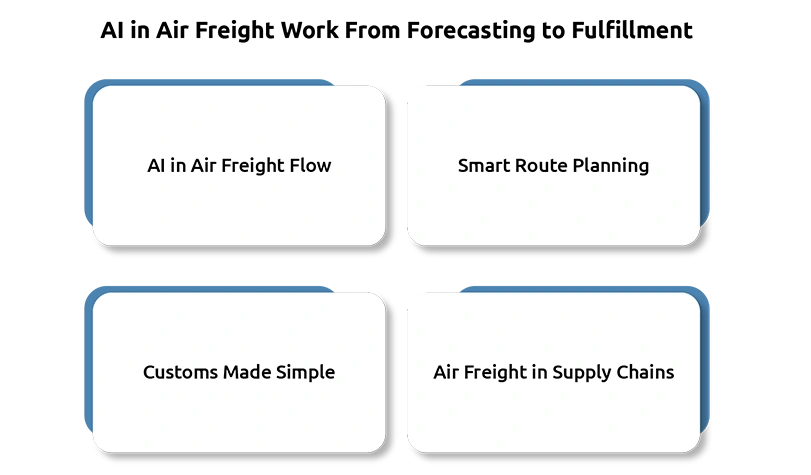
Across air shipping work, AI delivers end-to-end tracking and efficiency from demand forecasting to shipment. AI-powered route planning systems analyze airport overcrowding, tariff changes, and geopolitical risks to show the most effective path for cargo shipment. These systems also increase live shipment tracking, giving shippers clarity over every stage of shipment, from aircraft loading to last-mile delivery services. Automating classification reviews combined with HS code or HTS harmonized tariff schedule requirements, AI minimizes customs delays and avoids costly errors. For organizations handling sensitive cargo under DAPs or Delivered Duty Paid service terms, such tools confirm that all Import duties and tariffs are calculated correctly, allowing smooth cross-border movement. AI fulfillment systems in place, air freight becomes a dependable part of broader supply chain optimization plans.
Automation in Air Cargo: Smarter, Faster, Safer
AI gives unwanted consistency and safety in air cargo work. Automated scanning, digital airway bills, and robotic security screening accelerate processing times while improving accuracy. These technologies also contribute to safer management of high-value or oversized cargo. When combined with AI, automated systems can detect inconsistencies in cargo shipment, standard documentation discrepancies, and support the Exporter of Record definition process by validating necessary export documents. This combination of automation and AI increases the global logistics chain, allowing carriers and shippers to maintain agreements while achieving quicker shipping times.
By reducing manual intervention, automation also minimizes human error and operational delays across air cargo operations. Real-time data integration enables better tracking, faster decision-making, and improved transparency throughout the supply chain. As automation continues to evolve, it is becoming a key driver of efficiency, compliance, and reliability in global air freight logistics.
Conclusion
Artificial Intelligence and automation are revising the future of air cargo by making it work smarter, faster, and more flexible. As businesses navigate complex import duties and tariffs, manage IOR services, and rely on accurate HS code classification, AI serves as a support for global supply chain optimization. With increased live shipment tracking, automated cargo handling, and intelligent expectations, the air freight industry is entering an era where efficiency and clarity operate every shipment from booking to last-mile delivery.
DID YOU KNOW?
The International Air Transport Association (IATA) predicts that air cargo traffic will grow by 5.8% in 2025 to reach 72.5 million tonnes.
FAQs:
-
How is AI transforming air cargo operations?
AI improves air cargo by enabling predictive demand forecasting, automated documentation checks, real-time shipment tracking, and faster decision-making in routing and capacity management.
-
What role does automation play in cargo handling?
Automation speeds up ground handling through robotic palletization, automated scanning, digital airway bills, and smart warehouse systems, reducing manual errors and accelerating cargo movement.
-
How does AI help in HS code and tariff classification?
AI-based tools analyze shipment data to recommend the correct HS or HTS codes, ensuring accurate Import duties and preventing costly customs compliance errors.
-
Why is AI important for companies using DAP or DDP shipping terms?
AI confirms correct documentation, automates IOR-related checks, and calculates expected duties and taxes, helping avoid delays and ensuring smooth cross-border deliveries for DAP/DDP shipments.
-
What benefits do shippers get from AI-driven real-time tracking?
AI enhances visibility across the shipment lifecycle, alerts users about delays, analyzes route risks, and improves planning for last-mile delivery and warehouse readiness.