Introduction
Digitalization was once expected to combine global systems, reduce inefficiencies, and strengthen connectivity across economies. But as countries and organizations build their own rules, platforms, and restrictions, a new trend has emerged: digital fragmentation. This fragmentation impacts everything from artificial intelligence development to logistics, Importer of Record responsibilities, International freight services, and even the management of Import export documentation. In a world where supply chains and technologies are tightly interlinked, fragmented digital ecosystems are slowing progress and creating what can be called the Anti-AI Effect.
As digital barriers increase, companies face rising compliance costs, data localization requirements, and incompatible regulatory frameworks across borders. These challenges complicate cross-border technology deployment and slow innovation cycles, especially in AI-driven operations. Fragmented digital standards also disrupt seamless data exchange, which is essential for modern logistics and supply chain visibility. Without coordinated global policies, the gap between technological potential and practical implementation continues to widen.
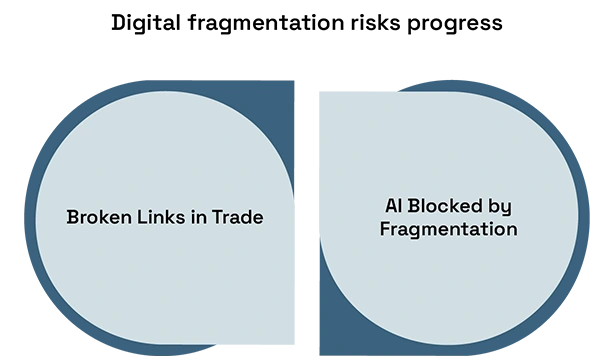
Digital fragmentation risks progress
Digital fragmentation creates unreachable digital systems that cannot communicate smoothly across borders. This has implications not only for AI methods but also for global trade systems that depend on digital work. When platforms fail to integrate, businesses face challenges in trade, such as Real-time shipment tracking, last-mile delivery services, and the application of Incoterms, such as Delivered Duty Paid service or DAP for cross-border shipments. Even tariff-related data, such as HS code, HTS Harmonized Tariff Schedule, and the interpretation of Import duties and tariffs, depend on synchronized digital infrastructure. When fragmentation rises, nations and companies develop their own standards, creating duplicated work, inconsistent datasets, and slow-moving digital processes. This weakens the possibility of AI to simplify operations such as Supply chain optimization, IOR services, or the Exporter of Record definition agreement. Instead of getting moving growth, digitalization begins to mirror the complications once seen in the analog world.

Why Digital Fragmentation Is a Problem
AI depends on clean, connected, and large-scale data. Fragmented systems reduce data flow, limit learning, and minimize AI’s ability to make accurate predictions. For example, when trade platforms across borders use different formats for Import export documentation, AI systems cannot fully automate customs clearance. Similarly, supply chain partners using incompatible software create delays that undermine Supply chain optimization, especially in time-sensitive deliveries. Companies may need multiple tools, integrations, and regulatory interpretations due to varying digital rules. Even processes involving DAPs, GSP (Generalized System of Preferences) benefits, or customs documentation management become more complex when digital systems cannot synchronize. The Anti-AI Effect grows stronger as AI’s true potential gets restricted.
How to Solve Digital Fragmentation for AI
Solving this issue requires work between governments, industries, and technology providers. Standardizing the digital system for documentation, cross-border approval, and logistics operations is necessary. Unified digital rules can simplify tasks such as mapping HS code, validating HTS Harmonized Tariff Schedule classifications, clarifying Importer of Record responsibilities, and automating last-mile updates through live shipment tracking tools. Open digital ecosystems allow AI to work across borders, allowing automated checks, predictive analytics, and smooth work in International freight services. When companies follow standardized formats and interoperable systems, even procedures involving Delivered Duty Paid service, customs brokerage, or Exporter of Record issues become more effective. Also, solving fragmentation helps AI generate insights at a global scale instead of being trapped within isolated digital environments.
Why We Must solve Fragmentation to improve AI for the Benefit of All
AI has the power to reduce errors, lower costs, and increase global trade efficiency, but only if digital systems are connected. Overcoming fragmentation confirms smoother logistics flows, accurate duty calculations, and simplified global trade. It also supports fairer use of programs such as GSP, increases transparency in DAP or DDP transactions, and strengthens automated decision-making in customs, sourcing, and supply chains. A unified digital environment confirms that nations and businesses benefit equally. AI can then optimize networks across borders, reduce delays, reduce errors in tariff classification, and increase reliability throughout supply chains.
Conclusion
The fragmentation of digitalization causes serious risks to AI development, global trade, and supply chain performance. To stop the Anti-AI Effect, the world must move toward global digital standards that support relationships. When digital systems align, AI can strengthen logistics efficiency, simplify Import export documentation, improve approval processes like IOR services, and ultimately deliver a globally optimized, interconnected future.
DID YOU KNOW?
Studies have shown that 79 percent of organizations have more than 100 different data sources, and 30 percent of organizations use more than 1,000 sources.
FAQs:
-
What is digital fragmentation?
Digital fragmentation occurs when countries, companies, or platforms create separate, incompatible digital systems. These systems cannot communicate effectively, causing delays, data gaps, and inefficiencies across AI, logistics, and global trade operations.
-
How does digital fragmentation create the Anti-AI Effect?
AI depends on integrated, clean, and large datasets. When systems are isolated or incompatible, AI cannot learn or automate processes efficiently. This restricts automation in customs clearance, supply chain optimization, and real-time shipment tracking, creating the Anti-AI Effect.
-
How is digital fragmentation affecting global trade and logistics?
It leads to inconsistent documentation formats, incompatible tracking tools, and delays in interpreting HS codes, duties, and Incoterms. Businesses face duplicated work, slower processes, and higher compliance risks.
-
What is needed to solve digital fragmentation?
Governments, logistics providers, and tech companies must adopt unified digital standards, interoperable platforms, and common formats for customs data, shipment tracking, and regulatory documentation.
-
How can AI improve once digital fragmentation is reduced?
With connected digital systems, AI can automate customs classification, optimize supply chains, predict delays, lower compliance errors, streamline IOR responsibilities, and support smoother cross-border logistics.