
Introduction: Africa’s Expanding Role in Global Imports
The trading situation in Africa is rapidly developing. It was not so long ago that shipping high-value equipment into many African countries was like throwing the dice- unknown routes, customs, and lots of paperwork to deal with. Nowadays, the situation is different. Significant increases in the rates of economic growth and expansion of cities have made ports and airports in Africa busier than before. The need for sophisticated equipment, whether aviation or automobiles, IT hardware, or medical equipment, is immense. The continent is quickly attracting the attention of companies aiming to access new markets and develop a actual difference.
Service Overview: Making Equipment Imports Simple
It is a fact that sometimes it may not be that smooth going when importing sensitive equipment. You have to fill in the paperwork, go through customs, and have a persistent fear of delays or getting the item damaged. However, you can relax with the right support. Modern logistics products are prepared to put less strain on you. No matter what you send, be it a jet engine, a fleet of vehicles, or servers and medical scanners, you can receive real-time updates and have secure storage and clear communication. It stops being a question of stress and becomes more of the results.

Key Hubs: Africa’s Gateways to Trade
Africa’s trade network is anchored by a handful of powerhouse hubs. In the south, Durban’s port is the busiest, handling a huge slice of the continent’s cargo. Over in East Africa, Mombasa and Djibouti keep goods flowing inland. The Djibouti-Addis Ababa Corridor, with its massive free trade zone, is a magnet for all sorts of equipment imports.
Air freight matters just as much. Nairobi’s Jomo Kenyatta International and Johannesburg’s OR Tambo International airports are the go-to choices for high-value shipments that can’t afford to wait. These places aren’t standing still—there’s constant investment in better tech, more storage, and faster processing.
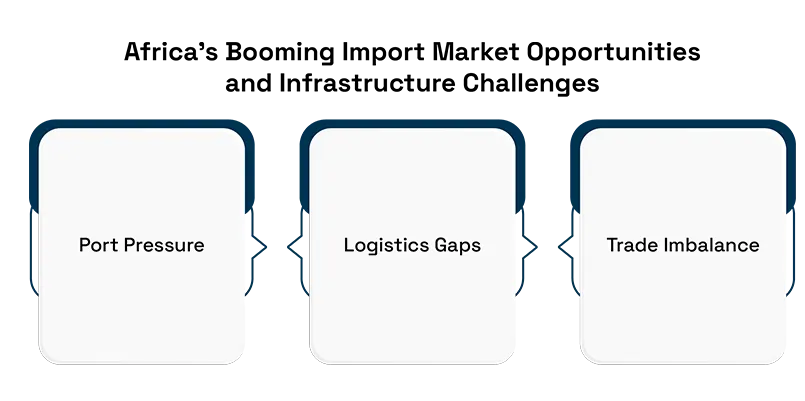
Expanding Business Through Africa’s Import and Logistics Network
Africa’s imports are increasing year after year, providing new chances for company growth in many types of industries. A strong logistics network makes sure that goods move securely and reach on time. Good planning also supports international trade by reducing delays and simplifying shipping. A well-managed supply chain in African marketplaces allows companies to save time, reduce costs, and serve customers more efficiently. It also allows businesses to deliver products faster and avoid too many shipping problems. Businesses in many African countries could grow with the proper logistics help.
Primary Service Advantages and Options
Partnering with an expert logistics firm in Africa gives you expert shipping, which is much more than that. You have quick and trustworthy shipping by sea, air, and overland, and solutions to accommodate sensitive or high-value freight. Free trade zones and bonded warehouses allow you to save on expenses and clear customs as fast as possible, so your equipment does not have to wait.
In modern warehouses the warehousing service offers the storage of assets in a secure, climate-controlled facility. Online applications update you at all times. Thus, you would not be oblivious to where your shipment would be. Better still, the paperwork and the panic deliveries are carried out by teams with lots of experience. This way, you can concentrate on where you excel in what you are good at, and the rest is left to the logistics experts.
Navigating a Complex Landscape
There are rudimentary routes, few railways, and congested ports in certain areas, which is a drag and a cost. Rules concerning customs do not always remain identical within different countries, and accessing remote locations is difficult.
The situation is changing. States are sinking funds into novel highways, railways, and online networks. The African Continental Free Trade Area is simplifying the transportation of goods between borders, and emerging technologies are securing the connection between the cities and rural regions. You can create opportunities from those challenges by remaining open and working with the local experts.
Conclusion
The import boom in Africa is ushering in a redefinition of international trade. The continent is a hub of aviation, automotive, IT/data center, and medical equipment opportunities. Their demand is skyrocketing, so an estimated number of businesses thirsty to invest and expand are scattered across the continent. Of course, there is still time to take on some challenges. Still, the rate of progress is thrilling: ports and airports are growing bigger, and new technologies are making it easier to get through the process year after year.
Our mission at One Union Solutions is to ensure that you make the best of what Africa offers. We understand the difficulties, and we do see enormous potential. Working with us means having a partner concerned with ensuring your equipment travels safely and efficiently and is prepared to propel your business upwards.
Did You Know,
Over three-quarters of Africa’s data center capacity is confined to only three nations: South Africa, Nigeria, and Kenya. Africa is utilizing this cluster to transform its digital landscape and how business is done.
FAQs
What opportunities exist in Africa for equipment importers?
Rapid urban growth and large-scale infrastructure projects across Africa are driving strong demand for advanced machinery and industrial equipment in sectors such as construction, energy, and manufacturing.
Which ports and airports are most important for equipment imports?
Key seaports include Durban, Mombasa, Djibouti, and Lagos, while major air cargo hubs are Nairobi, Johannesburg, and Addis Ababa, all of which support high volumes of equipment imports.
How do infrastructure challenges affect equipment imports?
Limited transport links and slow customs processes can cause delays, but ongoing infrastructure upgrades and improved logistics planning are helping to reduce these issues.
Can equipment imports be made faster and more cost-effective?
Yes, using free trade zones, bonded warehouses, and experienced local logistics partners can speed up customs clearance and lower unexpected costs.
What trends will shape the future of Africa’s equipment import market?
The market will see increased digitalization, more efficient supply chains, stronger regional trade integration, and a growing focus on sustainable logistics solutions.