
Introduction
Till 2026, global supply chains will face more demand than ever before for shipments. From stronger border guidelines and growing approval expectations to geopolitical issues and changes in global manufacturing hubs, businesses must know how they ship goods across borders effectively and safely. For industries such as IT hardware, aviation parts, medical equipment, and automotive manufacturing, where good value, regulations, and growing times are necessary, the ability to build resilience is no longer optional. It is the defining factor of competitive advantage. A major change growing across all global trade industries is the growing importance of a combined customs approach.
What Is Supply Chain Resilience?
Supply chain resilience is the organization’s ability to withstand, hold, and recover from unexpected disruptions. If caused by political tensions, regulatory changes, pandemics, port congestion, or supplier instability, issues are now more frequent and require more work.
For import–export businesses dealing with sensitive and high-value products in IT, aviation, medical, and automotive categories, resilience requires:
- Reliable cross-border movement
- Strong compliance readiness
- Faster response times during disruptions
- Strategic redundancy in suppliers and trade routes
- Deep visibility across the entire movement cycle
Traditional supply chain models that operate in island, procurement, transportation, warehousing, and customs all functioning separately, can no longer support global business continuity. Resilience in 2026 depends on combined systems where customs are implanted into every planning and execution stage.

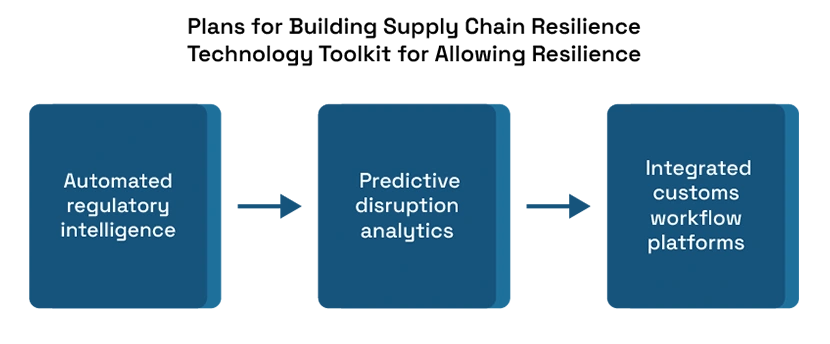
Plans for Building Supply Chain Resilience: Technology Toolkit for Allowing Resilience
Some core technology tools shaping resilience in 2026 include:
Automated regulatory intelligence
AI-allowed systems track global rule updates and help businesses to know before new approval requirements affect the shipment. This is important for industries with strong safety and agreement guidelines, such as aviation parts and medical devices.
Predictive disruption analytics
Machine learning models analyze trade route conditions, political environments, weather events, and border risks. Businesses can predict delays early and redirect cargo through alternative routes.
Integrated customs workflow platforms
These unify all customs-related processes such as document preparation, categorizations, risk valuation, inspection planning, and approvals into a single digital ecosystem. This reduces manual issues and speeds up clearance times.
Digital twins for supply chain planning
Simulated supply chain environments help organizations test alternative routes, assess issues, and build contingency strategies before disruptions occur during delivery.
End-to-end process automation
Automation reduces the administrative workloads that frequently slow down the shipment of valuable imports in sectors such as IT and automotive.
Competing With Emerging Markets: Balancing Investment, Stability, and Supply Chain Resilience
Growing trade in Asia, Africa, and Eastern Europe is becoming a strong manufacturing competitor, providing attractive cost benefits. But these fast-growing regions also come with problems, changing regulatory guidelines, changing border requirements, a poor system, and inconsistent risk standards.
To compete effectively, businesses must strike a balance between low-cost sourcing and stability. Combined customs play a vital role in achieving this balance by confirming:
- Faster market entry for new sourcing regions
- Reduced delays at unfamiliar borders
- Better compliance preparedness
- More predictable delivery cycles
- Lower financial and operational exposure
For sectors such as IT hardware or automotive electronics, where speed-to-market determines profitability, strong customs combined become a direct competitive advantage. Organizations that create resilience in their sourcing strategies can work in growing trades while having strong expectations in regions.
Free Trade Agreements May Allow and Encourage Supply Chain Restructuring
2026 will see a continued growth in cross-border economic partnerships and trade agreements. These agreements will unlock new chances for manufacturing and the supply chain by allowing businesses to restructure their shipment more effectively.
Integrated customs solutions help companies take advantage of these agreements by:
- Simplifying agreement with multi-country requirements
- Reducing costs related to cross-border trade
- Allowing smooth shipment of goods during regulatory transitions
- Supporting changes in supplier bases across regions
Conclusion
By 2026, supply chain resilience will be defined by a company’s ability to combine customs into its strategic system, not as a post-shipment formality, but as a vital operational stage. For industries working in fast-moving, high-compliance sectors such as IT, aviation, medical, and automotive manufacturing, resilience depends on proactive planning, advanced technology adoption, and HS Code trade processes across global routes. Combined customs empowers organizations to respond faster, reduce risk, maintain affordability, and secure a stronger competitive position in growing trades.
DID YOU KNOW?
Due to recent difficulties, the Manufacturing Supplier Deliveries Index rose to 48.9 in April 2024, from 47 in December 2023.
FAQs:
Why is supply chain resilience important in 2026?
Because global trade is facing stronger regulatory controls, geopolitical challenges, and growing demand, businesses must build systems that can predict, withstand, and recover from disruptions quickly.
How does integrated customs improve supply chain resilience?
Integrated customs eliminates delays by embedding compliance, documentation, and regulatory checks into early planning stages, reducing risks and accelerating clearance.
What technologies support supply chain resilience in 2026?
Key tools include automated regulatory intelligence, predictive analytics, digital twins, end-to-end automation, and integrated customs workflow platforms.
How do free trade agreements (FTAs) impact supply chain restructuring?
FTAs open new sourcing opportunities, reduce cross-border costs, and encourage companies to redesign their supply chains for efficiency and compliance readiness.
Which industries benefit most from integrated customs solutions?
Sectors dealing with high-value, sensitive, and regulated goods such as IT hardware, aviation parts, medical devices, and automotive manufacturing benefit the most.