Africa is starting to play a bigger role in discussions about global supply chains. Companies are basing on the continent as a location for managing, technological services, issues, & regional operations in addition to sales.
This change is taking place as companies reconsider how they manage international supply chains. Due to these issues, growing transportation costs, changing trade laws, & the need for more stable supply chains, businesses are thinking about developing.
Even in Africa still faces many issues, investments in industry, technology, network, & regional commerce are creating new opportunities. The cross-border movement of equipment, parts, & finished products in industries including IT & telecom, healthcare, aviation, & autos may be directly affected by these changes.
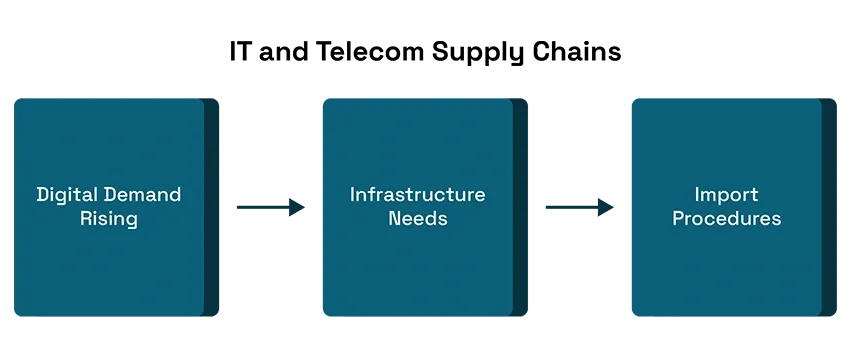
IT and Telecom Supply Chains
The demand for IT and telecom infrastructure is rising due to the expansion of digital services throughout Africa. To support growing digital networks, businesses, governments, telecom companies, and data-driven organizations require equipment.
Servers, networking gear, telecom hardware, data center equipment, and other technological infrastructure fall under this category.
It takes more than just making transportation arrangements for foreign technology corporations to supply this equipment to African markets. Import procedures, customs documentation, product specifications, taxes and tariffs, and local compliance requirements can all have an impact on the shipment of equipment.
Healthcare Supply Chains
Healthcare is another sector where reliable international supply chains are essential.
The prompt and secure delivery of medical equipment and technology is essential to hospitals, labs, clinics, and other healthcare facilities. Delays at customs or issues with documentation can result in serious operational issues for companies waiting for essential equipment.
Therefore, before shipping to African markets, international healthcare organizations must comprehend local import regulations. Various nations may have various requirements depending on the type of equipment, its intended use, and the organizations involved.
A well-planned supply chain can help healthcare organizations better handle local distribution, customs clearance, transportation, and regulatory requirements.
Aviation Supply Chains
International supply networks have a major role in aviation. Access to equipment, parts, and replacement parts from global suppliers is essential for aviation corporations, maintenance groups, and aircraft operators.
Because aviation equipment may need to travel across borders fast, reliable logistics can be especially crucial for Africa’s aviation industry. Aircraft availability and maintenance schedules may be impacted by a delay in customs clearance.
Therefore, before a cargo departs the place of origin, companies that offer aviation equipment must take into account the entire import process. It is advisable to review documentation, customs classification, import obligations, and local regulations beforehand.
Stronger logistics networks can assist businesses in supporting aircraft operators and maintenance operations throughout the continent as African aviation markets continue to grow.
Automotive Supply Chains
The automobile sector is also playing a significant role in the evolving supply-chain environment in Africa.
Several African economies are seeing growth in the production and assembly of automobiles, and the demand for automobiles and associated services continues to present prospects for global businesses.
Recent investments show that manufacturers are focusing more on Africa. For example, Chinese automaker Chery has announced plans to construct plug-in hybrid and electric vehicles at a former Nissan facility in South Africa.
Businesses need reliable transportation of automobiles, parts, machinery, and production-related supplies as their operations grow. Coordination between suppliers, freight companies, customs officers, and regional partners is necessary for this.
Therefore, rather than depending solely on imports of completed vehicles, the expansion of automotive production might establish new regional supply-chain relationships.
Technology Can Improve Supply-Chain Visibility
Another significant component of Africa’s supply-chain development is digital technology.
Businesses can have more management over their operations for enhances communication between supply-chain partners, warehousing systems, digital customs platforms, electronic paperwork, & shipment tracking.
Tracking might be mainly important for businesses carrying medical, automotive, aviation, or IT equipment. When something goes wrong, it can react more rapidly if they know where a shipment is & whether it has completed the need procedures.

Challenges Businesses Should Know
It is important to distinguish between a problem-free logistics environment and Africa’s supply-chain potential.
Businesses may encounter variations in import requirements, infrastructure, transportation networks, laws, and customs processes between nations. Depending on the destination and kind of shipping, logistics expenses can also differ dramatically.
Logistics, technology, fragmented markets, finance access, and regulatory inadequacies are some of the issues that UN Trade and Development has identified as potentially limiting Africa’s involvement in technology-intensive global supply chains.
Because of this, careful planning is crucial. Instead of treating transportation as the sole component of the supply chain, businesses should examine the entire import process before sending equipment.
Conclusion
Africa’s place in international supply chains is expanding, but each nation and industry should take advantage of this opportunity.
Moving technological infrastructure into expanding digital markets may be the main emphasis for telecom and IT corporations. Reliable routes for medical equipment may be necessary for healthcare organizations. Reliable equipment and part mobility may be necessary for aviation businesses. Automakers may be considering regional supply networks, manufacturing, assembly, and distribution.
Stronger ties between Africa and the larger global economy may result from the expansion of these sectors. Established global supply-chain hubs are not being replaced by Africa. Rather, it is developing into yet another crucial component of the network. Businesses that comprehend local needs will be better equipped to establish dependable operations throughout African markets as infrastructure, regional commerce, technology, and industrial capacity continue to advance.
Did you know?
Africa’s economic growth has outpaced the global average, and in 2025, seven of the ten fastest-growing economies were in Africa. Despite the high growth rates, African countries consistently rank among the lowest in many other economic and human development rankings, such as the UN’s Human Development Index and gross national income per capita.
FAQs
1. Why is Africa becoming more important in global supply chains?
Africa is attracting greater attention because of its growing digital, healthcare, aviation, and automotive sectors. Improvements in infrastructure, technology, regional trade, and logistics are also creating new opportunities for international businesses.
2. Which industries can benefit from Africa’s growing supply-chain role?
IT and Telecom, Healthcare, Aviation, and Automotive are four key industries that can benefit. These sectors depend on the reliable movement of equipment, parts, technology, and other business-critical supplies across borders.
3. What supply-chain challenges do businesses face when entering African markets?
Businesses may face different customs procedures, import regulations, transportation networks, infrastructure conditions, taxes, and documentation requirements from one country to another. Planning these requirements before shipping can help reduce delays.
4. How can technology improve supply chains in Africa?
Digital customs systems, shipment tracking, electronic documentation, warehouse management systems, and better communication between supply-chain partners can help businesses track shipments and manage cross-border operations more effectively.
5. What should companies consider before shipping equipment to Africa?
Companies should review the destination country’s import rules, customs requirements, product regulations, duties and taxes, documentation, and importer responsibilities before shipping. Requirements can vary significantly between African countries, so the process should be checked for each shipment.