
Introduction
In today’s highly competitive global trade environment, governments implement various trade remedies to protect local industries from unfair competition. These measures are important under international export regulations to confirm fair trade practices and safeguard national economic interests. Whether a country is part of a global supply chain service or looking at its import and export business, trade remedies play a major role in maintaining trade balance and industrial stability.
What Are Trade Remedies?
Trade remedies are policy tools used by governments to counter the negative effects of unfair trade methods or sudden import surges. They act as corrective mechanisms when local industries face injury due to dumped, subsidized, or unexpectedly high imports. These remedies, such as anti-dumping duties, countervailing duties, and safeguard measures, help restore fair competition in the local market. Such mechanisms work with Comprehensive import-export support systems and Customs clearance support services, confirming that fair pricing and equitable market conditions are maintained under global trade rules.
How do anti-dumping duties work?
Anti-dumping duties are applied when imported goods are sold at very low prices that harm local producers. Governments first investigate whether foreign companies are selling products below their normal value in their home market.
If it is proven that this practice is hurting domestic industries, extra duties are added to the imported goods to balance the price. This helps local businesses compete fairly and prevents market disruption.
These duties are usually applied for a specific period and are reviewed regularly. Proper documentation and compliance are important for importers to avoid penalties and delays in customs clearance.

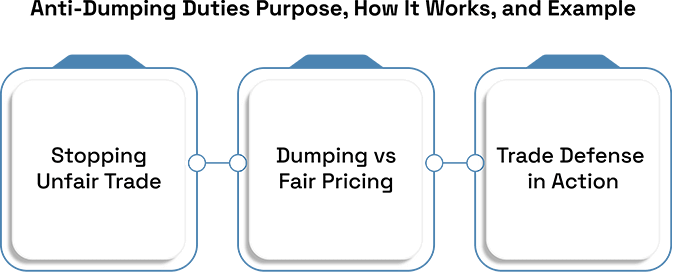
Anti-Dumping Duties: Purpose, How It Works, and Example
Purpose:
Anti-dumping duties are imposed to protect local industries from global exporters selling goods at prices lower than their normal value in the exporter’s local trade, a method known as dumping. These unwanted pricing issues affect the local market and damage local good producers.
How It Works:
When a country expects dumping, its trade authority investigates and, if confirmed, imposes anti-dumping duties on the imported goods. These duties equal the margin between the product’s fair value and its export price, thus invalidating the unfair advantage.
Example:
If a country exports steel to another market at a significantly reduced price, the importing nation may impose an anti-dumping duty to level the price difference. For instance, the U.S. has imposed anti-dumping duties on certain Chinese goods imports to protect its domestic producers.
This measure confirms a transparent and fair environment for importer-exporter work and supports the long-term trade of the import and export sector.
Countervailing Duties: Purpose, How It Works, and Example
Purpose:
Countervailing duties (CVDs) are applied when global producers receive unfair government subsidies, allowing them to sell goods at mainly low prices. CVDs aim to offset these subsidies and maintain equal footing between local and global producers.
How It Works:
After a thorough investigation, authorities impose CVDs equivalent to the amount received by the exporter. This stops market misrepresentation and protects local industries.
Example:
The European Union imposed countervailing duties on some IT imported from countries providing export subsidies. These duties help promote fair conflict within the import and export business systems and confirm agreement with international export regulations.
Safeguard Measures: Purpose, How It Works, and Example
Purpose:
Dissimilar anti-dumping or countervailing duties, safeguard measures are not targeted at unfair trade methods but at unexpected import growth that threatens local industries. They provide temporary comfort, giving local manufacturing time to adjust to increased competition.
How It Works:
Governments may impose limited-time import restrictions, such as quotas or tariffs, to reduce import size. These measures must follow World Trade Organization regulations and are mostly applied for a limited period.
Example:
A country may apply safeguard measures on imported aviation goods if a sudden rush harms its local manufacturer. This approach supports sustainable trade growth within the global supply chain services network and confirms industrial dependence.
Anti-dumping duties and countervailing duties are both trade remedies used to address unfair trade practices and ensure fair competition for domestic industries. They are applied after proper investigations that follow World Trade Organization guidelines. While both aim to protect local producers, they differ in their purpose. Anti-dumping duties are used when goods are exported at unfairly low prices, harming local markets.
On the other hand, countervailing duties are applied when exporting countries provide subsidies that give their products an unfair advantage. In simple terms, dumping is related to pricing, while subsidies involve government financial support. Understanding these differences helps governments, Importer of Record (IOR) services, and export customs brokerage professionals manage international trade more effectively.
Conclusion
Trade remedies such as anti-dumping, countervailing, and safeguard measures are important tools that advance fair competition and industrial safeguarding in the import-export business. They confirm that local industries are not undermined by unwanted fees or excessive imports, working with the methods of international export regulations and customs clearance support. Using these mechanisms, nations strengthen their involvement in the global supply chain, support sustainable trade growth, and create an equitable environment for all importer-exporter customers.
DID YOU KNOW?
There were 297 trade measure inspections on Vietnamese products. Countries have followed up and reviewed more than 100 trade measures annually.
FAQs:
-
What are trade remedies in international trade?
Trade remedies are government-imposed measures such as anti-dumping duties, countervailing duties, and safeguard measures used to protect domestic industries from unfair trade practices or sudden import surges.
-
What is the difference between anti-dumping and countervailing duties?
Anti-dumping duties address goods sold below fair market value (dumping), while countervailing duties offset unfair government subsidies given to exporters in foreign countries.
-
How do safeguard measures protect local industries?
Safeguard measures provide temporary relief when import volumes rise sharply, allowing domestic producers time to adapt to increased competition without permanently restricting trade.
-
Who regulates trade remedies internationally?
The World Trade Organization (WTO) governs trade remedies, setting global rules and procedures to ensure fairness and prevent misuse of such measures by member countries.
-
Why are trade remedies important for global supply chains?
Trade remedies promote fair pricing, prevent market distortion, and protect local manufacturing, ensuring stability and sustainable growth across the global supply chain.