Introduction
In the modern era of global trade and increasing digital work, businesses require tools that support the smooth shipment of goods and consistent operational visibility. As companies expand into new markets, manage Import duties and tariffs, or manage Warehousing solutions for import and export goods, the requirement for smarter operational support becomes necessary. A WMS increases warehouse work by improving accuracy, allowing Real-time shipment tracking, and supporting International freight services when goods move across regions. As customer expectations grow, mainly for dependable last-mile delivery services, flexibility becomes a major priority for any organization looking to stay advantageous.
What is a Warehouse Management System?
A WMS is a special software source designed to simplify the shipment, storage, and flow of goods within a warehouse. It provides a systems environment where goods can be received, stored, processed, picked, packed, and shipped with accuracy. For organizations working with Customs clearance or difficult import-related processes, such as HS code categorization or HTS harmonized tariff schedule mapping, having a capable WMS confirms far fewer errors and delays. A WMS supports everything from category layout to Shipment coordination, making it a central technology for organizations that work with Delivered Duty Paid service or supply goods to multiple regions.

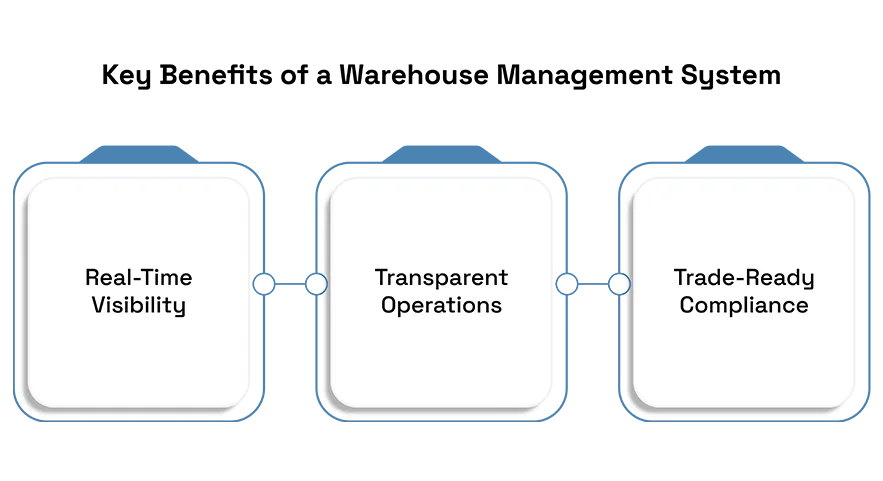
Key Benefits of a Warehouse Management System
One of the major advantages of a modern WMS is improved accuracy. It reduces issues in order picking, reduces inventory shrinkage, and aligns inbound and outbound processes. As businesses grow operations to support Transportation and warehousing or International freight services, accuracy becomes necessary for maintaining customer trust. Another benefit is process transparency. With Real-time shipment tracking combined into your system, both suppliers and customers can stay informed throughout the product shipping. A WMS also makes it easier to manage import export documentation and comply with various trade rules, such as Incoterms.
What does a Warehouse Management System do?
A WMS automates and manages daily warehouse tasks that were conventionally time-consuming. It directs workers on where to place goods, when to pick goods, and how to pack orders effectively. It monitors stock levels, signals reorder points, and confirms that inventory mismatches are minimized. When working with high-volume goods or difficult IOR services, a WMS organizes data that helps maintain approval and working speed. It also supports multi-warehouse environments and allows smoother integration when expanding systems or adding a new distribution hub. For global shippers who handle DAP shipments, Delivered Duty Paid service, or other multimodal movements, the system confirms visibility at each step, reducing delays caused by manual interventions.
Types of Warehouse Management Systems
Warehouse Management Systems generally fall into many categories depending on operational requirements. Separate systems are basic platforms used mainly for inventory control and manual task tracking. Cloud-based WMS solutions provide scalability, flexibility, and easier integration with tools that manage Supply chain management, warehousing, and Transportation and warehousing. Combined WMS systems connect deeply with the organization’s software, allowing better management of International freight services and complex workflows involving Customs clearance. Advanced WMS solutions even come with AI-driven analytics to forecast demand and stop stockouts.
How to Select the Right Warehouse Management System
Selecting the right WMS begins with understanding the scale and nature of your operations. Organizations dealing with Warehousing solutions for import and export goods should look for platforms that support Import duties and tariffs calculations and smooth import export documentation. If your business method heavily depends on last-mile delivery services or Real-time shipment tracking, you require a system with strong integration capabilities. Evaluate how well each WMS can handle high-order volumes, multi-location coordination, or product-level visibility. It is also necessary to get vendor support, future scalability, and compatibility with other tools used in International freight services or DAP and DAPs’ shipping system.
Conclusion
A Warehouse Management System is more than a software tool; it is the start that supports operational excellence, efficiency, and long-term scalability. For organizations guiding global trade, working with Customs clearance, managing Import duties and tariffs, or using Delivered Duty Paid service, selecting the right WMS confirms smooth work at every stage. As markets develop and customer expectations rise, businesses that invest in strong warehousing technology will always remain a step ahead.
DID YOU KNOW?
According to an Accenture report, 96% of executives indicated that the integration of information technology and operational technology will have a transformative impact on their industries in the next 10 years.
FAQs:
What is a Warehouse Management System (WMS)?
A WMS is software designed to streamline warehouse operations, including receiving, storing, picking, packing, and shipping goods. It improves accuracy, visibility, and workflow efficiency.
Why is a WMS important for import and export businesses?
A WMS supports customs clearance, import/export documentation, HS code mapping, tariff management, and tracking international shipments, reducing errors and delays.
What features should I look for when choosing a WMS?
Key features include real-time inventory tracking, integration with freight systems, multi-warehouse support, automation tools, order accuracy control, and customs documentation capabilities.
How does a WMS help with real-time shipment tracking?
A WMS integrates with logistics platforms to provide live updates on order status, location, and transit progress, improving visibility for suppliers and customers.
Can a WMS scale as my business grows?
Yes. Modern WMS solutions, especially cloud-based ones, offer scalability to support additional warehouses, higher order volumes, and new distribution channels.