Overview
The U.S. logistics sector is rapidly evolving as companies embrace advanced technologies to meet growing global trade demands. With increasing shipment volumes, complex regulatory environments, and rising customer expectations, businesses are shifting toward digital transformation to remain competitive. Technology adoption is no longer optional—it has become a strategic necessity for improving efficiency, reducing costs, and ensuring compliance.
For businesses that import and export goods in areas like IT, aviation, medical equipment and automotive this change is very important. These industries need things to be precise, fast and reliable and that is why advancements in technology are key to their success in today’s logistics. They help businesses in these areas to move goods quickly and accurately.
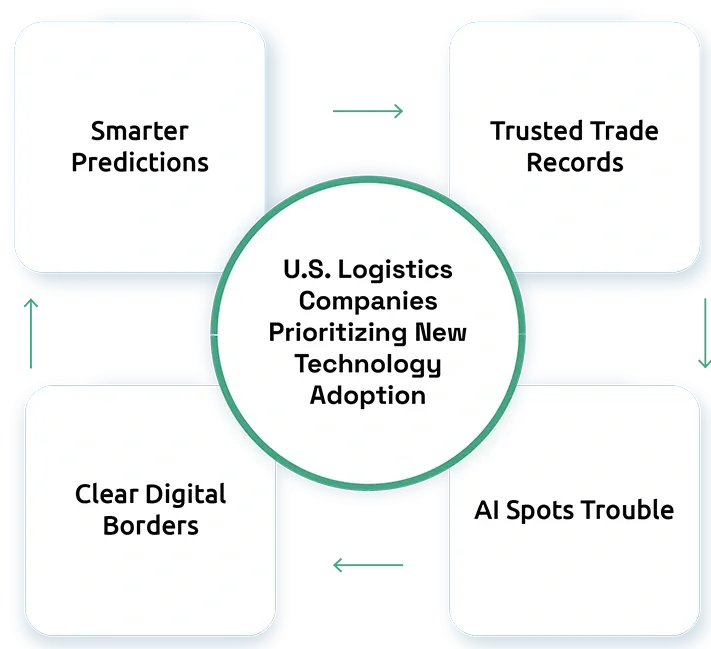
U.S. Logistics Companies Prioritizing New Technology Adoption
U.S. logistics companies are using technologies like AI, automation, IoT, & blockchain to improve supply chain efficiency & accuracy.
Automation is simplifying warehouse operations, reducing errors, & supporting demand predicting & route improvement.
IoT-based real-time tracking provides continuous shipment clarity, especially for high-value and sensitive cargo.
Blockchain improves data security & transparency by creating tamper-proof transaction records in trade operations.
Digital platforms are also simplifying documentation & compliance, reducing errors & improving regulatory efficiency.
Technology-Driven Transformation in Global Trade Operations
The way things work is changing because of technology. These new technologies are changing the way the world trades with each other. These digital ecosystems help manufacturers and suppliers and people who move goods around work really easily. The way technology is being used is really changing the way global trade works. Now we have ecosystems that let manufacturers and suppliers and logistics providers work together really easily. This is making a difference in global trade processes. Technology is helping manufacturers and suppliers and logistics providers to work seamlessly.
Predictive analytics is another game-changer. By analyzing historical data and market trends, companies can anticipate potential disruptions and take proactive measures. This is especially valuable in industries like automotive and aviation, where delays can have significant financial and operational impacts.
Furthermore, cybersecurity has become a top priority as digital adoption increases. Logistics companies are investing in robust security measures to protect sensitive data and maintain the integrity of their operations.
Sustainability is something that technology is really helping with. Technology is making a difference when it comes to sustainability. This means companies are also lowering their carbon footprint when they use technology for sustainability. Technology and sustainability are teaming up to help make sustainability a reality and sustainability is the goal here. Sustainability is what matters most.

Conclusion
The U.S. Logistics companies are now focusing on adopting technology. This is a change in how global trade works. They are using things like Artificial Intelligence, Internet of Things, automation and blockchain businesses to enhance efficiency, improve transparency, and strengthen their competitive position.
For import-export companies that work with IT, aviation, medical equipment, and automotive sectors, it is really important to keep up with technology. Import-export companies need to be able to change with the market and use tools. This will help import-export companies do well in the run when it comes to trading with other countries, which is getting more and more complicated. Import-export companies have to be good at adapting to things to succeed.
As the industry keeps changing technology will still be key in changing logistics. It will help businesses make supply chains that’re stronger, work better and are ready for what’s next.
DID YOU KNOW
100% of BTS freight datasets are now published in digital, interactive formats (e.g., Freight Facts & Figures, Supply Chain & Freight Indicators dashboards).
FAQs
1.How are U.S. logistics companies improving supply chain visibility with digital systems?
U.S. logistics companies are using digital platforms, GPS tracking, & data connection systems to improve real-time supply chain visibility, reduce delays, & improve shipment coordination across multiple shipping modes.
2. What are the key benefits of data-driven logistics systems in the United States?
Data-driven logistics systems help U.S. companies improve route planning, reduce predicted delivery delays, & improve overall freight efficiency using analytics and real-time operational data.
3. How does real-time tracking benefit global logistics operations?
Real-time tracking provides complete visibility of shipments, allowing businesses to monitor cargo conditions, respond quickly to disruptions, and ensure timely deliveries.
4. What role does automation play in logistics?
Automation streamlines warehouse operations, reduces human errors, speeds up order processing, and helps companies manage large shipment volumes more efficiently.
5. How is technology improving compliance in international trade?
Digital platforms and compliance software help businesses manage documentation, follow regulations, and reduce the risk of errors, delays, and penalties in cross-border trade.