Overview
The decision by the Taiwan Semiconductor Manufacturing Company (TSMC) to receive an annual license allowing the import of U.S. chip making equipment into China shows an important development in global semiconductor trade. At a time when technology restrictions and geopolitical tensions are changing the manufacturing chain, this regulatory approval shows a complete approach between national security problems and economic continuity. Semiconductors are required for nearly every new industry, from consumer electronics and electric vehicles to healthcare equipment and advanced computing. The license provides a controlled pathway that allows operations to continue while maintaining regulatory problems in countries.
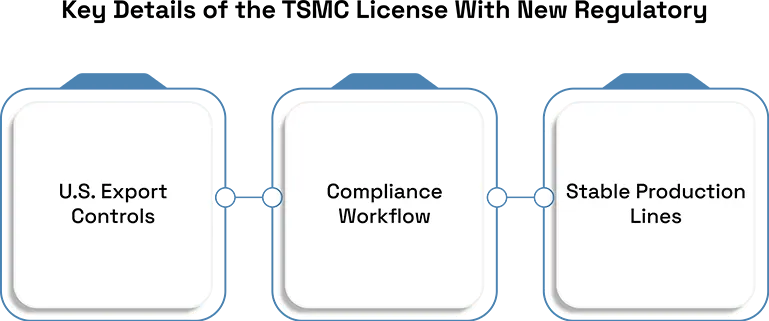
Key Details of the TSMC License With New Regulatory
Regulatory Background Of Providers
The approval comes under the export control system overseen by the United States Department of Commerce. These regulations look to reduce access to advanced semiconductor technologies while still permitting some logistics activities under strict approval conditions. Instead of issuing repeated short-term approvals, regulators confirmed TSMC for an annual authorization. This reduces operational disruptions and administrative delays, allowing the company to maintain predictable production schedules at its facilities in China.
What occurred following the previous VEU authorization?
TSMC’s Nanjing facility previously operated under a Validated End User (VEU) authorization for certain U.S.-controlled items. That authorization expired on December 31, 2025. For 2026, the U.S. Department of Commerce granted TSMC Nanjing an annual export license, creating a new authorization route for approved U.S.-origin equipment and items. The license does not remove U.S. export controls; shipments still have to meet the conditions of the authorization.
What the License Allows
The license mainly permits the import of approved U.S.-origin chipmaking tools used for maintaining and working under existing semiconductor production lines. It does not provide unrestricted access to the most advanced manufacturing technologies. Authorities continue to track equipment categories, usage conditions, and approval reporting requirements.
Why Annual Licensing Matters
An annual system improves stability for manufacturers and suppliers in China. Frequent approvals mainly create uncertainty in procurement planning, inventory, and order management, and long-term investment decisions. With a longer authorization schedule, organizations can align sourcing strategies and reduce working risks without compromising regulatory safeguards.
What the Annual License Does Not Allow
The annual authorization does not mean that TSMC can freely import every type of U.S. semiconductor manufacturing technology into China. The authorization applies to items covered by its specific terms and remains subject to U.S. export-control requirements. TSMC’s Nanjing facility is associated with mature-node semiconductor production, including 16-nanometre technology, rather than unrestricted access to the most advanced manufacturing equipment.
What’s the Use of the TSMC License for Import
The license plays an important role beyond the regulatory approval of china’s regulatory. Semiconductor production depends on highly specialized equipment that requires constant modernization, calibration, and replacement of components.
Equipment manufacturers working in China, the license confirms continuity in equipment servicing and technological maintenance. This helps avoid production slowdowns and stops disruptions that could impact global electronics supply. It also supports stability in international freight services and customs clearance processes by providing clear documentation requirements recognized by authorities.
Also, structured licensing improves approval operations. Companies importing equipment must have approval to export, correct documentation, and transparent reporting methods. These help reduce continuous paperwork errors and minimize delays caused by regulatory problems.

How IOR Service Providers Support Semiconductor Equipment Imports into China
Role of Importer of Record Support
Importer of record service providers play a critical role in managing regulated shipments. When specialized semiconductor tools ship across borders, approval accuracy becomes as important as logistics itself in China. They coordinate documentation, verify regulatory categorizations, and manage customs communication to stop shipment holds. This becomes mainly valuable when working with sensitive technologies governed by strict export controls.
Approval and Documentation Management
An IOR provider can help ease the import process on the China side by coordinating the relevant customs documentation, importer information, duties, taxes and communications with customs brokers. U.S. export-control licensing, however, remains a separate requirement. The relevant exporter and other parties must ensure that the shipment is authorized before the equipment is dispatched.
Supply Chain Efficiency
Working with experienced providers also supports supply chain optimization. Proper planning reduces inventory imbalances, avoids unnecessary storage costs, and confirms equipment arrives within required schedules. In highly technical industries, correct timing and controlled environments are necessary to maintain equipment reliability.
Conclusion
The annual licensing arrangement confirmed to TSMC highlights how governments and industry leaders are attempting to balance economic growth with major miscalculation. Allowing controlled access to U.S. chip making equipment, regulators support ongoing semiconductor production while maintaining strict monitoring standards. For businesses required in cross-border semiconductor operations, understanding licensing requirements and working with qualified approval partners is mainly important in China. As global technology trade continues to develop, a structured regulatory method such as this one will likely shape how advanced manufacturing ecosystems operate in the years ahead.
DID YOU KNOW?
TSMC also has a chip making plant in Shanghai. TSMC said in its 2024 annual report that its Nanjing site generated about 2.4% of its revenue.
FAQs:
1. What occurred to TSMC’s Nanjing plant in 2026?
TSMC’s previous VEU authorization expired at the end of 2025. For 2026, the U.S. Department of Commerce granted an annual export license covering approved U.S.-controlled items for the Nanjing facility.
2. What does the TSMC U.S. equipment license allow?
The license permits the import of specific chipmaking tools used for maintenance and operation of existing production lines, not unrestricted access to the most advanced semiconductor technologies.
3. Who regulates semiconductor export licenses to China?
Export controls are overseen by the United States Department of Commerce, which manages approvals under U.S. export control laws.
4. How does the TSMC license impact global semiconductor supply chains?
It reduces operational uncertainty, supports equipment servicing, and helps stop disruptions that could affect electronics, automotive, and healthcare industries worldwide.
5. Does an IOR license a U.S. semiconductor equipment export to China?
No. An IOR provider supports the import and customs side of the shipment in China. U.S. export licensing is a separate process and must be handled under the applicable U.S. export control rules.