

Nearshoring: Concepts and Application in the Industry
Nearshoring is the act of relocating manufacturing or logistics to the target market, usually to a neighboring nation. This is unlike offshoring, which is a process of moving operations to other distant countries. In the case of industries that deal with aviation equipment, automobile parts, medical equipment, and IT hardware, nearshoring minimizes transit time and also minimizes risks. The shorter the distance, the faster the port-to-port shipment, and the flexibility and adjustment of the supply chains to demand changes.
The Driving Forces Behind Nearshoring in Equipment Shipping
The increase in nearshoring is being driven by a number of major factors. Companies are looking at supply chains that will stand up to geopolitical friction and unforeseen tampering, such as pandemics. By proximity to key markets, nearshoring will provide reduced costs of transportation, primarily through air freight shipping. The shift in the labor markets and wage growth in foreign countries also makes companies consider moving production closer. In the case of industries that have complex and high-value equipment, nearshoring is more in line with high-quality and regulatory demands that enable easier compliance.

Nearshoring vs. Offshoring: Benefits and Challenges for Shipping Equipment
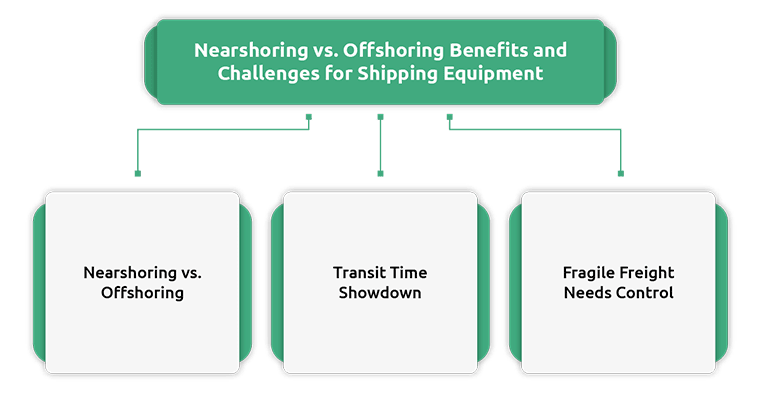
Among the advantages of nearshoring there is faster transit time, faster clearance at customs, and better tracking of port-to-port shipments. Offshoring may also have lower labour prices, but typically takes longer transportation time and increases freight costs. It may also bring additional risks and a lack of control in the supply chain. Nearshoring allows companies to have freight forwarding and customs clearance, as well as import-export compliance, better managed. Shipping heavy and fragile equipment like aviation equipment or healthcare equipment is a critical issue of this control to ensure transportation safety and efficiency.
Regional Hotspots for Nearshoring of High-Tech Equipment
Mexico is one of the top destinations of nearshoring in Latin America due to the characteristics of its proximity to the North American market and established networks of air freight. Another central location is Eastern Europe, which supplies Europe particularly with IT and automotive parts. The regions have an excellent warehouse infrastructure, including amenities such as white glove delivery of delicate and expensive devices, which address issues such as volumetric weight in air transport. Processing times are also accelerated by regional proximity and, hence, fast turnaround.
Technology’s Role in Efficient Nearshoring Supply Chains
Technology is also critical in maximizing nearshoring. Digital tools are used to integrate warehousing, freight forwarding, and airline operations to coordinate them effectively. The software used in logistics management enhances inventory management. It enables real-time tracking of shipments, thereby increasing supply chain visibility. Online teamwork platforms enhance coordination and decision-making among all stakeholders. Automation and robotics in the warehousing of delicate medical equipment allow it to work with the accuracy of the IT equipment, which is a compromise between quality and speed.
The Effect on Globalization: A move to sustainable and resilient trade
Nearshoring can be regarded as an indicator of a new age of globalization, where the emphasis is on shorter shipping distances & sustainability. Companies can reduce the carbon footprint of long-haul air & sea freight by shifting production to markets closer to their consumers. This not only benefits the environment but also makes a more resilient & adaptable supply chain to face any unexpected market transformation or disruption. Nearshoring is not a retreat from globalization, but rather a process of adopting a more comfortable, geographically focused, and environmentally conscious pattern of trade.
This trend enables the creation of agile supply chains that can respond more effectively to changes in demand and regulations. Many companies regard nearshoring as a means of reducing risks associated with geopolitical tensions, pandemic disruptions, and tariff uncertainty. The increased momentum towards sustainability is in tandem with the global policies and corporate social responsibility agendas, and nearshoring is the centre of future trade strategies.
Conclusion
Nearshoring requires reforming logistics and supply chain planning. Effective air freight transportation, in conjunction with professional management by the importer of record and the exporter of record, ensures compliance and facilitates easy customs clearance. One Union Solutions provides port-to-port freight forwarding solutions, warehousing services, and specialized solutions for aviation, automobiles, healthcare, & IT equipment. The practice of nearshoring is an effective way for companies to maintain flexibility and minimize risks, while also responding to emerging global trade requirements without hesitation.
Did You Know,
The global air freight market hit $257 billion in 2023 & is projected to surpass $500 billion by 2030. This growth is driven by technology, healthcare, aviation, and automotive equipment shipping, supported by advanced tracking and green logistics.
FAQ’s
What is nearshoring, and how does it help in shipping high-value equipment?
Nearshoring brings manufacturing or logistics closer to markets, cutting down transit time and risks. It also allows quicker port-to-port delivery and enhanced visibility of the supply chain.
What is the nearshoring value in air freight logistics of specialized equipment?
Nearshoring reduces distances, increases speed, and reliability. It reduces the time spent at customs and risks damage to fragile IT and automobile parts.
What is the role of the importer of record in nearshoring logistics?
The importer of record takes care of import compliance, customs clearance, and documentation, which prevents wastage of time and ensures regulatory compliance.
How does technology play a role in nearshoring supply chains?
The digital solutions optimize the inventory, visibility of the deliveries in real time, and communication during freight forwarding, warehousing, and customs.
In nearshoring, why should port-to-port shipping be used with aviation equipment and healthcare equipment?
Port-to-port shipping benefits optimizing logistics hubs at both ends of origin and destination, and reduces the risk of handling as well as coordinated transportation of heavy and delicate equipment.


