Insight
Businesses are faced with the challenge of reaching profitability & ensuring that the company grows sustainably to grow globally. Sustainability in trade has become an integral part of ensuring long-term business success with the least environmental damage. With organisations being eyed more closely than ever for responsibility in their operations, companies must strive to implement more sustainable processes to compete in the market and abide by changing regulations worldwide.
Sustainable trade practices call for environmentally responsible policies to be mainstreamed throughout the supply chain and business practices. The objective is to minimise negative externalities and instill ethics that underpin long-term business prosperity. However, the struggle is real for firms trying to balance the bottom line and the environment. It takes a real dedication to being green in concert with quality and the bottom line.
The Importance of Sustainable Trade Practices
Sustainability in trade is a necessity for several reasons. They assist companies with compliance, build their reputation, establish consumer trust, and provide chances to save costs. In an era of environmental consciousness, businesses that care about the environment have come to be seen as pioneers of their industries and to secure customer loyalty in favour of environmentally friendly options.
In addition, corporations can use sustainable trading strategies to help mitigate the risks of environmental legislation, supply chain inefficiencies, and the increasing price of materials. For instance, businesses that operate on more energy-efficient processes or source their materials responsibly will have lower chances of bearing future costs related to compliance problems or scarcity of raw materials.

Role of Global Regulations in Sustainable Trade
Global trade regulations are rapidly supporting businesses in implementing sustainable practices as part of mandatory compliance frameworks. Global organizations are presenting stricter environmental rules that directly affect import & export operations. Companies are expected to follow sustainable rules while sustaining trade efficiency & competitive advantages. Failure to follow may result in fines, shipment delays, or restricted market access. This makes regulatory coordination a critical factor in global business strategy. Businesses that adapt early gain smoother approvals and stronger global reliability. Over time, compliance-based sustainability is becoming a key requirement rather than a choice in global trade.
Key Aspects of Sustainable Trade Practices
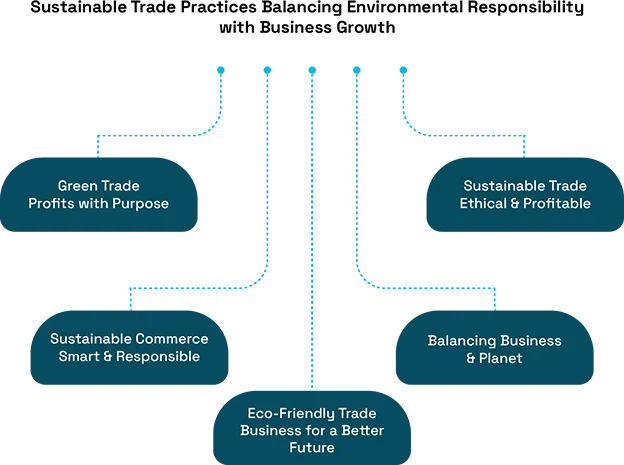
Eco trade Sustainable trade is about reducing your environmental impact while keeping your business as efficient as possible. Green SCM practices include sustainable sourcing, waste reduction, and reduced carbon footprint. Green technology and energy efficiency, such as solar power and electric vehicles, limit dependence on fossil fuels and minimize emissions. Eliminating waste and recycling efforts, such as zero-waste practices, work to maximize resources and reduce waste sent to landfills via improved packaging and reuse innovations. Ethical labour practices guarantee fair pay, labour rights, and safe working conditions, factors that impact long-term business success. Finally, compliance with regulations and reporting can make businesses comply with the world’s conscience about the environment and develop responsibly for sustainability.
Achieving a Balance Between Growth and Sustainability
One of the largest obstacles to sustainable business trading is the balance between environmental responsibility and business growth. On the one hand, companies want to grow into new markets and increase profit. On the other hand, they need to minimise their environmental impact, curb resource exhaustion, and plan their activities in light of sustainability objectives.
The secret to finding this balance, the campaign says, is to bake sustainability into the business as a whole. For example, buying energy-saving machinery may involve a substantial initial outlay. Still, in the long run, it will contribute to huge savings in the energy bills. Likewise, transitioning to sustainable materials may cost more upfront, leading to more resilient supply chains and a favorable brand perception and, ultimately, contributing to the vendor’s bottom line.
Sustainable practices within operations create new business prospects. The growing awareness about environmental impact in consumer purchases has led numerous people to back companies that embody their values. Implementing sustainable trade practices helps businesses attract new customers, set themselves apart from rivals & reach markets dedicated to environmentally friendly business practices.
Conclusion
Sustainable trade practices have become essential for businesses that want to grow instead of being optional. Businesses have two major benefits from embracing sustainability: they protect the planet and achieve market-leading positions. Business operations implementing sustainable methods across all functions ensure lasting growth with decreased environmental influence. One Union Solutions devotes itself to guiding businesses through sustainable trade challenges as they strive to run responsibly and reach their objectives.
Did you know?
Research by UNEP shows that 65% of consumers are willing to pay more for sustainable products, and 83%of executives believe sustainability is vital for future business success.
FAQs
What makes trade sustainable?
Sustainable trade schemes are conceived as policies that address the environmental impact of business, its labor standards, the efficient use of resources, and compliance with environmental regulations.
How can a business balance sustainability with growth?
Businesses can combine growth & sustainability by incorporating sustainability into operations, investing in energy-efficient technologies and sourcing ethically while still growing and meeting the market.
What are the key benefits of sustainable trade practices?
Sustainable trade practices help businesses reduce operational costs, enhance brand reputation, attract investment, improve compliance with regulations, and open up new markets focused on eco-friendly products.
How do sustainable trade practices improve business performance?
Sustainable trade practices improve efficiency and reduce waste in operations. They help companies save costs and optimize resource use. Over time, they strengthen overall business performance and competitiveness.
What challenges do companies face in sustainable trade?
Companies often face high initial costs and operational changes. Adapting to strict environmental regulations can be difficult. However, it leads to long-term savings and a better market reputation.