Introduction: Why Southeast Asia Is Becoming an Export Powerhouse
Southeast Asia is starting to play an increasing part in international exports and trade. ASEAN’s production exports increased by almost 14% in 2025, showing the region’s growing position in global trade. As companies search for new places for sourcing & production, this growth will continue in 2026. Diversification of the supply chain is an important factor in this change. Vietnam, Malaysia, Thailand, Indonesia, Singapore, & other countries are drawing investment in high-quality production, technology, electronics, and semiconductors. Due to its position and strong economic connections, Southeast Asia is also connected to important markets in North America, Europe, and Asia. Technology, foreign investment, new supply chains, & growing local demand will be key drivers of Southeast Asia’s next export growth wave. This opens up new export opportunities for companies, but it also makes it important for understanding the market trends and trade regulations of every country.
Why Southeast Asia’s Export Economy Is Growing
Stronger regional trade, foreign investment, production, & changing global supply chains are all supporting Southeast Asia’s export growth. While ASEAN’s share of world foreign direct investment (FDI) reach about 15% in 2024, its share of global goods exports has grown since 2018. This shows how Southeast Asia is growing in importance in international supply chains and trade. Another important factor is the diversification of the supply chain. To reduce their dependency on a single market, companies are growing their sourcing and production networks to include Southeast Asian nations. Opportunities in electronics, electrical devices, semiconductors, and other industrial areas are growing for Vietnam, Malaysia, Thailand, Indonesia, and other ASEAN economies. ASEAN has grown its share of U.S. imports in a number of tariff-affected industries, due to the IMF’s 2026 analysis, and it also has grown its role in global value chains. ASEAN’s economic growth is also helped by foreign direct investment (FDI). The 2025 ASEAN Investment Report indicates that FDI inflows grew by 8% to $226 billion, while industry FDI increased by almost 150% to $44 billion. The digital economy and supply-chain industries receive a significant part of this investment.
Trade within the region is another advantage. In 2024, intra ASEAN trade made up 21.4% of all ASEAN trades, showing the importance of global trade integration. China, the US, & the EU are still important trading partners outside of the EU. Even in 2026, these trends are going to continue. For example, in June 2026, Malaysia’s exports increased 45.4% year over year due to high demand for semiconductors & electronics. Southeast Asian export markets have received new opportunities because of increased industrial investment, global trade, & supply-chain diversity.
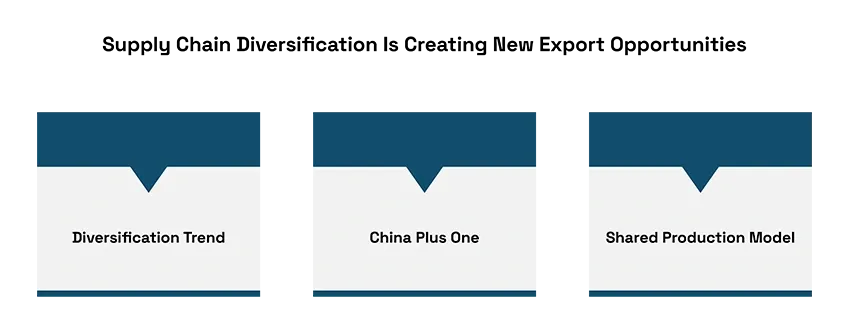
Supply Chain Diversification Is Creating New Export Opportunities
Diversification in the supply chain is changing how global companies source and produce goods. Many companies are growing into Southeast Asia in order to develop stronger. supply chains rather than depending on only one country. With Vietnam, Malaysia, Thailand, Indonesia, & Singapore playing different roles in electronics, semiconductors, automotive, and advanced production, interest in the China Plus One method has grown. Based on factors including cost, infrastructure, expertise, and market access, businesses may also share production among a number of ASEAN countries. Geopolitical issues may still have an effect on local trade, but this makes Southeast Asia an important new industrial location and a developing hub for the ASEAN supply chain.
The Rise of Digital Trade and Cross-Border E-Commerce
Digital trade in Southeast Asia is giving companies new opportunities for marketing globally. Online marketplaces, digital payments, electronic documents, and improved logistical systems all help the growth of ASEAN e-commerce. The size of the opportunity is shown by the prediction that the larger Asia-Pacific B2B e-commerce market will go above $28.9 trillion in 2026. Cross-border e-commerce can help SMEs in Southeast Asia in reaching customers worldwide without having an important local presence. Additionally, digital supply chains, digital customs processes, & electronic trade can speed up and simplify international transactions.

What the Next Wave of Southeast Asian Exports Could Look Like
Higher-value sectors are replacing traditional manufacturing in Southeast Asian trade. ASEAN countries are becoming more involved in advanced manufacturing, technology, semiconductors, electric vehicles, batteries, and digital trade. Different advantages are being developed in different regions by Malaysia, Vietnam, Thailand, Singapore, and Indonesia. This change may improve ASEAN’s standing in global supply chains and set up new trade opportunities. Southeast Asia’s export prospects will also be impacted by the market’s needs infrastructure, trained workers, and investment. As these industries grow, new export industries can add to the region’s change to more high-tech and valuable exports.
Conclusion: Southeast Asia’s Export Growth Is Entering a New Phase
Southeast Asia is no longer just a low-cost manufacturing location as it once was. Semiconductors, electric vehicles, digital trade, new production, and improved regional supply chains will all have more important part in Southeast Asian trade in the future. New export opportunities can develop from increased FDI & intra-Asian trade. Businesses must, however, also be ready for changing national laws, customs requirements, & geopolitical changes. Businesses looking to benefit from the next stage of the region’s export growth will need to understand local trade rules.
Did you know
The region’s B2B digital commerce market surpassed $90 billion in 2024 and is set to reach $130 billion by 2026, with trade agreements, digitization, and supply chain resilience at the core.
FAQ
Why is Southeast Asia important for global trade?
Southeast Asia has growing manufacturing, technology, & export industries. Its strong trade links also connect businesses with major global markets.
How is technology changing Southeast Asian exports?
Technology is helping the industry produce more advanced and higher-value products. Semiconductors, electronics, EVs, & digital trade are becoming important export areas.
Is Southeast Asia good for supply chain diversification?
Yes, many companies are helping Southeast Asian countries to their supply chains. This can reduce dependence on one production location & improve supply chain flexibility.
What challenges can affect Southeast Asia’s export growth?
Businesses may face changing tariffs, geopolitical risks, and different country rules. Customs rules & require documents can also different across Southeast Asian markets.
How does FDI support Southeast Asian exports?
Foreign direct investment helps businesses build factories, technology networks, & supply chains. This can increase production and create more export opportunities.