Overview
The Netherlands has grown as a major player in the global semiconductor supply chain, specifically in the export of advanced chip-making equipment. As demand for semiconductors continues to grow globally due to AI equipment, electric vehicles, and consumer electronics, the country is developing its semiconductor equipment exports to global trade. Dutch organizations, mostly industry leader ASML, are at the important of this growth, supplying crucial technology equipment and machines necessary for advanced chip production. This growth shows both economic opportunity and geopolitical difficulty, as governments mainly regulate guidelines for sensitive technologies.
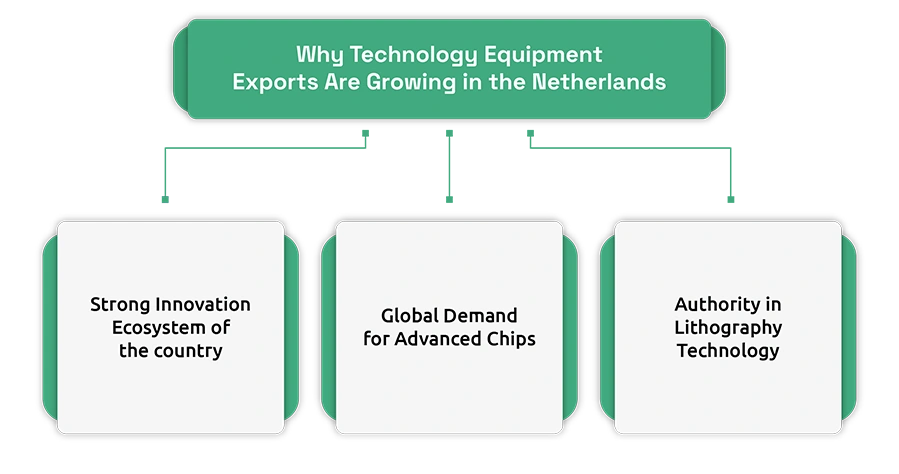
Why Technology Equipment Exports Are Growing in the Netherlands
Strong Innovation Ecosystem of the country
The Netherlands gets an advantage from a highly developed innovation in the country, supported by a strong partnership between universities, research institutions, and private organizations, such as TNO, which contribute mainly to technological growth and allow continuous improvement in semiconductor manufacturing tools.
Global Demand for Advanced Chips
The quick usage of AI, cloud computing, and 5G technologies has huge global demand for high-performance semiconductor devices. Countries such as the United States, China, and South Korea depend massively on advanced chipmaking equipment, creating strong export opportunities for Dutch manufacturers.
Authority in Lithography Technology
The Netherlands holds an adjustment in extreme ultraviolet (EUV) lithography, an important technology used to produce the most advanced chips for devices. ASML is the only organization that manufactures EUV machines globally, making it necessary for global semiconductor production in the country.
Netherlands to Change Export Controls on Semiconductor Equipment
Geopolitical Pressures and Major Interests
The Dutch government has been mostly working on its export control guidelines with partners such as the United States to restrict the change of advanced semiconductor technologies to some regions. These shows are looking to balance economic growth with national security problems.
New Permits Requirements
Recent policy updates require organizations exporting advanced semiconductor equipment to get licenses for specific destinations. These controls specifically affect high-end lithography systems, which are considered sensitive technologies due to their possible major applications using semiconductors.
Impact on Trade Relations
While export controls may limit access to some markets, they also improve partnerships with nations. Also, collaboration between the Netherlands and Japan has increased for semiconductor chips, as both countries have secure and flexible semiconductor supply chains.
Netherlands Semiconductor Equipment Manufacturing Market Analysis
Market Leadership and Major Players
The Dutch semiconductor equipment industry is dominated by globally recognized organizations such as ASML, ASM MNC, and BE Semiconductor Industries of the country. These companies specialize in different devices, such as lithography, deposition, and packaging technologies. The global chip shortage and growing demand for electronics have led to growing investments in semiconductor manufacturing, simplify globally growing demand for Dutch equipment.
Trade Approval and Export Operations
In the context of growing exports, trade agreements and operational efficiency play a vital role in Netherland. Exporters frequently depend on schemes such as the Generalized System of Preferences (GSP) to improve tariff advantages in eligible markets. Shipping terms such as DAP and DDP shipping under globally recognized Incoterms help define responsibilities between buyers and sellers, confirming easy shipments.
Correct good categorization using the HS code and the HTS Harmonized Tariff Schedule is necessary for showing duties and regulatory requirements. Effective logistics and international freight services support the timely delivery of difficult semiconductor equipment across borders.
Exporters also depend on the exporter of record services and the importer of record services to manage legal responsibilities during cross-border shipments. Customs clearance processes must be managed carefully to avoid delays, frequently supported by the best trade compliance software for import export rules that confirm approval to regulations in the country.
Modern supply chain optimization strategies, along with strong inventory and order management systems, help organizations simplify operations and reduce costs. Questions such as “can a freight forwarder be an exporter of record?” and “can a customs broker handle both import and export documentation” are mostly related, as businesses look for combined solutions to simplify global trade shipments.

Conclusion
The Netherlands is showing its role as a global leader in semiconductor equipment exports, driven by innovation, strong industry players, and growing global demand in the world. Organizations like ASML continue to change the future of chip manufacturing, making the country necessary to the global technology ecosystem in logistics. Also, the expansion of export controls shows the fragile balance between economic growth and geopolitical plans in shipments of semiconductor equipment.
DID YOU KNOW?
The Dutch semiconductor equipment manufacturer BE Semiconductor Industries N.V. (Besi) is considering investing $1 billion in Vietnam as part of its extensive global expansion in the field of semiconductor manufacturing infrastructure.
FAQs:
1. Why is the Netherlands important in the semiconductor industry?
The Netherlands is crucial due to its leadership in advanced chip-making equipment, especially lithography machines produced by companies like ASML, which are essential for manufacturing modern semiconductors.
2. What is EUV lithography and why is it important?
Extreme Ultraviolet (EUV) lithography is an advanced technology used to produce highly complex and powerful semiconductor chips. It enables smaller, faster, and more efficient electronic devices.
3. Why are semiconductor export controls increasing?
Export controls are rising due to geopolitical concerns, especially to restrict sensitive technologies from reaching certain countries and to protect national security interests.
4. How does global demand affect semiconductor equipment exports?
Growing demand for AI, 5G, electric vehicles, and cloud computing is increasing the need for advanced chips, which directly boosts exports of semiconductor manufacturing equipment.
5. What role do trade compliance and logistics play in semiconductor exports?
Trade compliance ensures adherence to international regulations, while efficient logistics and supply chain management enable safe and timely delivery of complex semiconductor equipment worldwide.