AI infrastructure deployments often involve high-value GPUs, AI accelerators, GPU servers, high-performance computing systems, & supporting network equipment. Shipping this hardware across borders isn’t the same as importing ordinary IT equipment. Product specifications, country of origin, destination, end user, & intended use can all affect the compliance review.
An Importer of Record can manage the importer-side needs, such as customs documentation, import declarations, duties, & local compliance coordination. However, an IOR does not replace export-control screening or remove licensing requirements that may apply before the equipment leaves the country of export.
Why AI Hardware Is Different From Ordinary IT Equipment
AI GPUs and accelerators can be costly, technically difficult, and subject to detailed product classifications. Some updated computing products may also fall within export-control frameworks depending on their technical characteristics and the transaction.
This means a company planning a global AI infrastructure deployment should not treat a GPU shipment simply as a standard electronics import.
The compliance review should consider the product, destination, buyer, ultimate end user, and intended end use before shipment.
What Equipment Is Included?
AI infrastructure shipments can include some types of equipment, including:
- AI GPUs and accelerator cards
- GPU servers
- High-performance computing systems
- AI training and inference hardware
- High-speed networking equipment
- Storage systems
- Server components and replacement parts
- Racks and related data-center infrastructure
The exact classification depends on the product and its technical specifications. Companies should use manufacturer documentation & applicable government classification tools rather than assuming that every GPU or server has the same regulatory treatment.
Import Compliance vs. Export-Control Compliance
One of the most important points is that import compliance & export-control compliance are separate responsibilities.
Export compliance is mainly concerned with whether the product can legally leave the origin country & whether an authorization, license or exception is required. It can involve product classification, destination restrictions, end-user screening & end-use restrictions.
Import compliance focuses on bringing the equipment legally into the destination country. This can include customs declarations, tariff classification, valuation, duties, taxes, permits, and other local needs.
What Is ECCN and Why Can It Matter?
ECCN, or Export Control Classification Number, is a classification used under the U.S. Export Administration Regulations to identify items subject to export controls.
For AI infrastructure, ECCN can become important when the equipment contains updated computing integrated circuits or meets specific technical parameters. The classification can influence whether a transaction needs an export license or qualifies for a particular authorization or exception.
Companies should not determine an ECCN from the product name alone. Technical specifications, functionality, and the applicable laws need to be reviewed.
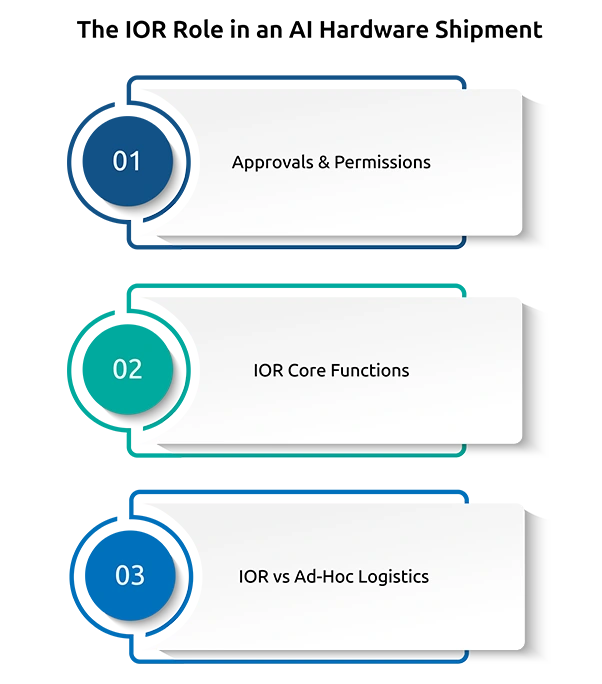
The IOR Role in an AI Hardware Shipment
Once the export side of the transaction has been reviewed, the IOR can help handle the destination-side import process.
Customs documentation, import declarations, duty and tax administration, customs communication, and local compliance needs may all be coordinated by the IOR. Additional permissions or regulatory approvals may also be required, depending on the destination and transportation.
For companies developing AI infrastructure across some countries, having a defined importer structure can make shipments easier to coordinate. Instead of treating every shipment as a separate logistics problem, the company can establish a consistent process for reviewing the equipment & destination requirements before dispatch.
However, the IOR involvement does not mean that restricted equipment can automatically be imported. If an export license or other authorization is required, that requirement must be addressed separately.
Common Mistakes When shipping GPUs globally
A common mistake is treating GPUs as generic electronics. Their technical characteristics can matter for export-control & customs analysis.
Another mistake is assuming that using an IOR makes a shipment unrestricted. An IOR handle importer-side responsibilities but cannot bypass export controls or sanctions.
Incomplete end-user or end-use information can also create problems. This information may be important when assessing whether additional export-control requirements apply.
Companies should also avoid waiting until the equipment reaches customs before reviewing classification & documentation. A pre-shipment compliance review gives the logistics & procurement teams more time to resolve issues.
Plan AI Hardware Deployments Before Shipment
Global AI infrastructure development need more than transportation planning. Companies need to understand the equipment, destination, end user, intended use, export requirements & import obligations before the shipment moves.
An Importer of Record for AI GPUs & accelerators can help handle the destination-side customs & import process, while export-control screening remains a separate & essential part of the transaction.
One Union Solutions can support companies with pre-shipment importer planning, customs coordination and destination-side compliance need for global AI hardware deployments. Each shipment should be assessed on its specific product, origin, destination & transaction details, and an IOR arrangement does not guarantee export authorization, customs clearance or regulatory approval.
Did you know?
Certain advanced computing chips and systems used for AI workloads may be subject to export controls depending on their technical specifications, destination, end user, and intended use. The U.S. Bureau of Industry and Security (BIS) identifies items under classifications such as ECCN 3A090 and 4A090, with additional controls that can apply to certain servers and other computing products.
FAQs
Can an IOR import AI GPUs?
An IOR can manage the destination-side import process when the shipment is legally eligible for import and the IOR accepts the transaction. Export restrictions and licensing requirements must still be satisfied separately.
Are GPUs subject to export controls?
Some advanced computing GPUs and related products can be subject to export controls depending on their technical specifications, classification, destination, end user and end use. Not every GPU shipment is automatically controlled.
What is ECCN?
ECCN stands for Export Control Classification Number. It is used under the U.S. EAR to identify certain items subject to export controls and can help determine applicable licensing requirements.
Can an IOR handle restricted or controlled products?
An IOR may be able to support the import side of a transaction involving controlled equipment, but only where the shipment is legally permissible and the required authorizations are in place. An IOR cannot bypass export controls or licensing requirements.
What should companies check before shipping AI accelerators internationally?
Companies should review product specifications, customs and export classifications, destination, end user, end use, export authorization, import requirements and supporting documentation before shipment.