Why Large Hardware Deployments Need an Import Strategy
Large data center deployments can involve hundreds of SKUs with different classifications, values, specifications and destination requirements. GPU servers may also require additional export-control and end-use screening.
Timing is equally important because delays in servers, switches, racks or replacement parts can affect installation schedules. An IOR for data center deployments should therefore be planned before equipment is ordered, not added after shipment preparation begins.
What Equipment Is Usually Included?
A global deployment can involve several categories of hardware moving from different suppliers to the same facility.
| Equipment type | Import and compliance questions |
| GPU servers | Product classification, technical specifications, export controls, destination and end-use screening |
| General-purpose servers | HS classification, customs value, commercial description and import documentation |
| Storage systems | Product configuration, classification, valuation and destination requirements |
| Switches and routers | Telecommunications or technical requirements, classification and supporting documents |
| Firewalls | Product description, classification and any destination-specific regulatory requirements |
| Racks and network appliances | Dimensions, classification, valuation and shipment configuration |
The exact requirements cannot be determined from the equipment name alone. A server configured with advanced accelerators can raise different questions from a conventional server, while a network appliance may be subject to requirements that do not apply to a rack or mechanical component.
Build the Import Plan Before Hardware Ships
The first step is to define who will act as the importer & who will manage the customs declaration in each destination. An IOR may support the import process where the deploying company does not have the required local setup, but the IOR role does not automatically cover every product approval, certification or export-control requirement.
Next, the project team should map the equipment list. Each SKU should have a consistent commercial description, technical information, quantity, value and classification basis. Supplier documents should use descriptions that match the information provided for customs clearance.
Regulatory screening should then be completed before shipment. This is especially important for advanced computing equipment. U.S. export controls have continued to change. In 2025, the U.S. Bureau of Industry and Security issued and subsequently revised measures concerning advanced computing chips, AI-related technology and associated export controls.
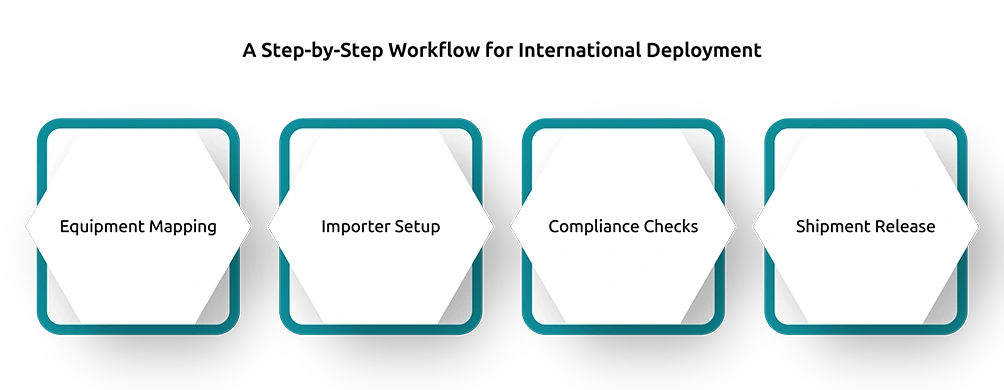
A Step-by-Step Workflow for International Deployment
A practical deployment starts with project intake. The equipment list, suppliers, destinations, estimated quantities, shipment schedule and site requirements are reviewed together rather than shipment by shipment.
The next stage is equipment mapping. Servers, GPUs, switches, storage equipment and spare parts are matched with their commercial descriptions, classification information and supporting documentation.
Importer setup or confirmation follows. The project team confirms whether the customer, consignee or another qualified party can act as importer and declarant, or whether an IOR arrangement is required.
The compliance checks then checks customs requirements & separates them from product-based rules. This difference matters because customs clearance does not by default mean that a product has met every technical, certification, registration or export-control requirement.
Once documentation is prepared, shipments can be released according to the project schedule. Customs clearance is coordinated with freight movement and site delivery so that cleared equipment reaches the correct facility, building, room or installation area.
Post-import support completes the cycle. Serial-number records, warranty information and shipment history can become important when equipment later requires repair, replacement or re-export.
Spare Parts and Replacement Equipment Need a Separate Plan
Spare parts and replacement equipment require planning beyond the initial deployment. Spare parts may be shipped before go-live, while replacements may move later under warranty or RMA processes.
Customs treatment can vary by transaction and destination, so replacement shipments should not automatically use the same documentation as the original import. For urgent RMAs, the importer, supplier documents and replacement identification should be confirmed in advance.

Common Mistakes That Delay Deployment
A common mistake is starting import planning only after the hardware is purchased, when inconsistent product descriptions may already be difficult to correct across destinations.
Another mistake is assuming all servers, GPUs and network devices have the same regulatory treatment. Configuration, technical specifications, destination, end user and end use can affect the assessment.
Advanced computing equipment also requires early export-control review, particularly where specific rules apply to controlled computing items and data-center applications.
A Practical Pre-Shipment Check
Before each shipment ship the supplier, the project team should confirm the equipment list, importer, consignee, classification, commercial invoice, packing information, have customs documents, regulatory review and planned delivery location.
The same information should be checked against the deployment schedule. A shipment can be customs-ready but still create a project delay if it arrives before the site can receive it or after the installation window has passed.
For multi-country projects, this review should be repeated for each destination. The goal is not to create one universal customs file , but a controlled process that keeps the project information consistent while accounting for country-specific requirements.
Conclusion
Global data center deployments require import planning that starts well before servers, GPUs and network equipment leave the supplier. Equipment mapping, importer setup, customs documentation and export-control review should be coordinated with the deployment schedule. Each destination may require a different assessment, even when similar hardware is shipped across countries. A structured import process helps keep documentation consistent, address country-specific requirements and reduce avoidable delays during installation and replacement shipments.
Did You Know?
U.S. data centers could consume 9.5%–15.3% of total U.S. electricity by 2030, according to the U.S. Department of Energy’s 2025 update.
FAQ
How do organization import servers for a new data center?
Companies normally begin by identifying the importer, mapping the equipment and reviewing classification, documentation and regulatory requirements for each destination. The shipment plan is then aligned with the construction and installation schedule.
Can an IOR manage a multi-country data-center deployment?
An IOR arrangement can support imports across multiple countries where the required local setup is available and the shipment is accepted after review. Each destination still needs its own customs and regulatory assessment.
How are GPUs, servers and network switches imported?
The process depends on the product, configuration, origin, destination, value, classification and intended use. GPU equipment may also require additional export-control screening where advanced computing controls apply.
What documents are needed for data-center hardware imports?
Common documents can include a commercial invoice, packing information, transport documents, product descriptions and classification information. Additional certificates, permits or regulatory documents may be required depending on the equipment and destination.
What happens when replacement equipment is needed after deployment?
A replacement may follow an RMA, warranty, repair or re-import process rather than a standard first-sale shipment. The customs treatment should be reviewed before the replacement is dispatched.