A failed server, network switch, storage unit, or other IT network can create a second customs challenge after the original purchase. When equipment is replaced under warranty or returned through an RMA process, the shipment still needs to meet the import needs of the destination country.
An IOR for replacement IT equipment can help companies handle the importer role, customs documentation, regulatory checks & delivery coordination for these time-sensitive shipments. However, warranty status alone does not automatically make a shipment duty-free or exempt from customs needs. The treatment depends on the destination country’s rules and the facts of the transaction.
Why Replacement IT Shipments Are Different
A normal commercial import usually represents a sale or transfer of goods into a market. An RMA shipment can have a different purpose. It may involve a free warranty replacement, a defective unit being returned for repair, an updated replacement, or a spare part being sent to restore equipment already in operation.
Customs authorities still need to know what is being imported, its value, classification, origin & purpose. The shipment description should clearly reflect the actual transaction rather than simply using terms such as “sample” or “no commercial value.”
Customs valuation is also important. The World Customs Organization notes that customs value is used to determine duties and other trade needs, & valuation rules mainly seek to reflect the commercial reality of the import.
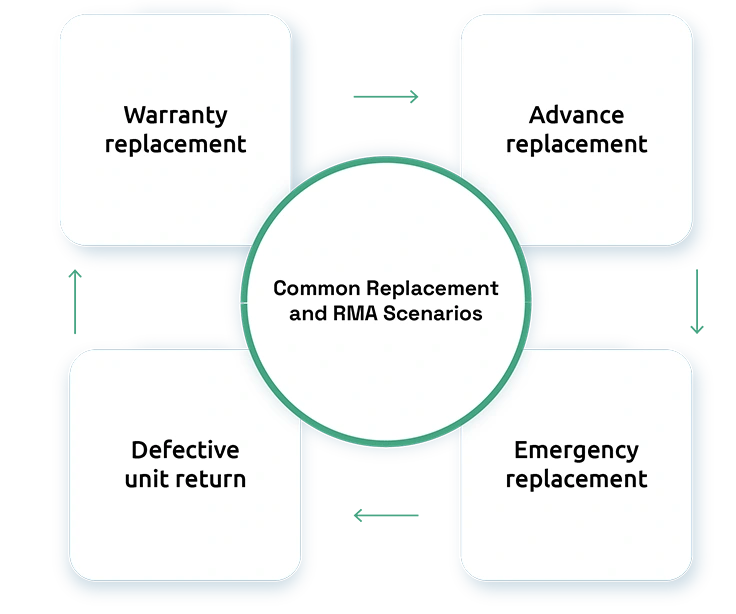
Common Replacement and RMA Scenarios
Replacement IT shipments can occur in some situations:
Warranty replacement: A defective server, switch or storage device is replaced by the manufacturer without a separate sale to the customer.
Advance replacement: A replacement unit is shipped before the defective equipment is returned, helping reduce downtime.
Defective unit return: The failed equipment is exported back to the manufacturer, repair center or service location.
Repair and return: The original equipment leaves the country for repair and is later returned to the customer.
Spare-part shipment: A replacement power supply, controller, network card, drive or other component is shipped to restore an existing system.
Emergency replacement: Critical equipment or components are moved quickly because a failure is affecting business or data-center operations.
Each scenario can have different customs requirements, so the shipment purpose should be established before dispatch.
Duties, Taxes and Customs Treatment
One of the biggest mistakes in RMA logistics is assuming that a warranty replacement automatically has zero customs duty or tax.
That is not a universal rule. Some countries provide specific relief or special procedures for returned, repaired or replacement goods, but eligibility can depend on factors such as the original export, repair arrangements, value, documentation, product equivalence & customs procedure. HMRC guidance provides specific procedures for warranty repairs & replacement goods, with documentary conditions & different treatment depending on the procedure used.
Therefore, companies should verify the destination country’s rules before shipping rather than assuming that “warranty replacement” means duty-free.
Step-by-Step RMA Import Process
A practical process for an importer of record for spare parts or replacement equipment includes:
- Identify the shipment purpose: Confirm whether it is a warranty replacement, repair, return, spare part or emergency shipment.
- Confirm the importer: Establish who can legally act as importer in the destination country.
- Review the equipment: Confirm model, serial number, description, classification, origin & value.
- Prepare documents: Match the invoice, packing list and RMA or warranty records to the shipment.
- Complete regulatory screening: Check whether the equipment requires permits, registrations or technical approvals.
- File the customs declaration: Submit the shipment using the appropriate customs procedure & supporting information.
- Clear and deliver: Coordinate customs clearance and delivery to the required site.
- Plan the return: If the defective unit must go back to the manufacturer, establish the export and re-import requirements in advance.
Common Mistakes That Delay Replacement Equipment
Some avoidable mistakes can create customs delays. These include describing a replacement as a “sample” without justification, declaring an incorrect value, leaving out the RMA reference, providing incomplete model or serial information, and ignoring local importer needs.
Another common mistake is assuming that the warranty agreement controls customs treatment. It does not. Customs treatment is determined under the rules applicable in the destination country.

Responsibility Matrix
| Party | Typical Responsibility |
| Manufacturer | Warranty/RMA approval, replacement equipment and technical details |
| Customer | Shipment information, site details and RMA coordination |
| IOR | Importer role, customs coordination and applicable compliance checks |
| Customs Broker | Customs filing and clearance support under the applicable local process |
Can an IOR Handle Global RMA Shipments?
Yes, an IOR can support eligible replacement IT equipment, spare parts, and RMA shipments where the needs importer structure and local rules allow it. The exact customs treatment must be assessed for each location & shipment.
One Union Solutions provides importer coordination for cross-border technology shipments, including replacement equipment, spare parts & other business-critical IT hardware. Before shipping, companies can review the importer structure, documentation, classification & applicable regulatory needs for the destination country.
Did you know?
The World Customs Organization describes a “replacement system” that can allow a replacement product to be imported under certain conditions when goods are sent abroad for repair. The eligibility, documentation and timing requirements depend on the applicable customs rules.
FAQs
Can an IOR handle warranty replacement shipments?
Yes, where the shipment and destination-country requirements allow the IOR to act in that role. Warranty status does not remove the need for proper customs documentation.
Can an IOR import replacement servers and network equipment?
An IOR can handle eligible imports of servers, switches, storage equipment and other IT hardware when the local importer and regulatory requirements are satisfied.
Do warranty replacements have customs duties and taxes?
Not necessarily. Some jurisdictions provide specific relief or special procedures, but eligibility varies by country and shipment circumstances.
What documents are needed for replacement IT equipment?
Common documents include an invoice, packing list, RMA or warranty reference, product details, classification information, customs value and any required regulatory documents.
How should defective equipment be returned?
The return should be planned as a separate customs movement. The company should check the export requirements and whether the destination country provides a repair, returned-goods or other applicable customs procedure.