How Cross-Border IT Equipment Repair Works
When IT equipment stops working, it may be sent to another country for repair. IT equipment export for repair includes preparing the right customs documents and recording the equipment details. The international hardware repair process should clearly show why the equipment is being shipped. Information like the model, serial number, and cause for repair should be recorded when returning IT equipment. Customs regulations for cross-border repair shipments change depending on the countries involved. The original export records, repair data, and the correct customs value may be required for the IT equipment re-import process following repair.
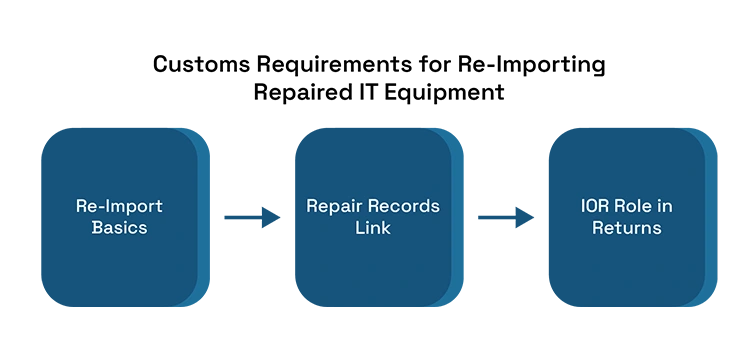
Customs Requirements for Re-Importing Repaired IT Equipment
When fixed IT equipment is returned, customs must know what it is, why it was supplied, and why it is being returned. The original export details and repair records may be needed for customs clearance of repaired equipment. The IT equipment re-import requirements can include the correct HS code, equipment description, serial number, value, and reason for return. A re-import customs declaration should show that the equipment is returning after repair rather than being imported as a new purchase.
An Importer of Record for repaired equipment may be needed to manage the import process, submit required information, and work with customs. The exact role depends on the country and shipment structure. The shipment declare, invoice or prepaid invoice, packing list, repair documents, and original import records are examples of customs documents for returned goods. The required documents can vary by country.
Customs Duties and Taxes on Repaired IT Equipment
Duties on re-imported IT equipment depend on the customs rules of the country where the repaired equipment returns. The company should check whether a special repair or re-import procedure applies. Customs duty on repaired goods may be based on the applicable customs procedure and the value accepted by customs. A repair return does not automatically mean that the equipment is duty-free.
Tax on returned IT equipment can also depend on the destination country and the reason for the return. VAT, GST, or other import taxes may still apply. Duty relief for repaired goods may be available under certain customs procedures, but it is not automatic. The company may need proof of the original export and repair details. Customs valuation for repaired equipment should be prepared carefully. The declared value and repair cost may be considered differently depending on the applicable customs rules.
IOR Requirements for Re-Importing Repaired IT Equipment
An IOR for repaired equipment helps manage the import when the company sending the equipment back does not have the required importer presence in the destination country. The IOR is responsible for meeting the applicable import requirements. The Importer of Record for returned hardware may need to provide shipment details, customs information, and supporting records for the repaired equipment.
IOR customs clearance can include checking the equipment details, customs declaration, HS code, value, and required documents before the shipment is released. IOR documentation support may include the invoice or pro-forma invoice, packing list, repair records, original export details, and serial number information.
Local importer requirements vary by country. Some destinations may require a registered local importer, tax registration, licence, or other conditions before repaired IT equipment can be re-imported.
Repair Return vs Replacement vs Normal Return
Repaired IT equipment is hardware sent back to the original company or customer after repair. The customs process should show that the same equipment is returning after service. Replacement hardware is a different unit sent instead of the faulty equipment. Its import may be treated separately because the replacement has its own model, serial number, and shipment details.
Returned IT equipment can have different reasons, such as repair, replacement, warranty return, or cancellation. The reason should be clearly stated in the shipping documents. The main difference in repair return vs replacement is whether the original unit comes back or a different unit is supplied. This can affect the customs documents and import procedure. The customs treatment of replacement equipment depends on the destination country’s rules. A replacement should not automatically be treated the same as repaired equipment.
How to Declare the Value of Repaired IT Equipment
The customs value of repaired equipment should be declared according to the customs rules of the country where the equipment is returning. The value should match the documents and the actual repair situation. When declaring repair costs, the company should keep the repair invoice or service record. Customs may consider repair charges when checking the value, depending on the applicable rules.
For the value of returned servers, details such as the server model, condition, original value, and repair work should be clearly recorded. This helps avoid confusion during customs review. A pro-forma invoice for repair returns can show that the server is being returned for repair and is not a normal commercial sale. It should include clear equipment and shipment details. Customs valuation for re-import can differ by country and customs procedure. Companies should confirm the correct valuation method before the repaired equipment is shipped back.

Conclusion
Cross-border IT equipment returns need clear planning. Companies should keep the original import and export records, serial numbers, repair details, and correct customs documents. When a local importer is needed, an Importer of Record can help in handling the re-import process. Before the repaired equipment is delivered back, the rules should be checked because customs duties and tax status can change by country.
Did you know
The global IT hardware market size was valued at USD 141.15 billion in 2025 and estimated to grow from USD 152.13 billion in 2026 to reach USD 221.34 billion by 2031, at a CAGR of 7.78% during the forecast period (2026-2031).
FAQ
Can the same server be re-imported after international repair?
Yes, the same server can be returned after repair, but the company must follow the destination country’s customs process and provide the required records.
Does repaired IT equipment automatically qualify for duty relief?
No. Duty relief is not automatic. It depends on the customs procedure, country rules, and documents proving the equipment was exported for repair.
Can a replacement server follow the same customs process as a repair return?
Not always. A replacement is different hardware, so its serial number, value, and customs treatment may need to be handled separately.
What value should be shown when a server comes back after repair?
The declared value should follow the destination country’s customs rules. Repair costs and other relevant values may need to be supported with invoices or service records.
Can a company re-import repaired IT equipment without keeping the original export record?
The company may face difficulties proving the equipment was previously exported. Keeping the original export record helps support the re-import process.