The Growing Policy Debate Around Refurbished Healthcare Equipment
Governments in countries are making the rules for bringing in used medical equipment much stricter. They want to keep people safe and healthy. They also want to help their own companies grow. So they are making rules for medical devices that come from other countries. This way they can be sure that these devices are safe for patients to use and that they meet quality standards. The governments also want to help the companies in their countries make these medical devices. At the same time, healthcare providers continue to depend on affordable refurbished diagnostic systems, imaging machines, and critical care equipment to expand medical access in cost-sensitive markets.
This growing disagreement over regulations has sparked debates among the healthcare sector and those involved in importing and exporting medical equipment about how to balance keeping people safe with making healthcare affordable.. This growing policy conflict has created major discussions within the healthcare and healthcare providers want to make sure they can get the equipment they need at a price they can afford.
The debate about healthcare is really important now. Hospitals and clinics have to buy equipment to help. Sometimes they buy equipment that has been fixed up because buying new equipment is very expensive. The government wants to make sure that the equipment is made in their country so they can keep record of the import export. Global healthcare is an issue and the government wants to make sure that everything is done correctly. This means that businesses that sell equipment to other countries have to get used to new rules and regulations. They have to deal with changing compliance requirements for medical equipment trade and new ways of doing paperwork for medical equipment trade. Businesses that do medical equipment trade have a lot of things to think about. They still need to make sure that they get care. This is the goal of the medical equipment trade.
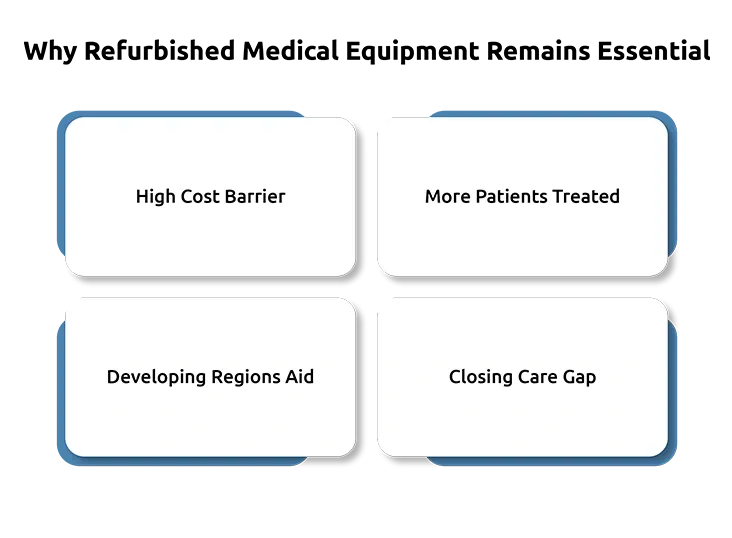
Why Refurbished Medical Equipment Remains Essential?
Refurbished medical equipment is really important for making healthcare accessible. Advanced diagnostic systems such as MRI scanners and CT machines are very expensive when you buy them new. This makes it hard for smaller hospitals to cope up with the prices. Refurbished medical equipment, like ventilators and patient monitoring devices can be a help. Refurbished alternatives are an option for hospitals and clinics and diagnostic centers because they provide a way to get the healthcare technology they need without having to spend a lot of money. This means they can do more to help people without going over their budget. Refurbished alternatives are an option for hospitals and clinics because they get to use modern healthcare technology at a lower cost.
This is really important for hospitals and healthcare providers, in rural areas because they do not have a lot of money to spend. Refurbished equipment is really helpful in developing regions. It helps to bridge the gap between the number of patients who need healthcare and the money that is available for healthcare. It enables healthcare institutions to make diagnoses more accurate and helps them to increase the number of patients they can treat. It allows them to deliver better care to patients without having to wait for big changes to be made to the system.
Multiple Stakeholders Shaping Refurbished Medical Equipment Policies
The argument about bringing in used healthcare equipment from countries is a big deal. It affects a lot of people including the government, companies and patients. The government people who make rules are worried about keeping patients safe and making sure the equipment is good enough. They also want to make sure everyone follows the rules for healthcare in the country. Refurbished healthcare equipment imports are a concern for the government regulators because they need to ensure the equipment is safe for patients to use. Authorities want to stop badly fixed devices from being used in hospitals and diagnostic centers because they can cause problems. They also want to help local factories grow and make medical equipment. This way hospitals and diagnostic centers will not have to rely much on imported medical technologies.
Hospitals and healthcare providers want to make sure to emphasize affordability and accessibility. Many hospitals, the ones in rural areas, have to buy used medical equipment because new systems are just too costly. This is where affordable imported devices come in. They help hospitals and healthcare providers, like these facilities, to expand the services they offer, make their diagnostics better and take better care of patients without having to spend a lot of money upfront on new equipment. Hospitals and healthcare providers can then use this money to do important things for their patients.
Compliance Challenges in Refurbished Medical Equipment Imports
Refurbished healthcare equipment importers have a lot of trouble following the rules. The rules for importing this kind of equipment are always changing around the world. This makes it hard for importers of refurbished healthcare equipment to keep up with the rules. Refurbished healthcare equipment importers also have to deal with licensing and changing policies for importing things. The process to approve refurbished healthcare equipment is different in each country. All these things make it take a time to get important medical devices to where they need to go. In many cases, importers have to show that the products they are bringing in are safe and work properly. This can include things like certificates that say the equipment has been refurbished and reports that show it has been tested. Product inspection procedures have also become more rigorous, with authorities closely examining equipment quality, operational safety, and environmental compliance. The equipment has to meet standards so the importers have to show equipment performance and that is a big part of the process.
Regulatory uncertainty makes things really complicated for businesses. This is especially true when policies change quickly without giving companies time to adjust. For companies that export equipment around the world it is very important to keep accurate records, make sure they are following all the rules and work with many different regulatory authorities. This helps to prevent problems with shipments and makes sure that everything runs smoothly when moving things across borders. Medical equipment trade is a business and companies need to be careful to avoid any issues.

Conclusion
The future of refurbished healthcare equipment imports should focus on balanced regulation rather than extreme restrictions or completely unrestricted trade. Refurbished healthcare equipment imports are very important. We should make sure they are regulated in a fair way. Refurbished healthcare equipment imports can help the industry.
We need a system that makes sure things are done right. This system should have rules that everyone follows. These rules should say that old things must be fixed and tested properly before they are used again. Making sure everyone is following these rules will help to get the care they need and it will also help the companies in our country grow. A good system like this will support healthcare accessibility and domestic industrial growth.
When we talk about businesses that do trade with countries we see that it is really important for them to know what they are doing to be aware of the rules and to have a good system for handling paperwork. Businesses that do trade need to have operational expertise and regulatory awareness and they need to have efficient documentation processes.
DID YOU KNOW
“Refurbished equipment significantly lowers capital costs by 30% to 70%, offering enhanced access to healthcare in smaller towns, domestic manufacturers raise strong concerns about patient safety, reliability, and the impact on the local Make in India initiative. ”
FAQs
1. What is the customs duty on import of medical equipment?
In India, import duty on medical equipment generally includes a Basic Customs Duty (BCD) of 7.5% to 10%, a 5% Health Cess, and a 12% Integrated Goods and Services Tax (IGST).
2. Can we import used medical equipment in India?
Further, the Central Drugs Standard Control Organisation (CDSCO) issued a clarification on 10 January 2025 confirming that refurbished medical devices are not permitted for import under current Medical Devices Rules, exposing a direct conflict between regulatory policy and MoEFCC’s recent approvals.
3. Is medical equipment subject to tariffs?
Tariffs will also raise the cost of medical devices and equipment. When tariffs are applied, companies that import these goods face higher input costs and typically pass those costs on to hospitals, then to insurance companies, and then, ultimately, to consumers through higher premiums and rates.
4. Is there import duty on MRI machines in India?
Currently, India imposes up to 7.5% import duty on medical devices as opposed to 4.2% in the UK.
5. How to import restricted items?
Items that cannot be imported without first receiving an Import of Restricted Items license, Authorization or approval from the Directorate General of Foreign Trade are considered Restricted Import Items. Obtaining a Restricted Import License is required to bring in restricted items.