
Insight
One of the greatest aspects of economic development in the world is trade among nations. When countries purchase and sell across countries, the individual companies and entire economies are impacted. Imports and exports affect critical sectors such as production, employment, currency value, inflation, & government policies. Understanding how trade impacts these aspects allows nations and corporations to make smart decisions that boost economic expansion and financial security over time. After all, the global economy relies heavily on free cross-country trade.
Exporters earn money by trading goods and services abroad, contributing to local industries and employment. This is counterbalanced by imports that supply goods and information that might not be delivered efficiently in the country, including advanced machinery and technology. These capital goods promote productivity and competitiveness. Also, global trade promotes specialization and innovation. This dynamic market connection generally enhances economic well-being and increases global integration.
The Impact on Gross Domestic Product: GDP
GDP measures a nation’s economic activity using the expenditure method, expressed as: GDP=C+I+G+(X−M)
where:
C = consumer spending
I = investments
G = government spending
X = exports
M = imports
The (X-M), or net exports, can often demonstrate the position of a country in trade. When net exports are positive, the country experiences a trade surplus, meaning exports exceed imports. Such excess increases GDP through greater output and employment in exporting industries. The higher the number of products manufactured in foreign markets, the higher the money coming into the country, which increases consumer expenditure and investments.
A trade deficit, where imports surpass exports, results in an outflow of funds. This may seem unfavourable, but in many cases, it means that the country has a well-developed domestic demand. This can be offset by importing new machinery or modern technology that will enable it to generate more productive power in the future.

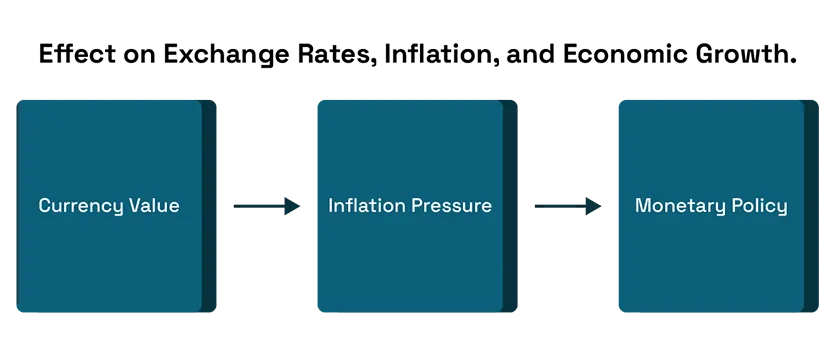
Effect on Exchange Rates, Inflation, and Economic Growth.
The trade balances greatly influence the currency exchange rates. When a country’s exports increase, demand for its currency typically rises and in most cases, it appreciates. A high currency will reduce the cost of imports but threaten the exporters by causing them to lose competitiveness. Persistent trade deficits may lead to currency depreciation raising the price of imports and possibly consumer prices.
Currency fluctuations also play an important role in inflationary pressures. When one currency weakens against another, it drives up import costs & adds inflationary pressures. Central banks react by modifying interest rates to control inflation and boost economic development
An increase in interest rates helps control inflation but may slow borrowing and consumer spending, whereas a decrease in rates stimulates the economy. Finally, imports and exports determine an economy’s monetary policies and stability.
Advantages of exportation and importation
The expansion of importing open up new technologies, materials, and equipment that enhance domestic innovation and the quality of products. Export business opens up international markets, boosts the earnings of a country, expands production capacity, and sustains employment. Combined, these commercial endeavors cause economic diversification and robustness as local industries are connected to open markets worldwide and develop over time. International trade plays a vital role in developing global economic growth, where imports and exports change production and currency stability. Import duties and tariffs directly impact trade balances, changing consumer prices and national competitiveness. Understanding the Exporter of Record definition is necessary for businesses managing approval and documentation when shipping goods globally. Effective freight logistics services further simplify the movement of goods, ensuring timely delivery and regulatory guidelines. Also, these elements create a balanced trade ecosystem that promotes sustainable development and economic dependence.
Trade & Economic Reports
Governments carefully track import & export data to evaluate the economy’s performance and make policy decisions accordingly. Trends in trade influence key activities like tariff modifications, trade agreements, and subsidies designed to assist industries in competing favorably. Also, timely reports allow policymakers to act swiftly to maintain an economy-wide trade balance that ensures stability.
The key to a sustainable economy is balancing importing & exporting. Imports increase consumer selection and provide vital resources required to produce other goods in the country. In the meantime, exports provide access to world markets and generate job opportunities and national income. Once a nation has achieved this balance, the value of its currency becomes more stable, inflation is under control, and economic growth is stable. On the other hand, an imbalance may attract currency variations and inflationary problems that endanger the financial well-being.
Conclusion
In a highly interdependent globalized world, imports & exports play a vital economic role. It stimulates GDP growth and innovation, job creation, increased productivity, & greater access to resources, including technology and expanded markets. However, managing complex trade balances, currency fluctuations, and inflationary pressures can be challenging. Balancing these is important to ensure stable growth, increasing living standards, and expanding global competitive advantage.
Did You Know,
The global data center equipment market, consisting of servers, storage, and networking hardware, was estimated at $53.85 billion in 2022 & projected to reach a cumulative compound annual growth rate of 13.2% by 2031 due to cloud computing, IoT, and rising data demands. India saw annual revenue for data center equipment reach $3.8 billion by 2021, with growth projected to hit over $6 billion by 2028, at 6.8% annually!
FAQ’s
How do imports influence a country’s economy?
Imports provide essential goods and technology that enhance domestic productivity and expand consumer choice.
What role do net exports play in economic output?
Net exports directly affect GDP by showing whether a country is a net seller or buyer in global trade.
What impact can trade balances have on currency value?
The effect of surpluses is that they boost demand for a country’s currency, hence increasing its value, whereas deficits normally decrease its value.
Why do imports cause inflation?
Currency devaluation increases the prices of imports, which can increase the general prices in the economy.
What are the economic risks of the imbalances in the trade?
Lack of control over trade imbalances may lead to fluctuating currency markets, inflation, & undermine economic stability.