Overview
Many importers suppose that once they declare an HS code during filing, it will remain unchanged throughout the customs clearance process. Also, customs officials have the legal power to reevaluate and modify good categorizations even without giving notice to the importer. This frequently goes to unexpected duty changes, shipment delays, and interruptions in inventory and order management. Understanding why this happens is necessary for businesses working in global trade and cross-border logistics.
What Are HS Codes?
HS codes are standardized numerical classifications used to identify traded products globally. Developed under the Harmonized System, these codes help customs officials determine applicable duties, taxes, and regulatory controls during customs clearance. While the structure is globally aligned, each country may extend classifications at the national level, which can result in variations during international shipping terms interpretation.
Purpose of Product Classification
The primary purpose of an HS code is to create a common language for trade. It ensures accurate duty assessment, trade statistics, and enforcement of import regulations. However, classification is based on product description, composition, and intended use, not on commercial naming or supplier invoices.

How HS Codes Work in Global Trade
In global trade, HS codes affect much more than duty calculation. They impact agreement requirements, licensing requirements, and eligibility under various international shipping terms. When goods move through international freight services, customs officials review product details against tariff schedules to confirm consistency and accuracy.
Role in Customs Clearance
During customs clearance, officials may check documents, product samples, or goods specifications. If the declared classification does not align with their interpretation, customs has the authority to revise it. This reassessment may occur even after goods arrive at port, affecting premium delivery service commitments and timelines.
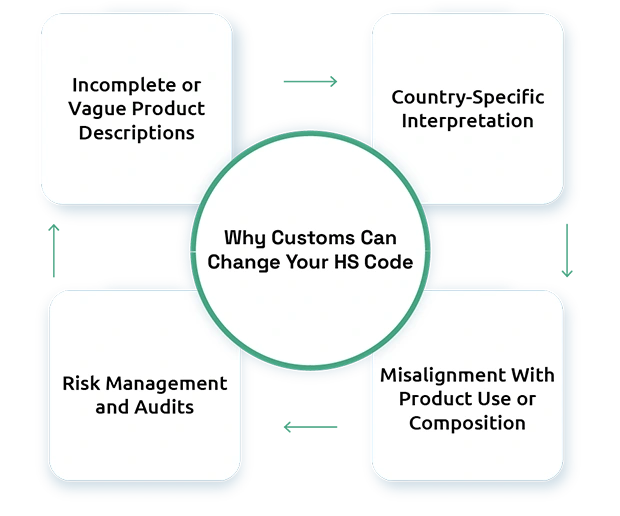
Why Customs Can Change Your HS Code
Customs authorities are not bound by the importer’s declaration. Their mandate is to apply the most accurate classification based on law and precedent.
Incomplete or Vague Product Descriptions
One of the most common reasons for HS code changes is insufficient product description. Generic terms such as “machine parts” or “electronic goods” frequently trigger reclassification.
Misalignment With Product Use or Composition
If the declared code does not show the actual material, function, or end use, customs may apply a different category under the HTS harmonized tariff system.
Country-Specific Interpretation
Even though the Harmonized System is globally used, each country applies its own tariff logic to goods. What is accepted in one market may be rejected in another, mainly during high-value international shipping.
Risk Management and Audits
Customs may change classifications as part of post-clearance audits or risk profiling. This can affect businesses relying on an Importer of Record service or Exporter of Record services to manage approval responsibilities.
How to Find the Right HS Code for Global Imports
Correct categorization reduces issues, penalties, and shipment delays. Businesses working in supply chain optimization should take a major approach.
Use Detailed Technical Documentation
Provide clear specifications, product catalogs, and usage explanations when filing import documents. This helps customs officers make accurate decisions.
Consult Classification Experts
Trade consultants and customs professionals familiar with the HTS harmonized tariff schedule interpretations can help identify the most correct code before shipment.
Use Advance Rulings
Many customs officials provide advance categorization rulings. These provide legal certainty and reduce the risk of changes during customs clearance.
Work With Your Importer of Record
Confirm your importer of record service maintains consistency across filings, invoices, and shipping documents. Misalignment frequently leads to reclassification.
Conclusion
Customs changing your HS code without informing you is not an exception; it is a standard regulatory right. For businesses working in global trade, this reality highlights the importance of correct classification, clear documentation, and expert approval support. Knowing how HS codes work and why customs may use them, importers can reduce disruptions, protect delivery timelines, and maintain easy international freight services. Proactive planning is the major to avoiding costly surprises in today’s difficult global trade environment.
DID YOU KNOW?
In 2024, Ford Motor Company received a bill for $365 million from the U.S. government for misclassifying its Transit Connect vans under the wrong Harmonized Tariff Schedule (HTS) code.
FAQs:
1. Can customs change an HS code after goods are shipped?
Yes. Customs authorities can reassess and change HS codes during clearance or even after arrival if the declared classification does not match the product’s characteristics.
2. Do customs officials need to inform importers before changing an HS code?
In many cases, customs can revise the HS code without prior notice, especially during inspections, audits, or risk assessments.
3. What happens if customs changes my HS code?
A reclassification can lead to higher or lower duties, shipment delays, document revisions, and possible penalties depending on the case.
4. Why do HS code interpretations differ between countries?
Although HS codes follow a global system, each country applies national tariff extensions and legal interpretations, which may result in classification differences.
5. How can importers reduce the risk of HS code changes?
Providing detailed product descriptions, using technical documentation, seeking advance rulings, and working with experienced customs professionals can minimize reclassification risks.